Every time you click a link, stream a video or send a message, a complex chain of technology quietly springs into action. Most people never stop to think about how the internet works, yet within milliseconds, dozens of processes take place to deliver exactly what you requested. Understanding how the internet works reveals just how remarkable this everyday technology truly is.
From the moment you type a web address to the second a page appears on your screen, data travels across cables, satellites and servers spanning the entire globe. This article breaks down how the internet works step by step, explaining the technology behind every single click.
What Happens the Moment You Click a Link
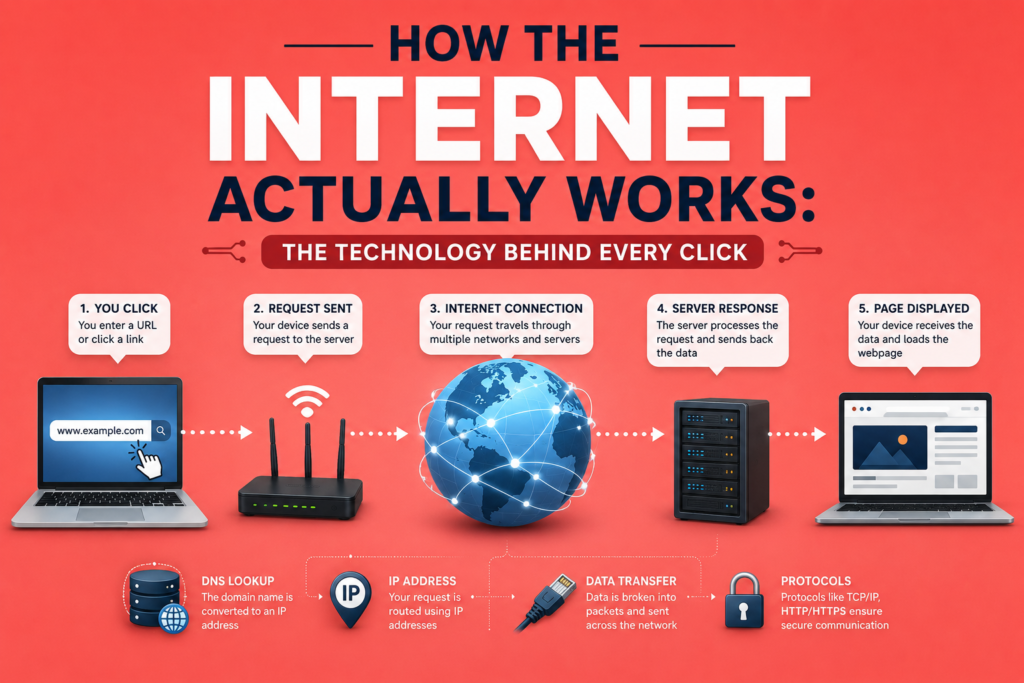
To understand how the internet works, it helps to follow a single click from start to finish. When you click a link or type a web address, your device does not instantly know where that website lives. Instead, it must first translate the readable web address into something machines can understand.
This translation process relies on a system that converts domain names into numerical addresses, allowing your device to locate the correct server anywhere in the world. Without this crucial first step, none of the remaining process could take place.
DNS Lookup: Translating Web Addresses
The first major step in how the internet works involves a DNS lookup. Every website has a human friendly domain name, but computers communicate using numerical addresses instead. When you enter a web address, your device sends a request to a domain name system, which acts like a phonebook for the internet.
This system searches for the matching IP address explained simply as a unique numerical identifier assigned to every device and server connected to the internet. Once found, your device now knows exactly where to send its request, setting the stage for the next phase of the connection process.
Establishing a Connection Through TCP Handshake
Once the correct IP address is identified, your device needs to establish a secure and reliable connection with the destination server. This happens through a process often called a TCP handshake, part of the broader TCP/IP explained protocol suite that governs how data is transmitted across networks.
During this handshake, your device and the server exchange a series of signals to confirm that both sides are ready to communicate. This ensures that data will be sent and received accurately, without corruption or unnecessary loss, which is essential for how the internet works reliably at scale.
How Data Packets Travel Across the Internet
Once a connection is established, your request does not travel as a single continuous stream. Instead, it gets broken into smaller units called data packets. Each packet contains a portion of your request along with essential information, including its destination address and sequencing details.
Understanding how the internet works requires understanding this packet based system. As packets travel across the network, they pass through multiple routers, each one examining the destination address and forwarding the packet along the most efficient available path.
The Role of Routers and Routing Tables
Routers play a critical role in how the internet works, acting like traffic directors for data. Each router maintains a routing table, a constantly updated list of paths that helps determine the fastest and most reliable route for each packet.
As packets pass through multiple routers, sometimes crossing several countries or continents, routing tables continuously optimize the journey. If one path becomes congested or unavailable, routers can reroute packets almost instantly, ensuring smooth data transmission even during network disruptions.
Traveling Through Internet Infrastructure
Behind every website you visit lies a massive physical network of cables, servers and data centers collectively known as internet infrastructure. Much of global data transmission relies on undersea fiber optic cables that stretch across oceans, connecting continents at incredible speeds.
This physical backbone is essential to how the internet works on a global scale. Without this vast infrastructure of fiber optic networks, satellites and data centers, the instant communication we now take for granted would simply be impossible.
Reaching the Web Server
Once your request successfully travels through the network, it finally reaches its destination, a web server responsible for storing the website’s files and data. The web server processes your HTTP request and prepares the appropriate response, whether that means loading a webpage, streaming a video or delivering an image.
This step is a crucial part of understanding how the internet works, since the server’s response determines exactly what content gets sent back through the same complex network of routers and cables you just traveled through.
The Journey Back: Delivering the Response
After the web server processes your request, the response begins its journey back to your device, following a similar packet based path through routers and internet infrastructure. This return trip typically happens within milliseconds, despite potentially traveling thousands of miles.
Your Internet Service Provider plays an important role here, acting as the gateway that connects your local device to the broader internet. This partnership between local networks and global infrastructure is a key reason why how the internet works so smoothly for billions of users simultaneously.
Client Server Model Explained
Much of this process relies on a client server model explained simply as a relationship where your device, the client, requests information, and a remote server provides it. This model forms the foundation of nearly all web based communication, from browsing websites to streaming content.
Understanding this client server relationship makes it much easier to visualize how the internet works, since nearly every online interaction follows this same basic request and response pattern, regardless of the specific website or service involved.
How Web Pages Actually Load
Once your browser receives the server’s response, it must assemble everything into a readable webpage. This involves processing HTML, CSS and other files to display text, images and interactive elements correctly on your screen.
This final rendering step completes the picture of how the internet works from click to display. Modern browsers are optimized to load these elements quickly, often within a fraction of a second, creating the seamless browsing experience most users expect today.
The Importance of Bandwidth and Speed
The speed at which all of this happens depends heavily on bandwidth explained as the amount of data that can travel through a connection at any given moment. Higher bandwidth allows more data to move simultaneously, resulting in faster loading times and smoother streaming experiences.
Factors like network congestion, distance from servers and the quality of your internet connection all influence overall performance. This is why how the internet works can sometimes feel instantaneous, while other times pages may load more slowly depending on network conditions.
Security Measures Protecting Your Data
Throughout this entire process, security measures work to protect your information. Network security tools like firewalls and encryption protocols help prevent unauthorized access and protect sensitive data as it travels across public networks.
Many websites also use secure connections that encrypt data during transmission, making it significantly harder for malicious actors to intercept or manipulate information. These protections are an essential part of how the internet works safely in an increasingly connected world.
Frequently Asked Questions (FAQs)
How does the internet actually work in simple terms?
The internet works by breaking your request into data packets, sending them through routers and internet infrastructure to reach a web server, then returning the response back to your device within milliseconds.
What happens during a DNS lookup?
During a DNS lookup, your device translates a readable web address into a numerical IP address, allowing it to locate the correct server responsible for hosting the requested website.
Why does the internet feel so fast despite long distances?
The internet feels fast because data packets travel at near light speed through fiber optic cables, and routers continuously optimize paths, allowing information to cross continents within milliseconds.
What role do routers play in how the internet works?
Routers direct data packets along the most efficient path using routing tables, ensuring information reaches its destination quickly, even when network conditions change unexpectedly.
Conclusion
Understanding how the internet works reveals the incredible complexity hidden behind something as simple as clicking a link. From DNS lookups and data packets to routers and internet infrastructure, every click triggers a remarkable chain of technology working together in milliseconds.
As internet infrastructure continues to evolve, how the internet works will keep improving, delivering faster speeds and more reliable connections for users around the world every single day.