Every single click, message and video stream you send across the internet relies on one foundational technology, and tcp/ip explained in simple terms reveals exactly how this happens. Without this protocol suite quietly working behind the scenes, devices around the world would have no reliable way to communicate with one another. Understanding tcp/ip explained helps clarify why the internet functions as smoothly and consistently as it does today.
Standing for Transmission Control Protocol and Internet Protocol, TCP/IP forms the backbone of nearly all modern networking. This article breaks down tcp/ip explained step by step, covering how it works, its layered structure and why it remains essential to internet infrastructure worldwide.
What Is TCP/IP and Why It Matters
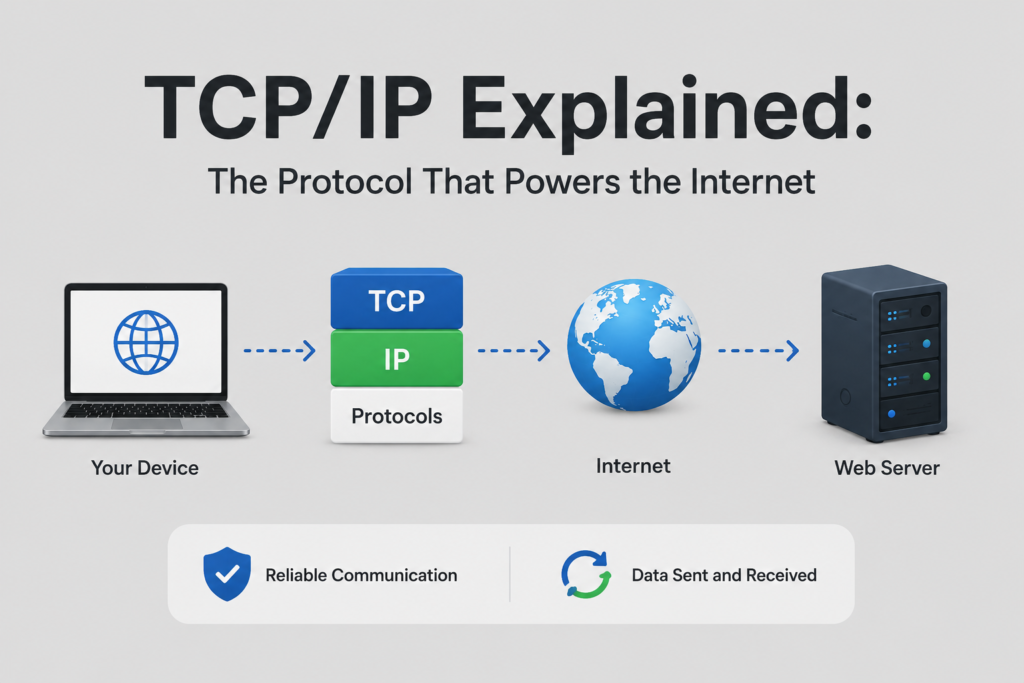
To fully understand tcp/ip explained, it helps to start with the basics. TCP/IP is a suite of communication protocols that governs how data is broken down, transmitted and reassembled across networks. Rather than being a single protocol, it combines two essential components working together to ensure reliable data delivery.
Without TCP/IP, different networks and devices would struggle to communicate effectively, since each system might otherwise use incompatible methods for sending and receiving data. This standardized approach is why tcp/ip explained remains foundational to understanding how the internet works on a global scale.
Breaking Down TCP and IP Separately
Although often mentioned together, TCP and IP serve distinct purposes within the protocol suite. The Internet Protocol handles addressing and routing, ensuring data packets know exactly where to travel across the network. Every packet includes an IP packet header containing essential routing information, including source and destination addresses.
Meanwhile, Transmission Control Protocol focuses on ensuring reliable, ordered delivery of data. Comparing TCP vs IP directly, IP handles the journey itself, while TCP ensures that data arrives completely, accurately and in the correct sequence, making both components essential for successful communication.
The Layers of TCP/IP Explained
Understanding tcp/ip explained requires exploring its layered structure. The TCP/IP model layers typically include four main sections, each responsible for a specific part of the communication process. The network layer handles addressing and routing, determining how data moves between different networks.
Above this sits the transport layer, responsible for managing reliable data delivery through TCP. Higher layers handle application specific functions, allowing everyday tools like web browsers and email clients to communicate properly using standardized internet protocols across countless different devices and platforms.
TCP/IP Versus the OSI Model
Many people studying networking encounter both TCP/IP and another framework called the OSI model. Comparing TCP/IP vs OSI model structures, the OSI model divides communication into seven layers, offering a more detailed theoretical framework, while TCP/IP condenses these concepts into four practical layers actually used in real world networking.
The OSI model explained serves primarily as an educational tool, helping engineers understand networking concepts conceptually, while TCP/IP remains the actual protocol suite implemented across the internet and most modern networks worldwide.
Understanding the Three Way Handshake
One of the most important concepts within tcp/ip explained involves establishing a connection through a three way handshake. Before any data transfer begins, two devices exchange a series of signals to confirm they are ready to communicate reliably.
This process typically involves SYN and ACK packets, special signals that synchronize communication between devices. Once this three way handshake completes successfully, both devices establish a connection oriented session, ensuring data will be transmitted accurately without unnecessary loss or corruption during transfer.
How Data Packets Travel Using TCP/IP
Once a connection is established, data does not travel as one continuous stream. Instead, it gets broken into smaller units called data packets, each containing a portion of the overall message along with sequence numbers that help reassemble information correctly at its destination.
As these packets travel across various network paths, they pass through multiple routers, each one examining destination information before forwarding packets toward their final destination. This packet based approach forms the practical foundation of everything covered under tcp/ip explained.
Error Checking and Reliable Delivery
A key strength of tcp/ip explained lies in its built in error checking capabilities. TCP continuously monitors data transmission, checking for any packet loss during transfer. If a packet fails to arrive or becomes corrupted, TCP automatically requests retransmission, ensuring complete and accurate delivery.
This reliability makes TCP particularly suitable for tasks requiring complete data accuracy, such as loading websites or downloading files, where missing or corrupted information could cause significant problems for end users relying on consistent internet infrastructure.
Flow Control and Window Size Management
Beyond simple error checking, tcp/ip explained also includes sophisticated flow control mechanisms. TCP uses window size settings to manage how much data can be sent before requiring acknowledgment from the receiving device. This prevents overwhelming slower devices or congested networks with excessive data all at once.
By dynamically adjusting window size based on network conditions, TCP helps maintain smooth, efficient data transfer, even when connection speeds fluctuate or multiple devices compete for available bandwidth across the same network infrastructure.
Port Numbers and Network Sockets
Every device using TCP/IP relies on port numbers to manage multiple simultaneous connections effectively. A network socket combines an IP address with a specific port number, creating a unique identifier for each individual connection running on a device.
This system allows your computer to simultaneously browse websites, check email and stream music without confusion, since each activity uses its own distinct socket combination. Understanding this concept adds important depth to tcp/ip explained beyond basic packet transmission.
TCP/IP and Everyday Internet Activities
Nearly every online activity relies on tcp/ip explained principles working correctly behind the scenes. When comparing http vs https, both protocols depend entirely on TCP/IP for establishing connections and transmitting data securely between browsers and servers.
Similarly, technologies like vpn explained solutions rely on TCP/IP as their underlying communication method, encrypting data while still relying on the same fundamental packet based transmission process that powers standard internet traffic worldwide.
Why TCP/IP Remains Essential Today
Despite decades of technological advancement, tcp/ip explained concepts remain just as relevant today as when the protocol suite was first developed. Nearly all modern internet infrastructure, from cloud services to mobile networks, continues relying on TCP/IP as its foundational communication standard.
This enduring relevance demonstrates just how well designed the original protocol suite truly was, successfully scaling from a small research network into the massive, interconnected global system supporting billions of devices communicating simultaneously every single day.
Frequently Asked Questions (FAQs)
What does TCP/IP actually stand for?
TCP/IP stands for Transmission Control Protocol and Internet Protocol, two core components working together to enable reliable data transmission across computer networks worldwide.
What is the difference between TCP and IP?
IP handles addressing and routing, ensuring data packets know where to travel, while TCP ensures those packets arrive completely, accurately and in the correct order.
Why is the three way handshake important?
The three way handshake establishes a reliable connection between two devices before data transfer begins, ensuring both sides are ready to communicate without errors or interruptions.
Is TCP/IP still used today?
Yes, TCP/IP remains the foundational protocol suite powering nearly all modern internet infrastructure, including websites, mobile networks, cloud services and everyday online communication.
Conclusion
Understanding tcp/ip explained reveals just how much complex coordination happens behind every online interaction, from establishing connections through a three way handshake to ensuring reliable, error free data delivery across global networks. This protocol suite remains the true backbone of modern communication technology.
As internet infrastructure continues expanding to support billions of connected devices, tcp/ip explained principles will remain foundational, proving that this decades old protocol suite was truly built to last.