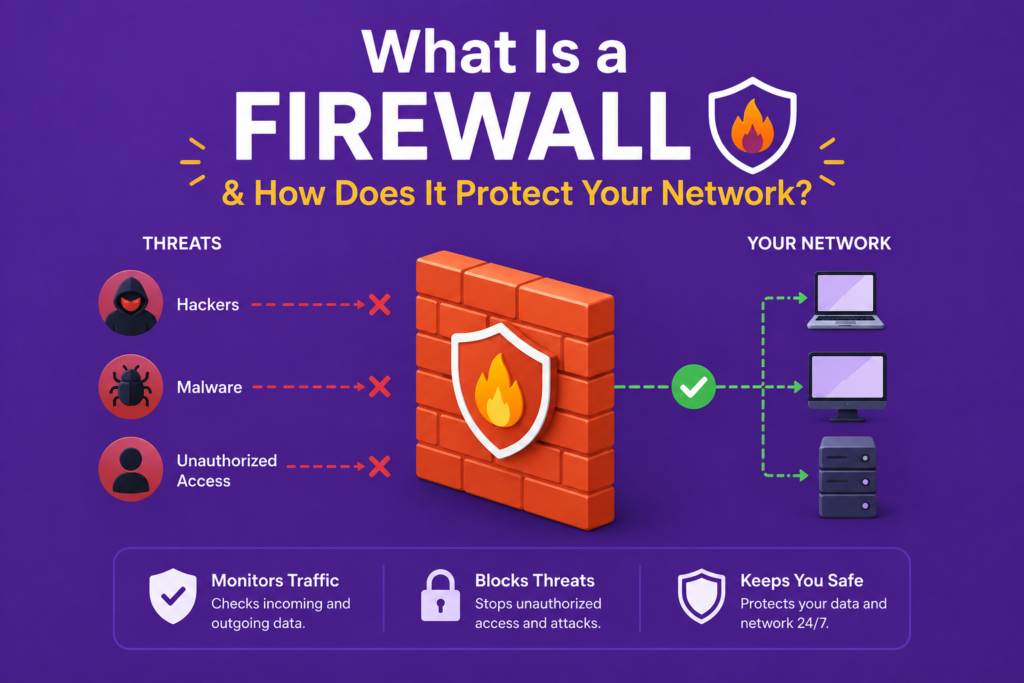
In a world where cyber threats continue growing more sophisticated, understanding what is a firewall has become essential for anyone using the internet. Whether you realize it or not, a firewall likely protects your devices right now, quietly filtering traffic and blocking potential threats before they ever reach your network. Understanding what is a firewall helps explain how this critical security tool actually works behind the scenes.
In simple terms, a firewall acts as a protective barrier between your device and the wider internet, monitoring traffic and blocking anything suspicious. This guide breaks down what is a firewall in clear language, covering its types, functions and why it remains essential for modern network protection.
Understanding What Is a Firewall
At its core, what is a firewall comes down to traffic monitoring and control. A firewall is a security system, either software or hardware based, that monitors incoming and outgoing network traffic based on predetermined security rules. Its primary purpose is to create a protective barrier between trusted internal networks and untrusted external networks, such as the broader internet.
Without a properly configured firewall, devices become significantly more vulnerable to cyber attacks, malicious software and unauthorized access attempts. This makes understanding what is a firewall essential for anyone concerned about protecting their what is a computer network setup from potential threats.
How a Firewall Works in Practice
To fully grasp what is a firewall, it helps to understand how a firewall works on a practical level. Every firewall examines data packets traveling in and out of a network, comparing them against a security ruleset that determines whether traffic should be allowed or blocked.
This process happens continuously, filtering both inbound traffic entering the network and outbound traffic leaving it. By analyzing IP addresses, network ports and other packet details, firewalls can quickly identify and block suspicious activity before it causes harm to connected devices or systems.
Software Firewalls Versus Hardware Firewalls
One important distinction within what is a firewall discussions involves software vs hardware firewall options. A software firewall runs directly on an individual device, such as a computer or smartphone, monitoring traffic specific to that particular system. Windows Defender Firewall is a common example built into many operating systems by default.
A hardware firewall, by contrast, operates as a separate physical device, typically positioned between your router and the wider internet, protecting every device connected to that network simultaneously. Businesses often prefer hardware firewalls for their ability to protect multiple devices without requiring individual software installations.
Packet Filtering Firewalls Explained
Among the earliest and simplest types of firewalls, a packet filtering firewall examines individual data packets based on basic criteria like source and destination IP addresses, along with network port blocking rules. If a packet matches an allowed rule, it passes through. If not, the firewall blocks it immediately.
While packet filtering firewalls remain fast and efficient, they lack the ability to analyze more complex threats hidden within seemingly legitimate traffic. This limitation eventually led to the development of more advanced firewall technologies capable of deeper traffic analysis.
Stateful Inspection Firewalls
Building upon basic packet filtering, a stateful inspection firewall tracks the state of active connections, analyzing whether incoming traffic matches an established, legitimate session. This approach provides significantly better security compared to simple packet filtering, since it considers the broader context of ongoing communication rather than evaluating packets in isolation.
Stateful inspection firewalls remain widely used today, offering a strong balance between security effectiveness and network performance, making them a popular choice for both home and business network protection.
Next Generation Firewalls and Advanced Protection
Modern next-generation firewall technology combines traditional filtering capabilities with more advanced features, including intrusion prevention system functionality and deep packet inspection. These advanced systems can identify and block sophisticated threats that traditional firewalls might otherwise miss.
Next generation firewalls often incorporate additional security layers, working alongside network security tools to provide comprehensive protection against evolving cyber threats, spyware and other malicious software attempting to infiltrate protected networks.
Proxy Firewalls and Additional Protection Layers
A proxy firewall operates differently from traditional firewall types by acting as an intermediary between users and the internet. Rather than allowing direct connections, a proxy server receives requests on behalf of users, filtering content before forwarding legitimate traffic to its intended destination.
This additional layer of separation makes proxy firewalls particularly effective at hiding internal network details from external threats, adding an extra dimension of protection beyond standard packet filtering or stateful inspection methods.
Cloud-Based Firewalls for Modern Networks
As businesses increasingly rely on cloud services, cloud-based firewall solutions have become essential for protecting distributed internet infrastructure. These firewalls operate remotely, filtering traffic before it ever reaches an organization’s internal network, making them particularly effective for businesses with multiple locations or remote employees.
Cloud based firewalls offer scalability advantages, allowing organizations to adjust security resources based on changing needs without requiring significant hardware investments or complex on site installations.
Firewall Security Rules and Access Control
Every firewall relies on carefully configured firewall security rules to determine acceptable network behavior. These rules often work alongside an Access Control List, specifying exactly which IP addresses, ports or applications are permitted or denied access to network resources.
Properly configuring these rules requires balancing security with usability, since overly restrictive settings can block legitimate traffic, while overly permissive rules might leave networks vulnerable to potential cyber attacks or unauthorized access attempts.
Firewalls and DMZ Configuration
Larger networks sometimes implement a DMZ, or demilitarized zone, as an additional security measure. This configuration creates a separate network segment for public facing services, such as web servers, isolating them from more sensitive internal systems.
By placing certain services within a DMZ, organizations can allow necessary external access while still protecting critical internal resources behind additional firewall layers, significantly reducing the risk of a successful breach spreading throughout the entire network.
Why Everyone Needs a Firewall
Addressing the common question of why do I need a firewall, the answer becomes clear when considering the constant threats present across modern internet infrastructure. Firewalls provide essential protection against malicious software, unauthorized access attempts and various forms of cyber attacks targeting both individuals and organizations.
Even with additional security measures like a VPN connection providing encrypted browsing, firewalls remain a critical first line of defense, filtering traffic before threats ever reach your devices or sensitive personal information.
How to Set Up a Firewall Properly
Learning how to setup a firewall properly involves more than simply enabling default settings. Users should review and customize security rules based on their specific needs, ensuring appropriate ports remain open for legitimate applications while blocking unnecessary or suspicious traffic.
Regularly updating firewall software and reviewing security logs helps maintain effective protection over time, ensuring your firewall continues adapting to new and emerging threats within the constantly evolving landscape of cyber security.
Frequently Asked Questions (FAQs)
What is a firewall in simple terms?
A firewall is a security system that monitors and controls incoming and outgoing network traffic, blocking suspicious activity while allowing legitimate communication to pass through safely.
Do I need both antivirus software and a firewall?
Yes, antivirus software and a firewall serve different purposes. A firewall filters network traffic, while antivirus software detects and removes malicious software already present on a device.
What is the difference between a software and hardware firewall?
A software firewall protects a single device, while a hardware firewall protects an entire network by filtering traffic before it reaches any connected devices.
Can a firewall block all cyber attacks completely?
No firewall can block every possible threat. Firewalls significantly reduce risk, but should be combined with other security measures like antivirus software and safe browsing habits.
Conclusion
Understanding what is a firewall reveals just how essential this security tool remains for protecting devices and networks from constantly evolving cyber threats. From basic packet filtering to advanced next generation firewalls, each type serves a specific role in maintaining network safety.
As cyber threats continue growing more sophisticated, understanding what is a firewall and properly configuring one remains a fundamental step toward protecting personal data and modern internet infrastructure from potential harm.