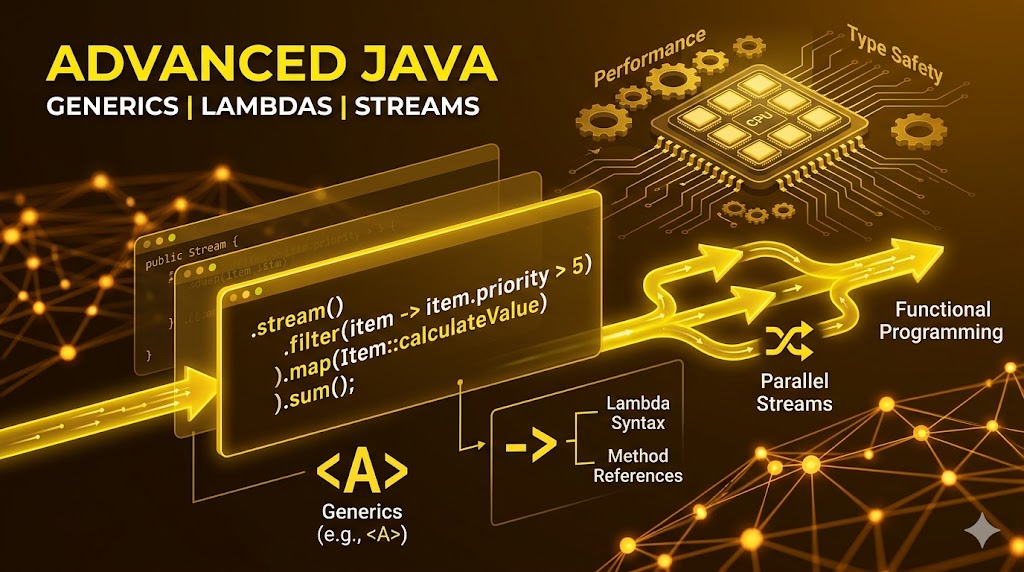
Modern software development requires tools that maximize code reuse, reduce boilerplate syntax, and leverage multi core hardware architecture efficiently. While basic syntax lets you build functional software, stepping into enterprise-grade development means you must transition toward declarative, type-safe paradigms. Spending quality time reading advanced java programming tutorials is the ultimate way to bridge that gap.
By prioritizing advanced java programming tutorials, engineers unlock a massive productivity boost. You stop writing repetitive loop mechanics and start building declarative data pipelines that read like human sentences. This deep dive will thoroughly unpack the core pillars of compile-time safety and functional development patterns that define modern, high-performance systems.
The Evolutionary Need for Type Safety and Readability (2000 – 2004)
During the early lifecycle of the language, developers managed collections using raw, un-parameterized objects. If you review the comprehensive java history: 1991 to today, you will notice a massive turning point in the early 2000s when software applications began expanding exponentially. Before structural changes arrived in 2004, a standard list could hold any data type simultaneously, a string could comfortably sit right next to an integer within the same collection instance.
This flexibility created a massive engineering risk. Because the compiler could not verify what was inside a collection, developers had to manually cast every extracted object back to its intended type at runtime. If an incorrect data type slipped into the collection, the application would crash immediately with a devastating ClassCastException. This historical problem highlighted why developers needed strict compile-time type safety.
To eliminate this vulnerability, language architects designed a robust type parameterization guide that allows developers to catch data mismatches during compilation rather than crashing in production. Understanding how these structural updates stabilized the enterprise ecosystem will clarify why these shifts remain incredibly relevant to the future of software engineering, where system stability and predictability are top priorities.
Mastering Type Safety with Java Generic Classes
Generics completely transformed collection management by enforcing strict type rules during compilation. When you define Java generic classes, you use a placeholder variable, typically written as <T>, to stand in for a concrete data type that the user specifies later when creating the object.
Let us look closely at a production-ready example of a generic repository pattern. This setup demonstrates how to handle different data types with absolute type safety.
Java
// A generic container class utilizing type parameterization guide rules
class SafeDataWarehouse<T> {
    private T protectedDataValue;

    public void archiveValue(T incomingValue) {
        this.protectedDataValue = incomingValue;
    }

    public T retrieveValue() {
        return protectedDataValue;
    }
}

public class GenericsExploration {
    public static void main(String[] args) {
        // Enforcing a strict String policy for this warehouse instance
        SafeDataWarehouse<String> textWarehouse = new SafeDataWarehouse<>();
        textWarehouse.archiveValue("Sophisticated Enterprise Log");
        String safeText = textWarehouse.retrieveValue();
        System.out.println("Retrieved type-safe data string: " + safeText);

        // Enforcing a strict Integer policy for this warehouse instance
        SafeDataWarehouse<Integer> numericWarehouse = new SafeDataWarehouse<>();
        numericWarehouse.archiveValue(2026);
        Integer safeNumber = numericWarehouse.retrieveValue();
        System.out.println("Retrieved type-safe numeric value: " + safeNumber);
    }
}
Behind the scenes, the virtual machine uses a mechanism called generic type erasure to maintain backwards compatibility with older legacy codebases. During compilation, the Java compiler strips away all generic type parameters and replaces them with standard Object bounds or explicit casts. This means that at runtime, your generic code looks exactly like raw bytecode, but you get the full peace of mind that comes with strict compile-time type safety.
If you want to build a rock-solid foundation before diving into these advanced object structures, checking out a comprehensive java oop concepts explained overview will help you understand class relationships and inheritance patterns.
The Paradigm Shift to Functional Programming Methodology (2010 – 2014)
For nearly two decades, the language operated strictly under the imperative object-oriented model. If you wanted to pass a block of business logic into a method, you had to wrap that logic inside an anonymous inner class wrapper. This clumsy structural pattern forced developers to write multi-line, nested blocks of code just to execute a simple, single line of actual logic.
The official launch of Java 8 in 2014 completely solved this issue by introducing a functional programming methodology. This milestone update changed how developers express logic by introducing lambda expressions and flexible functional interfaces Java developers could use right out of the box.
Instead of dealing with code verbosity reduction problems and verbose anonymous method declarations, engineers could suddenly treat functional actions as first-class citizens. This means you can now easily pass code logic into methods just like a standard data argument. This transformation is a core reason why engineers seek out modern advanced java programming tutorials to learn clean, readable code patterns.
Decoding Lambda Expression Syntax and Functional Interfaces
At the core of the Java functional programming paradigm is a clear, concise lambda expression syntax. A lambda expression is essentially an anonymous method declaration that does not require an explicit name, access modifiers, or a formal return type definition.
[Image showing anatomy of a Java Lambda expression: parameters on the left, an arrow operator in the middle, and the body/expression on the right]
Let us look at how lambda expressions simplify your code by comparing the old anonymous inner class approach with modern functional syntax:
Java
import java.util.ArrayList;
import java.util.List;

public class LambdaSyntaxShowcase {
    public static void main(String[] args) {
        List<String> frameworkList = new ArrayList<>();
        frameworkList.add("Spring Boot");
        frameworkList.add("Micronaut");
        frameworkList.add("Quarkus");

        // Old approach: Verbose anonymous inner class declaration
        frameworkList.forEach(new java.util.function.Consumer<String>() {
            @Override
            public void accept(String frameworkName) {
                System.out.println("Legacy output pattern: " + frameworkName);
            }
        });

        System.out.println("----------------------------------------------");

        // Modern approach: Clean code advanced Java lambda statement
        frameworkList.forEach(frameworkName -> System.out.println("Lambda syntax: " + frameworkName));

        System.out.println("----------------------------------------------");

        // Advanced approach: Method reference shorthand for clean code
        frameworkList.forEach(System.out::println);
    }
}
Lambdas only work with functional interfaces, which are interfaces that contain exactly one single abstract method. You can mark these interfaces with the @FunctionalInterface annotation to have the compiler verify they follow functional rules.
The language comes pre-packaged with highly adaptable predicate logic interfaces designed to handle common tasks:
- Predicate: Takes a single input argument and returns a boolean value.
- Function: Accepts one input argument and processes it to return a completely different output type.
- Consumer: Accepts an input argument, performs an action, and returns no result.
- Supplier: Takes zero input arguments and returns a fresh data value instance.
Using these built-in interfaces results in massive boilerplate code elimination, allowing you to write highly expressive applications that are easy to maintain over time.
Processing Data Collections with the Streams API
While lambdas provide the foundation for functional logic, the Streams API provides the actual processing engine. A Stream is not a traditional data structure that stores elements in memory. Instead, it acts as a functional pipeline that moves data from a source—like a collection—through a series of computational steps.
When learning how to use Streams API utilities, you will work with two primary types of operations:
- Intermediate Operations: These operations transform a stream into a different stream, allowing you to chain steps together. They are lazy, meaning they do not perform any actual processing until a final terminal operation is invoked.
- Terminal Operations: These operations close the stream pipeline and produce a concrete result, such as a computed sum, an aggregated list, or a printed line of text.
Let us explore a processing collection pipelines example. This snippet uses a filter map reduce streams pattern to cleanly filter, transform, and aggregate data elements:
Java
import java.util.Arrays;
import java.util.List;

public class StreamsPipelineMastery {
    public static void main(String[] args) {
        List<Integer> transactionalAmounts = Arrays.asList(120, 450, 90, 800, 1500, 300);

        // A comprehensive stream pipeline demonstrating how to use Streams API
        double totalPremiumTaxedValue = transactionalAmounts.stream()
            // Intermediate operation: Keep values greater than 200
            .filter(amount -> amount > 200)
            // Intermediate operation: Apply a 10% tax rate calculation
            .mapToDouble(amount -> amount * 1.10)
            // Terminal operation: Aggregate values into a final sum
            .sum();

        System.out.println("Final total sum of processed premium transactions is: " + totalPremiumTaxedValue);
    }
}
This pipeline element manipulation strategy relies heavily on a sequence lazy evaluation model. Elements travel through the pipeline one by one only when the terminal step requests them, which avoids unnecessary memory allocations and keeps your applications running fast.
Optimizing Streams with Parallel Processing Capabilities
One of the biggest advantages of utilizing a declarative functional pipeline is how easily you can scale your data processing across multiple CPU cores. By simply switching from a standard sequential stream to a parallel stream, you tell the framework to split your dataset into smaller chunks automatically using the built-in ForkJoinPool worker thread architecture.
Java
import java.util.Arrays;
import java.util.List;

public class ParallelStreamPerformance {
    public static void main(String[] args) {
        List<String> largeInventoryCatalog = Arrays.asList(
            "Enterprise Server Frame", "High Speed Switch", "Fiber Cable Spool", "Uninterruptible Power Supply"
        );

        // Converting a sequential pipeline into high-performance parallel code execution
        largeInventoryCatalog.parallelStream()
            .map(item -> item.toUpperCase())
            .forEach(item -> {
                System.out.println("Processed product token: " + item +
                        " via executing thread name: " + Thread.currentThread().getName());
            });
    }
}
While parallel streams make multi-core computing easy, you must use them carefully. If your pipeline performs asynchronous code execution that touches shared, non-thread-safe variables, you will quickly encounter data corruption and synchronization bugs. If your development tasks require heavy multi-threaded data processing, reading through a dedicated java multithreading explained guide is highly recommended to make sure you know how to safely coordinate background tasks.
Architectural Comparison: Streams vs Legacy Collections
To clearly understand why modern enterprise systems rely on functional processing pipelines, let us look at how streams compare to traditional collection approaches:
| Feature Dimension | Traditional Legacy Collections | Modern Streams API Framework |
|---|---|---|
| Data Storage Approach | Holds concrete values physically inside system RAM memory limits. | Does not store data; reads elements from an underlying source. |
| Modification Impact | Directly alters the structural contents of the array or collection. | Leaves the original source data completely untouched. |
| Execution Mechanics | Imperative style using loops to process data sequentially. | Declarative pipeline allowing easy optimization and parallelization. |
| Evaluation Strategy | Eagerly evaluates every single item as soon as the line executes. | Lazy evaluation; skips unnecessary items to optimize performance. |
Comprehensive Best Practices for Clean Advanced Java Code
Writing reliable, production-ready code with these advanced language features requires consistent design patterns. Here are the core guidelines to follow:
Avoid Mixing Raw Types with Generics
Always define clear type parameters when working with collections. Avoiding raw types makes sure you get the full benefits of compile-time type safety and prevents unexpected runtime crashes.
Keep Lambda Expressions Short and Readable
A lambda expression should be a short, clean statement. If a lambda requires complex conditional loops or nested try-catch blocks, move that business logic out into a dedicated, named helper method and reference it using a clean method reference shorthand instead.
Avoid Side Effects in Stream Operations
Make sure your intermediate operations remain completely stateless. If your stream filter or map steps modify external variables, your code will produce unpredictable bugs when you eventually scale up to parallel processing pipelines.
If you are currently building out data management layers using these best practices, checking out a complete java arrays & collections guide will ensure you choose the best data structures for your application requirements.
Frequently Asked Questions (FAQs)
Why does the compiler use generic type erasure instead of keeping types at runtime?
The language architects implemented generic type erasure to guarantee complete backwards compatibility with older legacy systems built before 2004. This mechanism ensures that old compiled bytecode and modern type-parameterized systems can interact smoothly without requiring massive rewrites to the core runtime engine.
Can a single lambda statement comfortably implement an interface with multiple methods?
No, lambdas can only implement functional interfaces that feature exactly one abstract method. If your application needs to implement a larger contract with multiple abstract methods, you must use a standard class declaration or an anonymous inner class instead.
What does sequence lazy evaluation mean when working with stream operations?
Sequence lazy evaluation means that intermediate operations like filter or map are not executed immediately when they are declared. Instead, they act as a recipe. The data elements are only pulled through the pipeline when a terminal operation—like collect or sum—is actively called, which optimizes memory usage and performance.
Is it always faster to use a parallel stream instead of a sequential one?
No, parallel streams introduce overhead because the framework has to split the dataset, coordinate threads, and combine the final results. For small datasets or operations that run quickly, a standard sequential stream is often faster and uses fewer system resources.
Conclusion
Mastering these advanced language features completely changes how you design and build enterprise-ready systems. Incorporating type parameterization guide rules protects your data from unexpected runtime crashes, while embracing functional interfaces Java workflows drastically lowers code verbosity. These tools allow you to eliminate brittle boilerplate code and replace it with clean, declarative pipelines that scale effortlessly across modern multi-core processors. As you continue exploring advanced java programming tutorials, applying these concepts consistently will help you build highly maintainable, world-class software solutions.
If you want to make sure your production environments run reliably under heavy traffic, take a look at our comprehensive java exception handling guide to learn how to manage runtime errors cleanly.