Introduction
More than two thousand years ago, Eratosthenes Calculated the Circumference of the Earth using a simple but brilliant scientific method. At a time when many people had limited understanding of the planet’s size, the Greek scholar Eratosthenes made an astonishing discovery using observation, geometry, and careful reasoning.
His experiment is considered one of the most remarkable achievements of ancient science. Without modern technology or advanced instruments, he was able to estimate the Earth’s size with impressive accuracy. This discovery demonstrated the power of mathematics and observation in understanding the natural world.
The work of Eratosthenes not only helped scientists better understand the Earth but also contributed significantly to the development of geography, astronomy, and mathematics.
Who Was Eratosthenes?
Before exploring how the experiment worked, it is important to understand who Eratosthenes was. He was a Greek mathematician, geographer, and astronomer who lived between 276 BCE and 194 BCE.
He studied philosophy and science in Athens before moving to Alexandria in Egypt. Because of his remarkable intelligence and wide-ranging knowledge, he was eventually appointed as the chief librarian of the famous Library of Alexandria, one of the most important centers of learning in the ancient world.
During his time there, he conducted research in many fields including mathematics, astronomy, and geography. His discoveries later became important milestones in the Birth of Geography as a scientific discipline.
The Key Observation in Syene
The story of how Eratosthenes Calculated the Circumference of the Earth began with a simple observation.
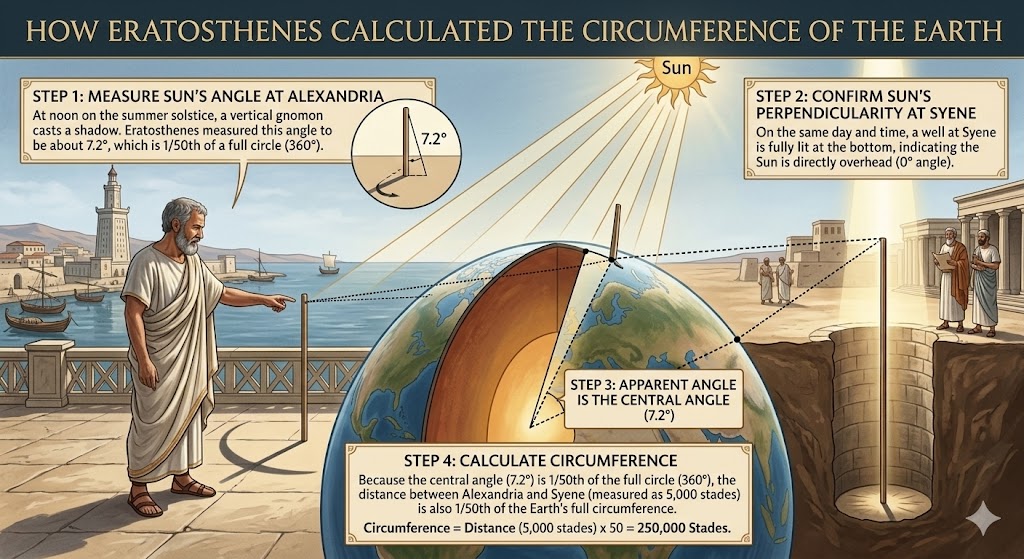
Eratosthenes learned that in the Egyptian city of Syene (modern-day Aswan), something unusual happened every year during the summer solstice. At noon on that day, the Sun was directly overhead.
This meant that sunlight reached the bottom of deep wells and vertical objects cast no shadow. In other words, the Sun was perfectly aligned above the city.
This observation fascinated Eratosthenes because he noticed that in Alexandria, located north of Syene, objects did cast a shadow at the same moment.
This difference gave him an idea.
Measuring the Angle of the Shadow
To investigate further, Eratosthenes measured the shadow cast by a tall object in Alexandria at noon during the summer solstice.
By measuring the angle between the object and its shadow, he discovered that the Sun’s rays formed an angle of approximately 7.2 degrees.
This angle represented about 1/50 of a full circle, since a circle contains 360 degrees.
Eratosthenes realized that if the angle between the two cities was 7.2 degrees, then the distance between them must represent 1/50 of the Earth’s total circumference.
This was the key step that allowed him to calculate the size of the planet.
Calculating the Distance Between the Cities
The next step required knowing the distance between Alexandria and Syene.
Historical records suggest that professional surveyors measured this distance to be about 5,000 stadia, an ancient Greek unit of measurement.
Eratosthenes then multiplied this distance by 50 because the measured angle represented one-fiftieth of a circle.
5,000 stadia × 50 = 250,000 stadia
This value represented his estimate for the Earth’s total circumference.
Depending on how the stadium unit is interpreted, modern scholars believe his estimate was surprisingly close to the actual value of about 40,075 kilometers.
Why This Discovery Was Remarkable
The experiment conducted by Eratosthenes was extraordinary for several reasons.
First, it relied entirely on logical reasoning and observation rather than complex instruments. Second, it used geometry to explain a natural phenomenon on a planetary scale.
This discovery showed how powerful mathematical thinking could be in understanding the universe.
His work also influenced other scientific fields and helped advance his broader Mathematics Contributions, which included studies of prime numbers and mathematical algorithms.
Eratosthenes and the Birth of Geography
The measurement of the Earth’s size played a major role in the Birth of Geography as a scientific discipline.
Before Eratosthenes, many maps were based on myths or incomplete travel stories. By calculating the size of the Earth, he helped scholars better understand distances between places.
He later created maps that attempted to represent the known world using mathematical principles. These early geographic models helped future explorers and scientists improve navigation and cartography.
His work helped transform geography from a descriptive field into a scientific one.
The Role of the Library of Alexandria
Much of Eratosthenes’ research was conducted while he worked at the Library of Alexandria.
The library was one of the largest and most important centers of knowledge in the ancient world. Scholars from across the Mediterranean gathered there to study science, philosophy, literature, and mathematics.
As chief librarian, Eratosthenes had access to a vast collection of texts and research materials. This intellectual environment allowed him to explore new ideas and collaborate with other scholars.
It was within this scholarly setting that many of his most important discoveries were made.
A Scientist Ahead of His Time
Many historians consider Eratosthenes to be truly Ahead of His Time.
His approach to science relied on observation, measurement, and logical reasoning—methods that resemble the modern scientific method.
At a time when many people relied on myths or speculation to explain the world, Eratosthenes used mathematics and evidence to reveal the true size of the Earth.
His work demonstrated that even complex questions about the planet could be answered through careful study and reasoning.
The Lasting Impact of the Experiment
The experiment conducted by Eratosthenes had a lasting impact on science.
Later scholars used his calculations to improve maps, develop navigation techniques, and explore the structure of the Earth.
His work also inspired future mathematicians and astronomers to study the relationship between mathematics and the physical world.
Today, the story of how Eratosthenes Calculated the Circumference of the Earth remains one of the most inspiring examples of ancient scientific brilliance.
Frequently Asked Questions (FAQs)
Who was Eratosthenes?
Eratosthenes was a Greek mathematician, geographer, and astronomer who lived during the third century BCE. He is best known for calculating the Earth’s circumference and contributing to mathematics and geography.
How accurate was Eratosthenes’ measurement of the Earth?
Eratosthenes’ estimate of the Earth’s circumference was remarkably accurate. Depending on the measurement used for the stadium unit, his calculation was very close to the modern value.
Why did Eratosthenes use shadows to measure the Earth?
He used shadows because they revealed the angle of the Sun’s rays at different locations. By comparing the angles in two cities, he could calculate the curvature of the Earth.
What tools did Eratosthenes use?
Eratosthenes used simple tools such as sticks to measure shadows, geometric calculations, and distance estimates between cities.
Why is Eratosthenes important in geography?
Eratosthenes helped establish scientific mapping and measurement of the Earth, contributing to the Birth of Geography as a scientific field.
Where did Eratosthenes conduct his research?
Much of his research took place at the Library of Alexandria, one of the most famous centers of learning in the ancient world.