Introduction
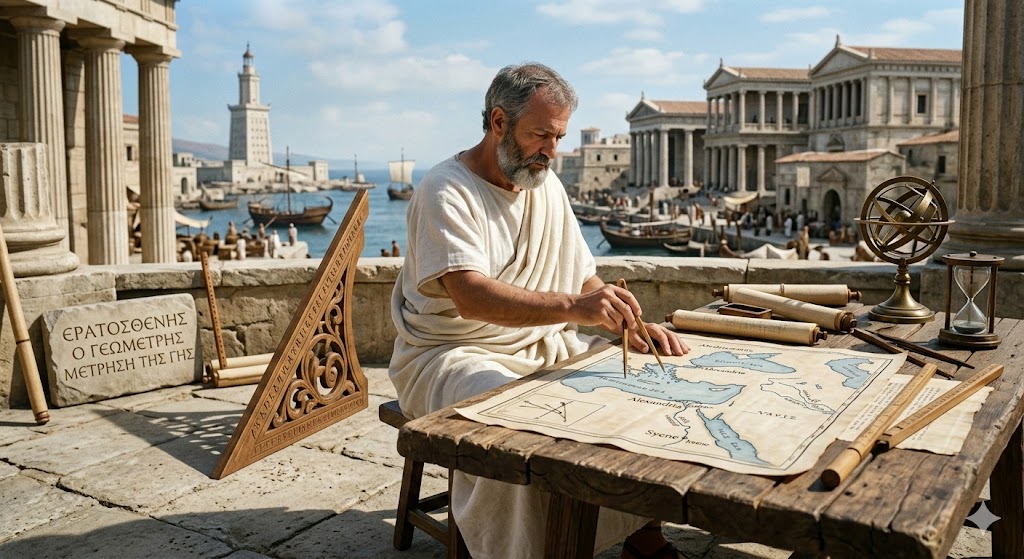
Eratosthenes was one of the most remarkable scholars of the ancient world. Living during the third century BCE, he made groundbreaking contributions to mathematics, astronomy, geography, and scientific thinking. His work helped transform early scientific knowledge into a more systematic and evidence-based discipline.
Often remembered as the man who first accurately measured the size of the Earth, Eratosthenes demonstrated that observation and mathematical reasoning could reveal profound truths about the world. His achievements placed him among the most influential thinkers of ancient Greece.
What makes his work even more impressive is that he accomplished these discoveries with limited tools and simple observations. Through careful reasoning, he showed that mathematics could explain the physical world.
Early Life and Education
Eratosthenes was born around 276 BCE in Cyrene, a Greek colony in North Africa located in modern-day Libya. From an early age, he showed a strong interest in learning and intellectual exploration.
He later traveled to Athens, which was one of the greatest centers of education in the Greek world. There he studied philosophy, mathematics, and literature. His diverse interests eventually earned him a reputation as a “universal scholar,” someone who mastered many fields of knowledge.
Because of his intellectual abilities, Eratosthenes was later invited to Alexandria in Egypt, where he would play a major role in advancing ancient scholarship.
Eratosthenes and the Measurement of the Earth
One of the most famous achievements of Eratosthenes was his calculation of the Earth’s Circumference. Using simple observations and geometry, he was able to estimate the size of our planet with remarkable accuracy.
He observed that at noon on the summer solstice in the city of Syene (modern Aswan), the Sun was directly overhead and cast no shadow in a deep well. At the same moment in Alexandria, however, objects cast a shadow.
By measuring the angle of that shadow and knowing the distance between the two cities, Eratosthenes used geometry to estimate the total circumference of the Earth.
His calculation was astonishingly close to the actual value. This achievement demonstrated the power of mathematical reasoning and remains one of the greatest scientific accomplishments of the ancient world.
Mathematical Innovations
Eratosthenes also made important discoveries in mathematics. One of his most famous ideas is the Sieve of Eratosthenes, a simple but powerful method used to identify prime numbers.
The sieve works by systematically eliminating multiples of numbers from a list of integers. What remains are the prime numbers, which can only be divided by 1 and themselves.
Even today, this method is still taught in mathematics classes and remains an elegant example of ancient mathematical thinking.
These innovations contributed to his broader Mathematics Contributions, which helped advance the understanding of numbers and mathematical reasoning.
The Birth of Scientific Geography
Eratosthenes is often credited with laying the foundations for scientific geography. Through his studies of the Earth’s size and shape, he created one of the earliest attempts to map the known world.
His work is closely associated with the Birth of Geography as a scientific discipline. He introduced the concept of dividing the Earth using lines similar to latitude and longitude, allowing scholars to describe locations more accurately.
By combining mathematics, astronomy, and observation, Eratosthenes helped transform geography from a collection of travel stories into a systematic field of study.
This approach influenced later geographers and explorers for centuries.
Leadership at the Library of Alexandria
Another major chapter of Eratosthenes’ life was his role at the Library of Alexandria, one of the most famous intellectual centers in the ancient world.
He was appointed as the chief librarian by the Egyptian ruler Ptolemy III. The library was home to thousands of scrolls and manuscripts, attracting scholars from across the Mediterranean.
As librarian, Eratosthenes worked to organize and preserve knowledge. He also conducted research across multiple disciplines, including astronomy, mathematics, and literature.
His position at the library allowed him to collaborate with other scholars and contribute to the vibrant intellectual culture of Alexandria.
A Scholar Ahead of His Time
Many historians believe that Eratosthenes was truly Ahead of His Time. His methods relied on observation, measurement, and logical reasoning—principles that later became central to the scientific method.
At a time when many people relied on myth or speculation to explain natural phenomena, Eratosthenes used mathematics and evidence to understand the world.
His work demonstrated that the Earth was far larger and more complex than many people imagined. It also showed that careful reasoning could reveal hidden patterns in nature.
Because of this forward-thinking approach, Eratosthenes remains one of the most respected scholars in the history of science.
Lasting Influence on Science
The achievements of Eratosthenes influenced generations of scholars. Later astronomers, geographers, and mathematicians built upon his work to expand humanity’s understanding of the Earth and the universe.
His measurement of the Earth’s size helped guide future exploration and navigation. His mathematical methods inspired later developments in number theory and scientific reasoning.
Even in modern times, Eratosthenes is remembered as a pioneer who demonstrated how simple observations could lead to powerful discoveries.
Frequently Asked Questions (FAQs)
Who was Eratosthenes?
Eratosthenes was a Greek mathematician, geographer, and astronomer who lived during the 3rd century BCE. He is best known for calculating the Earth’s circumference with remarkable accuracy and for developing the famous Sieve of Eratosthenes used to identify prime numbers.
How did Eratosthenes measure the Earth’s circumference?
Eratosthenes calculated the Earth’s Circumference by comparing the angle of shadows in two Egyptian cities—Syene and Alexandria—during the summer solstice. Using geometry and the known distance between the cities, he estimated the total size of the Earth with surprising accuracy.
What is the Sieve of Eratosthenes?
The Sieve of Eratosthenes is a mathematical method used to find prime numbers. It works by eliminating multiples of numbers from a list of integers, leaving only the prime numbers behind.
Why is Eratosthenes called the father of geography?
Eratosthenes is often called the father of geography because he helped establish the Birth of Geography as a scientific discipline. He introduced systematic mapping methods and attempted to measure and describe the Earth’s surface using mathematics.
What were Eratosthenes’ contributions to mathematics?
Eratosthenes made several important Mathematics Contributions, including developing the Sieve of Eratosthenes for finding prime numbers and applying geometry to calculate the size of the Earth.
What role did Eratosthenes play at the Library of Alexandria?
Eratosthenes served as the chief librarian of the Library of Alexandria, one of the most important centers of learning in the ancient world. In this role, he organized knowledge, conducted research, and collaborated with other scholars.
Why is Eratosthenes considered ahead of his time?
Eratosthenes is considered Ahead of His Time because he used observation, mathematics, and logical reasoning to understand the world—approaches that resemble the modern scientific method.
When did Eratosthenes live?
Eratosthenes lived from approximately 276 BCE to 194 BCE during the Hellenistic period of ancient Greek history.
Conclusion
Eratosthenes stands as one of the most remarkable intellectual figures of the ancient world. Through his work in mathematics, geography, and astronomy, he showed that careful reasoning and observation could reveal the true nature of our planet.
From calculating the Earth’s Circumference to developing the Sieve of Eratosthenes, his discoveries shaped scientific thought for centuries. His role in the Birth of Geography, his leadership at the Library of Alexandria, and his remarkable Mathematics Contributions all demonstrate the breadth of his intellectual achievements.
Perhaps most impressive is the fact that Eratosthenes achieved so much with limited technology. His curiosity, creativity, and dedication to knowledge made him a scholar truly Ahead of His Time.
Today, his legacy continues to inspire scientists, mathematicians, and historians who study the development of human knowledge.