Euler’s Work in Mechanics: Moving Beyond Newton
When Isaac Newton published his Philosophiæ Naturalis Principia Mathematica in 1687, he laid the foundations of classical mechanics. Yet Newton’s approach, while revolutionary, was geometric and somewhat cumbersome. It was Leonhard Euler, the Swiss mathematician of unparalleled productivity, who transformed Newton’s insights into the powerful analytical framework that engineers and physicists use today. The astonishing scope of euler physics work extends across every branch of mechanics, from the motion of rigid bodies to the flow of fluids to the wobble of spinning tops.
Euler recognized that Newton’s laws, expressed in geometric terms, could be reformulated using the calculus he helped develop. This shift from geometry to analysis made mechanics far more powerful and general. Where Newton solved problems one by one with geometric ingenuity, Euler provided universal equations that could be applied to any mechanical system. His work turned mechanics from a collection of clever solutions into a systematic science.
The euler physics work approach began with a fundamental insight: the motion of any object can be described by its position, velocity, and acceleration as functions of time. Using his euler calculus work, Euler formulated the equations of motion in a way that could be applied to particles, rigid bodies, and continuous media. This analytical approach became the standard for generations of physicists and engineers.
The Euler-Bernoulli Beam Theory: The Science of Skyscrapers
One of Euler’s most enduring contributions to physics was his development of beam theory, now known as the Euler-Bernoulli beam theory. This theory describes how beams bend under applied loads, and it remains the foundation of structural engineering to this day.
When a beam is subjected to a load, it deflects. The relationship between the load and the resulting deflection depends on the beam’s material properties and geometry. Euler derived the differential equation that governs this relationship:
In this equation, is the deflection of the beam at position , is the Young’s modulus of the material (a measure of stiffness), is the moment of inertia of the beam’s cross section, and is the distributed load applied to the beam.
For a beam with constant cross section and material properties, this simplifies to:
This elegant equation captures the essence of beam bending. By solving it with appropriate boundary conditions, engineers can determine exactly how much a beam will deflect under any load, where the maximum stress occurs, and whether the beam will fail.
The practical implications of this work are staggering. Every skyscraper, bridge, airplane wing, and building frame relies on Euler’s beam theory. When architects design a building to withstand wind loads, when engineers calculate how much a bridge will sag under traffic, when aerospace designers ensure wings flex safely during flight, they are using equations Euler developed in the 18th century. The euler physics work in structural mechanics literally holds up the modern world.
Fluid Dynamics: The Euler Equations for Inviscid Flow
Euler also made foundational contributions to the study of fluids. Before Euler, the motion of fluids was poorly understood. Newton had considered some aspects of fluid resistance, but a comprehensive mathematical framework did not exist. Euler changed that by deriving the equations that describe the flow of ideal fluids.
The Euler equations for inviscid flow are a set of partial differential equations that express the conservation of mass, momentum, and energy in a fluid. In their simplest form for an incompressible fluid, the momentum equation is:
Here, is the velocity vector field of the fluid, ρ is the density, and p is the pressure. The term represents the acceleration of fluid particles as they move through space, capturing the nonlinear behavior that makes fluid dynamics so rich and complex.
These equations, now known as the Euler equations, are the foundation of fluid dynamics equations. They describe the flow of air over airplane wings, the movement of water through pipes, and the behavior of weather systems. While real fluids have viscosity (internal friction) that Euler’s equations ignore, the Euler equations provide the essential starting point for understanding fluid motion.
Understanding Pressure and Velocity in Fluids
Euler’s approach to fluid dynamics introduced the concept of treating fluids as continuous media, rather than collections of individual particles. This continuum mechanics perspective allowed him to derive relationships between pressure, velocity, and density that apply at every point in the fluid.
One of Euler’s key insights was that pressure differences drive fluid motion. A fluid flows from regions of high pressure to regions of low pressure, and the acceleration of the fluid is proportional to the pressure gradient. This relationship is captured in the Euler equations and forms the basis for understanding everything from blood flow in arteries to the aerodynamics of cars.
The Euler equations also revealed the importance of vorticity, the tendency of fluids to rotate. Euler showed that in an inviscid fluid, vorticity is conserved along fluid particle paths. This insight helps explain the formation of whirlpools, tornadoes, and the large scale circulation of the Earth’s atmosphere.
Celestial Mechanics: Calculating the Paths of the Moon
Euler’s contributions to celestial mechanics Euler developed were essential to understanding the motions of the Moon, planets, and comets. Newton had shown that gravity follows an inverse square law, but calculating the precise orbits of multiple bodies interacting simultaneously was extraordinarily difficult.
Euler took up the challenge of the three body problem: determining the motion of the Moon under the gravitational influence of both the Earth and the Sun. This problem was critical for navigation, as sailors needed accurate lunar tables to determine longitude at sea. Euler developed powerful analytical methods to compute lunar orbits with unprecedented accuracy.
His approach involved using orbital mechanics to treat the Moon’s orbit as a Keplerian ellipse that slowly changes due to solar perturbations. He derived equations describing how the Moon’s orbital elements—its size, shape, orientation, and position—evolve over time. These equations allowed him to calculate lunar positions far more accurately than previous methods.
The euler physics work in celestial mechanics also included studies of planetary perturbations, the gravitational interactions that cause planets to deviate from perfect Keplerian orbits. Euler developed methods for calculating these perturbations that became standard tools in astronomy. His work helped establish that the solar system is stable over long periods, addressing concerns that gravitational interactions might eventually cause planets to crash into the Sun or fly off into space.
Rigid Body Rotation and the Dynamics of Spin
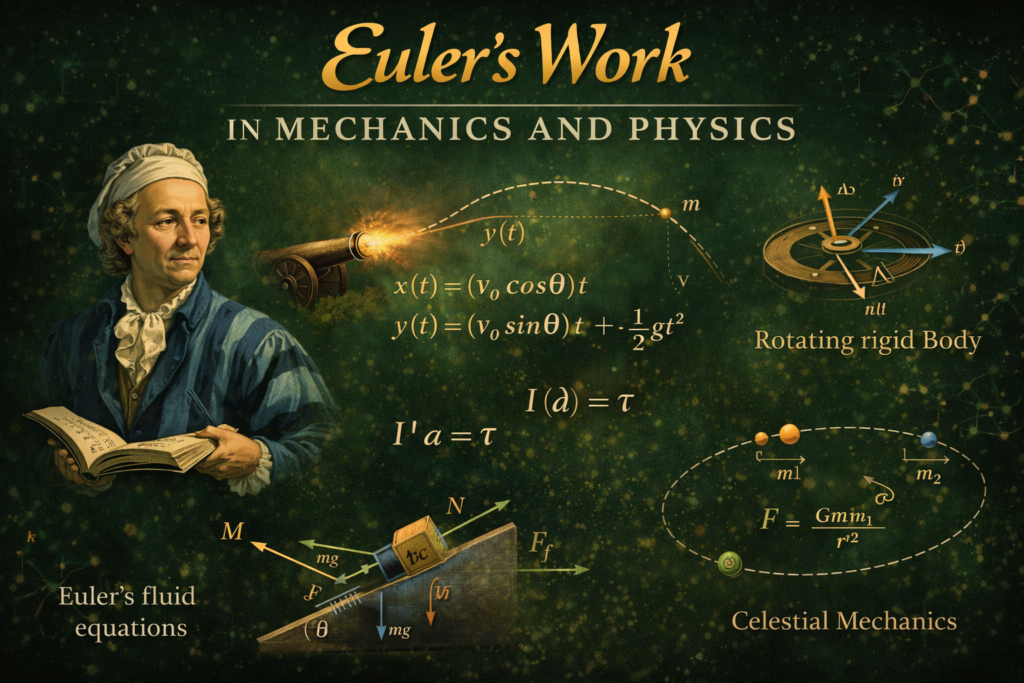
Euler’s work on the rotation of rigid bodies represents another monumental achievement in euler physics work. Before Euler, the rotation of objects was poorly understood. While Newton had analyzed the motion of point masses, extended objects rotating in three dimensions presented new challenges.
Euler introduced the concept of the moment of inertia, a quantity that measures how mass is distributed around an axis of rotation. For a system of particles with masses mi at distances from an axis, the moment of inertia is:
For continuous objects, this becomes an integral:
The moment of inertia plays the same role in rotational motion that mass plays in linear motion. Euler showed that the rotational equivalent of Newton’s second law is:
where τ is torque and α is angular acceleration.
Euler also derived the equations that govern the rotation of a rigid body in three dimensions. These equations, now known as Euler’s equations for rigid body rotation, are:
Here, I are the principal moments of inertia, are the components of angular velocity, and are the components of torque. These equations describe the complex behavior of spinning objects, from the wobble of a spinning top to the rotation of planets and spacecraft.
The inertia tensor, which Euler essentially invented, provides a complete description of how mass is distributed in an object. This concept is essential for understanding the rotational dynamics of everything from gyroscopes to satellites.
Frequently Asked Questions (FAQs)
1. What is euler physics work?
euler physics work encompasses Leonhard Euler’s contributions to mechanics, fluid dynamics, celestial mechanics, and rigid body dynamics. He transformed Newtonian mechanics into an analytical framework and developed foundational equations used throughout engineering and physics.
2. What is the Euler-Bernoulli beam theory?
The Euler-Bernoulli beam theory describes how beams bend under applied loads. It provides a differential equation relating beam deflection to the applied load, material properties, and geometry, forming the basis of structural engineering.
3. What are the Euler equations in fluid dynamics?
The Euler equations are partial differential equations describing the flow of inviscid (frictionless) fluids. They express conservation of mass, momentum, and energy, and are fundamental to understanding aerodynamics, hydrodynamics, and weather systems.
4. What did Euler contribute to celestial mechanics?
Euler developed analytical methods for calculating the motion of the Moon and planets under gravitational interactions. His work on the three body problem provided accurate lunar tables essential for navigation and helped establish the stability of the solar system.
5. What are Euler’s equations for rigid body rotation?
Euler’s equations describe the rotation of a rigid body in three dimensions. They relate torque to angular acceleration and account for the distribution of mass through the moment of inertia, governing the behavior of spinning objects from tops to spacecraft.
Conclusion: Euler’s Physical Legacy in Modern Engineering
Leonhard Euler’s contributions to mechanics and physics are so fundamental that they permeate every corner of modern engineering. The leonhard euler life and legacy includes the equations that describe how bridges bend, how fluids flow, how planets orbit, and how spinning objects rotate. His analytical approach transformed physics from a geometric science into a mathematical discipline.
The euler formula that connects exponentials to trigonometry appears throughout physics, from quantum mechanics to wave propagation. His euler calculus work provided the mathematical tools that make modern physics possible. His discovery of the euler number e is essential to understanding growth and decay in everything from radioactive dating to population dynamics. His euler modern math influence extends across science and engineering.
The euler physics work in beam theory made modern architecture possible. His fluid dynamics equations enable aircraft design, weather prediction, and climate modeling. His celestial mechanics calculations guided navigation for centuries. His rigid body dynamics underpin spacecraft attitude control, robotics, and mechanical engineering.
Just as how ancient greek scientists changed modern science by establishing the foundations of rational inquiry and mathematical description of nature, Euler changed physics by giving it the analytical tools to describe reality with precision. His work transformed the study of motion from a philosophical inquiry into a predictive science capable of building skyscrapers, launching rockets, and understanding the cosmos.
Euler’s productivity was legendary. Even after losing his eyesight, he continued to produce groundbreaking work, dictating papers to assistants with undiminished clarity. His astonishing contributions to mechanics and physics represent some of the most important scientific achievements in history. When engineers design structures, when physicists model fluids, when astronomers calculate orbits, they are standing on the shoulders of Euler.