Introduction
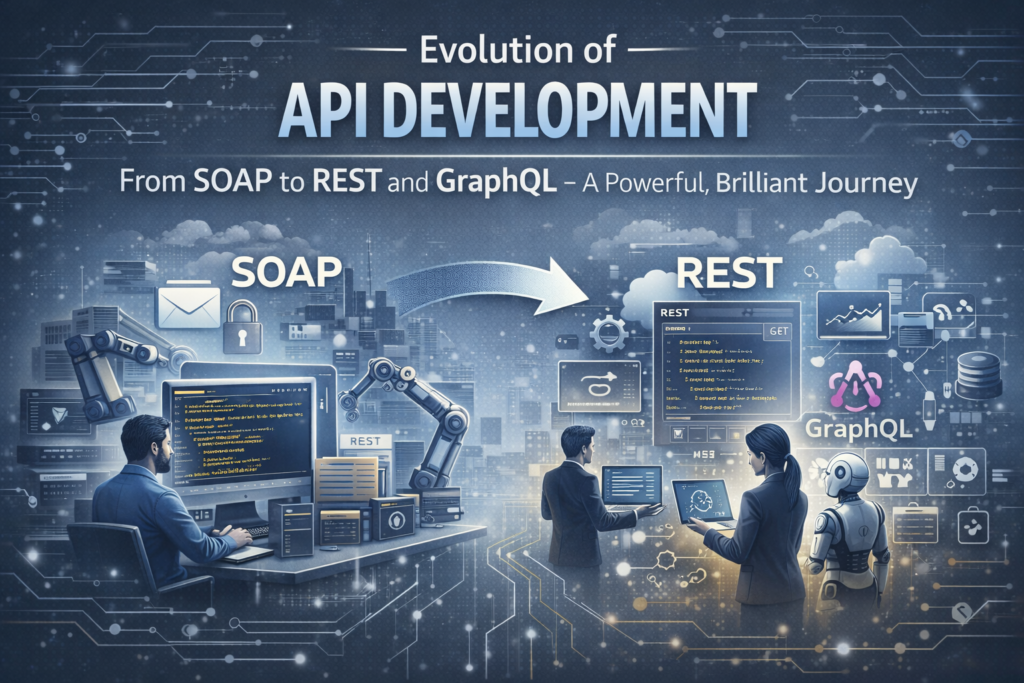
Every time your phone checks the weather, your bank app shows a balance, or your website loads a Google map, an API is working behind the scenes. The evolution of API development is a powerful story of how software learned to talk to software. What began with complex, verbose XML documents has evolved into lightweight JSON payloads and flexible query languages. The brilliant journey of the evolution of API development has transformed how we build web applications, mobile apps, and microservices. Understanding this progression helps developers choose the right API paradigm for modern projects.
Before APIs: Monolithic Applications (Pre 1990)
Before the evolution of API development began, applications were monolithic. A payroll system ran on one mainframe. An inventory system ran on another. They did not talk to each other. If data needed to move between systems, someone exported a file, transferred it physically, and imported it elsewhere. The history of computers was filled with isolated islands of automation. The history of computer networking created the possibility of communication, but software needed standards to exchange data meaningfully. The evolution of API development would provide those standards.
The Early Days: Remote Procedure Call (1980 – 1995)
The first major step in the evolution of API development was Remote Procedure Call (RPC). RPC made a function call on a remote server look like a local function call. The developer wrote getCustomer(id) and the RPC system handled network communication, parameter serialization, and result delivery. Sun Microsystems introduced Sun RPC in the 1980s. Open Software Foundation developed Distributed Computing Environment (DCE) RPC. These systems worked but were tightly coupled. Client and server needed to use the same programming language and data formats.
The history of operating systems and history of programming languages influenced early RPC systems. Each had its own binary format. A C client could not easily talk to a COBOL server. The evolution of API development needed a language independent approach. The answer came from XML.
SOAP: The Enterprise Standard (1998 – 2005)
The evolution of API development took a major step forward with SOAP (Simple Object Access Protocol) . Microsoft, IBM, and others developed SOAP in the late 1990s. SOAP used XML for message format. It used HTTP or SMTP for transport. A SOAP message had an envelope (containing the XML), optional headers (for metadata), and a body (containing the actual request or response). SOAP was verbose but powerful. It supported sophisticated security (WS Security), reliable messaging (WS ReliableMessaging), and transactions (WS AtomicTransaction).
The history of software engineering embraced SOAP for enterprise integration. Banks, insurance companies, and government agencies used SOAP for business critical systems. SOAP was self describing. A client could read a Web Services Description Language (WSDL) file to understand exactly what operations the service offered. The Software interoperability promise of SOAP was compelling. A Java client could talk to a .NET server. A Python client could talk to a COBOL server.
However, SOAP had significant drawbacks. XML vs. JSON debates began because XML was heavy. A simple “get customer” request might require hundreds of lines of XML. Parsing XML was computationally expensive. The evolution of API development needed something simpler. The history of the Internet was shifting toward mobile devices with limited bandwidth and processing power. SOAP was too heavy for mobile apps.
REST: The Architectural Style (2000 – 2010)
The evolution of API development changed direction with REST (Representational State Transfer) . Roy Fielding introduced REST in his 2000 doctoral dissertation. Fielding was one of the authors of the HTTP specification. REST was not a protocol. It was an architectural style for building web APIs. REST leveraged existing HTTP features: methods (GET, POST, PUT, DELETE), status codes (200 OK, 404 Not Found), and headers (Content Type, Authorization).
REST had several key constraints. Client-server architecture separated concerns. Statelessness meant each request contained all necessary information. The server did not remember previous requests. Cache constrained responses could be cached to improve performance. A uniform interface (HTTP methods and resource identifiers) simplified interactions. Layered systems allowed intermediaries like load balancers and proxies. Code on demand (optional) allowed servers to extend client functionality.
The evolution of API development embraced REST because it was simple and scalable. Instead of complex XML envelopes, REST APIs used URLs to identify resources. GET /customers/123 retrieved customer 123. POST /customers created a new customer. DELETE /customers/123 deleted customer 123. Endpoint design became intuitive. Statelessness made REST APIs horizontally scalable. A server could handle any request without sharing session state.
XML vs. JSON shifted decisively toward JSON. JavaScript Object Notation was lighter, faster to parse, and easier to read than XML. A customer object in JSON was {"id":123,"name":"John Doe"}. The same object in XML was <customer><id>123</id><name>John Doe</name></customer>. JSON won because it matched the data structures of modern programming languages. The evolution of API development saw JSON become the default data format for web APIs.
The REST Explosion (2005 – 2015)
REST APIs became the standard for web development. Postman tool , launched in 2012, made API testing accessible. Developers could send HTTP requests, inspect responses, and save collections of API calls. Swagger / OpenAPI , originally created by Tony Tam in 2010, provided a specification for describing REST APIs. Swagger UI generated interactive documentation from the specification. Developers could explore and test APIs without writing code.
The history of mobile technology drove REST adoption. iPhone and Android apps needed lightweight APIs that worked over cellular networks. REST over HTTP with JSON was perfect. The history of cloud computing also relied on REST. AWS, Azure, and Google Cloud all exposed REST APIs for managing cloud resources. The evolution of API development had found a simple, scalable, widely adopted standard.
However, REST had limitations. The Data fetching problem emerged as applications became more complex. A mobile app screen might need a customer, their orders, and the items in each order. With REST, the client might make five or six sequential requests: one for the customer, one for the list of orders, and one for each order’s items. This chattiness was inefficient over high latency mobile networks. Over fetching and Under fetching were opposite problems. Over fetching meant the server returned more data than needed. A GET /customers/123 might return 50 fields when the client needed only name and email. Under fetching meant the response lacked needed data, forcing additional requests.
GraphQL: Facebook’s Solution (2012 – 2015)
The evolution of API development took another leap with GraphQL (Facebook) . Facebook developed GraphQL internally starting in 2012 to solve mobile performance problems. Facebook’s native mobile apps needed to fetch complex data efficiently. REST required multiple round trips. GraphQL allowed the client to specify exactly what data it needed in a single request. Facebook open sourced GraphQL in 2015.
GraphQL introduced a Query language for APIs. Clients sent a query that described the shape of the response. For example:
text
{
  customer(id: 123) {
    name
    email
    orders {
      date
      total
      items {
        name
        price
      }
    }
  }
}
The server returned a JSON response with exactly the requested fields, nested exactly as requested. No over fetching. No under fetching. One request instead of five or six. The evolution of API development had solved the data fetching problem.
GraphQL also introduced a strong type system. The API schema defined types, fields, and relationships. Tools like GraphiQL provided interactive documentation and query building. Clients could discover what data was available without reading external documentation. The Scalable APIs benefit was significant. Adding new fields did not break existing clients because clients requested only the fields they needed.
However, GraphQL was not a replacement for all REST APIs. GraphQL added complexity. Servers needed to resolve potentially expensive nested queries. Caching was harder because GraphQL used a single endpoint (POST /graphql) instead of resource specific URLs. Simple CRUD applications were often better served by REST. The evolution of API development offered choice rather than a single right answer.
Webhooks: Turning APIs Around (2007 – Present)
The evolution of API development also included asynchronous patterns. Traditional APIs were synchronous. The client made a request and waited for a response. Webhooks reversed the direction. The client provided a URL to the server. When an event occurred, the server sent an HTTP request to that URL. Webhooks enabled real time notifications. When a payment completed, a webhook notified the system. When a file finished processing, a webhook triggered the next step.
Webhooks were not a replacement for REST or GraphQL. They were a complement. REST handled request response interactions. Webhooks handled event driven interactions. Stripe, GitHub, and thousands of other services used webhooks extensively. The evolution of API development embraced both synchronous and asynchronous patterns.
The history of devOps and devops tools evolution relied on webhooks. A code push to GitHub triggered a webhook that started a Jenkins build. That build completed and triggered a webhook that deployed to production. Modern software delivery depended on asynchronous API interactions.
gRPC: High Performance RPC (2015 – Present)
Not all APIs needed to be HTTP based. The evolution of API development included gRPC (Google) for high performance scenarios. Google developed gRPC internally and open sourced it in 2015. gRPC used Protocol Buffers (Protobuf) as the interface definition language and serialization format. Protobuf was binary, not text like JSON or XML. Binary serialization was smaller and faster to parse.
gRPC supported four communication patterns. Unary RPC was traditional request response. Server streaming RPC allowed the server to send a stream of messages. Client streaming RPC allowed the client to send a stream. Bidirectional streaming allowed both to stream simultaneously. gRPC used HTTP/2 for transport, enabling multiplexed streams over a single connection.
The Microservices communication world embraced gRPC. Services inside a data center could communicate with high efficiency. gRPC was particularly popular in polyglot environments. A Go service could call a Java service. A Python service could call a C++ service. The evolution of API development had a high performance option for internal traffic, while REST remained dominant for external APIs.
API Gateways and Management (2010 – Present)
As APIs proliferated, organizations needed ways to manage them. API Gateways became essential infrastructure. An API gateway sat between clients and backend services. It handled authentication, rate limiting, logging, monitoring, request routing, and response transformation. Kong, Apigee (Google), AWS API Gateway, and Azure API Management were popular options.
The history of cloud computing made API gateways indispensable. A single gateway could front hundreds of microservices. Clients saw a unified API. The gateway translated requests to appropriate backend services. This decoupling allowed backend services to evolve independently. The evolution of API development included the operational infrastructure around APIs, not just the protocols.
API gateways also enforced security. OAuth tokens, API keys, and JWT validation happened at the gateway. Rate limiting protected backend services from abuse. Request logging provided audit trails. The history of cybersecurity and API management grew together.
OpenAPI and API Documentation (2010 – Present)
Good documentation was essential for API adoption. The evolution of API development produced the Swagger / OpenAPI standard. OpenAPI (originally Swagger) provided a machine readable specification for REST APIs. An OpenAPI document described endpoints, parameters, request bodies, responses, authentication methods, and data schemas. Tools generated interactive documentation, client SDKs, and server stubs from the specification.
The OpenAPI Initiative, hosted by the Linux Foundation, maintained the standard. Major companies including Google, Microsoft, and IBM participated. OpenAPI became the lingua franca for REST API description. The evolution of API development had solved the documentation problem. Developers could explore and test APIs without writing code.
The Future of API Development
What comes next in the evolution of API development ? Several trends are clear. First, GraphQL adoption will continue growing, particularly for mobile and complex frontend applications. Second, gRPC will dominate internal microservices communication, especially for real time and streaming workloads. Third, REST will remain the standard for simple, cacheable, public APIs. Fourth, Webhooks and event driven architectures will expand. Fifth, API security will become more sophisticated with mutual TLS, JWT, and OAuth 2.1.
The evolution of the first digital computer from specialized hardware to general purpose platform shows how abstraction enables progress. The same is true for APIs. Each generation of the evolution of API development has raised the level of abstraction. SOAP abstracted message formatting. REST abstracted resource manipulation. GraphQL abstracted data fetching. gRPC abstracted high performance streaming.
The history of databases and history of software engineering continue to influence API design. As applications become more distributed, APIs become more critical. The evolution of API development is not slowing down. It is accelerating.
Frequently Asked Questions (FAQs)
Q1: What is the main difference between SOAP and REST?
SOAP (Simple Object Access Protocol) is a protocol with strict standards, XML only messages, and built in security and transaction features. REST (Representational State Transfer) is an architectural style that uses HTTP methods, supports multiple data formats (JSON, XML, plain text), and is simpler and more lightweight. REST is better for web and mobile APIs. SOAP is still used in enterprise environments.
Q2: When should I use GraphQL instead of REST?
Use GraphQL (Facebook) when you have complex data relationships, mobile clients with limited bandwidth, or multiple client types (web, iOS, Android) that need different data shapes. Use REST for simple CRUD APIs, public APIs where caching is important, or when you need HTTP features like ETags and conditional requests.
Q3: What is the difference between REST and gRPC?
REST (Representational State Transfer) uses HTTP/1.1, text based JSON, and is designed for browser and mobile clients. gRPC (Google) uses HTTP/2, binary Protocol Buffers, and is designed for high performance server to server communication. gRPC supports streaming. REST is easier for browsers and public APIs.
Q4: What are webhooks and how do they work?
Webhooks are user defined HTTP callbacks. A client provides a URL to a server. When an event occurs, the server sends an HTTP request to that URL. Webhooks enable real time notifications without polling. For example, when a payment completes, Stripe sends a webhook to your server.
Q5: What is OpenAPI and why is it important?
Swagger / OpenAPI is a specification for describing REST APIs. An OpenAPI document is machine readable. It defines endpoints, parameters, responses, and authentication. Tools generate interactive documentation, client SDKs, and server stubs from OpenAPI files. It is the standard for REST API documentation.
Q6: What is an API gateway?
An API Gateway is a server that sits between clients and backend services. It handles authentication, rate limiting, logging, monitoring, request routing, and response transformation. API gateways are essential for microservices architectures and provide a single entry point for all API requests.
Q7: Which API style is best for microservices communication?
gRPC (Google) is often best for synchronous microservices communication because it is fast, supports streaming, and works across programming languages. For asynchronous communication, message queues (RabbitMQ, Kafka) or webhooks are better. For external facing APIs, REST or GraphQL are preferred.
Conclusion
The evolution of API development from SOAP to REST to GraphQL is a powerful story of simplification and specialization. SOAP gave us XML based enterprise integration. REST gave us lightweight, scalable web APIs. GraphQL gave us flexible data fetching. Webhooks gave us event driven interactions. gRPC gave us high performance streaming. Each paradigm has strengths and weaknesses. The best API developers understand the trade offs and choose the right tool for each job. The evolution of API development continues. The future will bring new protocols, new patterns, and new ways for software to talk to software