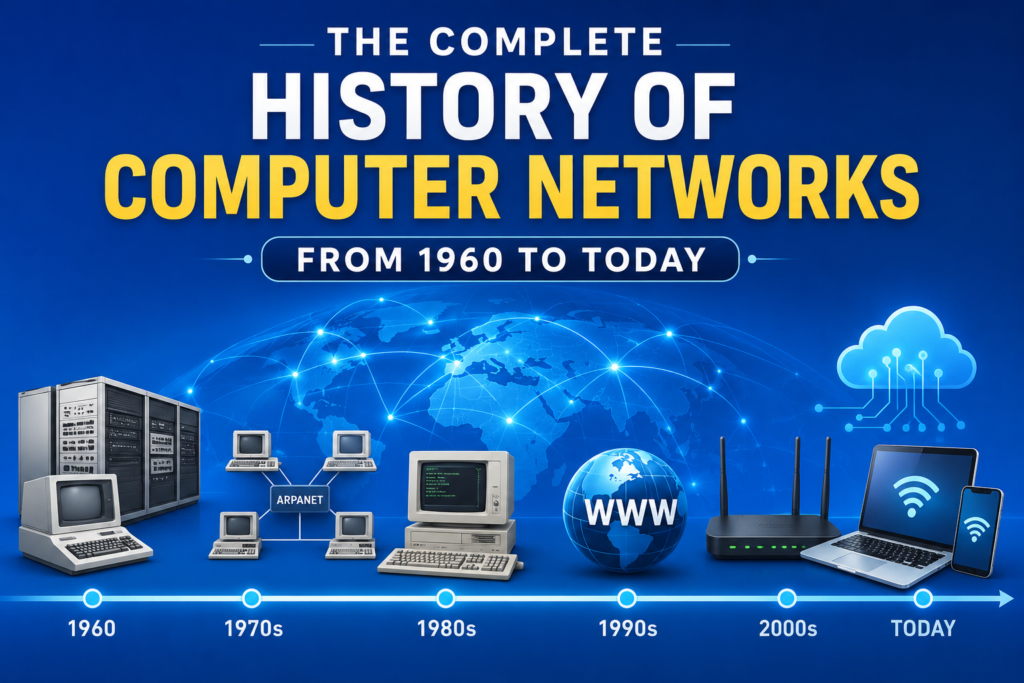
The history of computer networks is one of the most remarkable stories in modern technology. What began as a handful of isolated mainframe computers in research labs has grown into a global system connecting billions of devices. Understanding the history of computer networks helps explain not only how the internet works, but why it was built the way it is.
From the earliest experiments in the 1960s to today’s high speed wireless connections, this journey reflects decades of innovation, collaboration and problem solving by engineers around the world. This article walks through every major milestone in the history of computer networks, from the mainframe era to the age of 5G.
The Mainframe Era Before Networking
Before we can fully appreciate the history of computer networks, it helps to understand the world before networking existed. In the early 1960s, computers were massive mainframe machines that occupied entire rooms. Each machine operated independently, and sharing data between them required physically transporting tapes or punch cards from one location to another.
This isolation created a major bottleneck for researchers who wanted to share computing power and information quickly. The demand for a faster, more efficient method of communication between machines set the stage for the earliest networking experiments.
ARPANET: The Foundation of Modern Networking
No discussion of the history of computer networks is complete without ARPANET. Funded by DARPA in the United States, ARPANET was designed to connect research institutions and allow them to share resources even if part of the network failed. This resilience requirement, shaped by Cold War concerns, led to the development of packet switching, a method of breaking data into small packets that travel independently across a network.
In 1969, the first successful connection was made between UCLA and Stanford Research Institute. This event is widely regarded as the true beginning of what is a computer network in the modern sense, since it proved that separate machines could exchange information reliably over long distances.
ALOHANET and the Rise of Wireless Concepts
While ARPANET focused on wired connections, ALOHANET, developed in Hawaii in the early 1970s, introduced an early form of wireless networking. ALOHANET connected computers across the Hawaiian islands using radio signals instead of physical cables, solving the challenge of linking locations separated by ocean.
The techniques developed for ALOHANET later influenced Ethernet and other networking protocols, making it an important but often overlooked chapter in the history of computer networks. It demonstrated that wireless communication between computers was not just possible, but practical for real world use.
Ethernet and the Local Area Network Revolution
In 1973, Robert Metcalfe developed Ethernet at Xerox PARC, a breakthrough that transformed how computers connected within offices and buildings. Ethernet allowed multiple devices to communicate over a shared cable using a simple and efficient protocol, making it the backbone of local area networks for decades.
Ethernet’s success came from its simplicity and reliability. Businesses could now connect dozens of computers within a single building without relying on expensive, complex systems. This innovation played a massive role in shaping the types of computer networks we recognize today, particularly local area networks used in homes and offices worldwide.
TCP/IP and the Birth of Internetworking
As more networks emerged, a critical problem arose. Different networks used different protocols, making communication between them nearly impossible. Vint Cerf and Bob Kahn solved this by developing TCP/IP, a universal protocol suite that allowed different networks to connect and communicate seamlessly.
TCP/IP explained simply, it works by breaking data into packets, assigning each one an IP address, and reassembling them correctly at their destination. This innovation was the true turning point in the history of computer networks, since it allowed ARPANET, university networks and eventually commercial networks to merge into a single interconnected system.
Understanding the OSI Model and Network Standards
As networking expanded globally, engineers needed a standardized framework for designing and troubleshooting networks. This led to the creation of the OSI model explained through seven layers, ranging from physical hardware to application software.
Although developed later as a teaching tool, the OSI model became essential for understanding how a router works, how data moves between devices and how different networking technologies interact. It remains a foundational concept for anyone studying the history of computer networks or modern network engineering.
NSFNET and the Expansion of Internet Infrastructure
During the 1980s, the National Science Foundation launched NSFNET, connecting university computer centers across the United States. NSFNET dramatically expanded the number of network nodes and increased overall network traffic, requiring major upgrades to existing internet infrastructure.
This period marked a shift from a small research network into a rapidly growing system capable of supporting thousands of institutions. NSFNET’s expansion is a critical chapter in the history of computer networks, since it laid the groundwork for the commercial internet that emerged in the following decade.
The Rise of Dial Up Internet and Home Connectivity
By the late 1980s and early 1990s, dial up internet brought networking into homes for the first time. Using regular telephone lines, households could connect to the internet, although speeds were extremely slow compared to modern standards.
Dial up internet represented a major milestone in the history of computer networks because it shifted networking from an academic and government tool into something accessible for everyday consumers. This period also saw the rise of coaxial cable connections, which offered faster speeds than traditional phone lines.
Broadband, Fiber Optics and Modern Speeds
As demand for faster internet grew, broadband technology replaced dial up connections. Coaxial cable and eventually fiber optics allowed data to travel at speeds previously unimaginable, supporting streaming, gaming and large scale data transfer.
Fiber optic cables use light signals instead of electrical signals, making them faster and more reliable over long distances. This shift dramatically improved bandwidth explained in practical terms, allowing more data to move through networks simultaneously without significant slowdown.
Wireless Networking and Wi-Fi Standards
The introduction of Wi-Fi standards in the late 1990s marked another turning point in the history of computer networks. Wireless networking eliminated the need for physical cables in homes and offices, giving users the freedom to connect multiple devices without complex wiring.
Comparing wired vs wireless networks, wired connections generally offer more stability and speed, while wireless networks provide flexibility and convenience. Over time, Wi-Fi standards continued to improve, supporting faster speeds and more reliable connections for a growing number of connected devices.
Network Security in the Modern Era
As networks grew larger and more complex, protecting them became essential. Modern network security relies on firewalls, encryption and monitoring systems to prevent unauthorized access and protect sensitive information.
Security concerns have shaped much of the recent history of computer networks, as engineers continuously develop new methods to defend against evolving threats. Distributed systems and cloud based security tools now play a major role in keeping networks safe from attacks.
Cloud Networking and the Future
Today, cloud networking allows businesses and individuals to access computing resources remotely without maintaining physical hardware. This shift represents one of the most significant developments in the history of computer networks, enabling scalable, flexible infrastructure that adapts to changing demands.
Looking ahead, 5G networks promise faster speeds and lower latency, supporting emerging technologies like autonomous vehicles and smart cities. The continued evolution of internet infrastructure suggests that the history of computer networks is far from finished, with new innovations constantly reshaping how the world connects.
Frequently Asked Questions (FAQs)
What is the history of computer networks in simple terms?
The history of computer networks began with isolated mainframe computers in the 1960s, followed by ARPANET, the first successful network connection. Over time, technologies like TCP/IP, Ethernet and Wi-Fi transformed networking into the global system used today.
When did computer networks start?
Computer networks trace back to 1969, when ARPANET successfully connected UCLA and Stanford Research Institute, marking the first practical demonstration of computers communicating across a network.
What was the first type of computer network?
ARPANET is widely considered the first major computer network, developed by DARPA to allow research institutions to share resources and communicate reliably even during partial network failures.
How has networking changed over time?
Networking has evolved from wired mainframe connections to wireless, cloud based systems. Speeds have increased dramatically, moving from dial up connections to fiber optics and modern 5G networks, transforming how people access information.
Conclusion
The history of computer networks reflects decades of innovation, from isolated mainframe computers to a fully connected global system. Each milestone, from ARPANET and Ethernet to TCP/IP and Wi-Fi, built upon previous discoveries to create the internet infrastructure we depend on today.
As technology continues to evolve, the history of computer networks will keep expanding, with new advancements shaping how people communicate, work and connect across the world for generations to come.