Almost everyone uses the internet daily, yet very few people know who invented the internet or how this global network actually came to life. The truth is far more fascinating than a single garage invention story. Unlike the light bulb or the telephone, the internet was not the work of one person. It was built gradually by scientists, engineers and researchers working across decades, driven by military necessity, academic curiosity and a shared vision of connecting machines across long distances.
If you have ever wondered who invented the internet, the honest answer involves a chain of brilliant minds, government funded research projects and years of trial and error. This article breaks down the entire journey, from the earliest concepts of computer networking to the modern web we use today.
The Origins Before Asking Who Invented the Internet
Long before anyone could answer who invented the internet, computer scientists were already exploring the idea of linking machines together. In the 1960s, mainframe computers were massive, expensive and isolated. Universities and research labs wanted a way to share computing resources without physically moving data by tape or disk.
This need led researchers to explore the history of computer networks, a foundation that would eventually make the modern internet possible. The concept of connecting separate computers into a single communication system was radical for its time, and it required an entirely new way of thinking about data transfer.
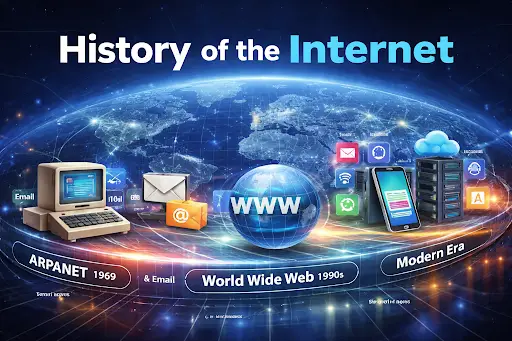
ARPANET and the Birth of Modern Networking
The story of who invented the internet almost always begins with ARPANET, a project funded by DARPA, the Defense Advanced Research Projects Agency, in the United States. ARPANET was created to allow research institutions to share information even if parts of the network were destroyed or disconnected, a priority influenced heavily by Cold War era concerns.
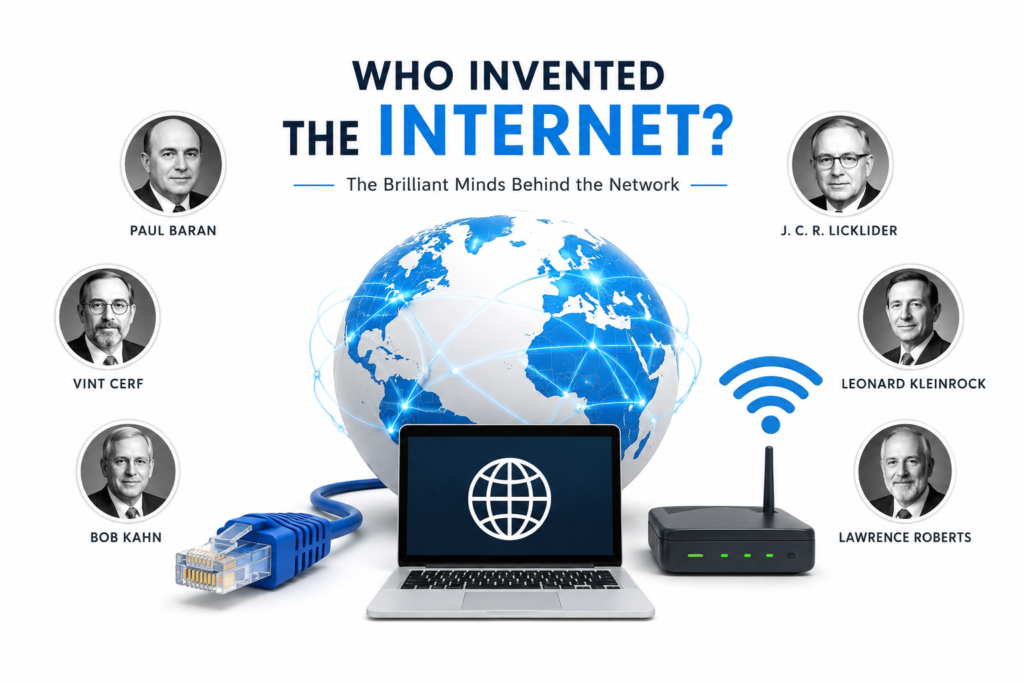
Leonard Kleinrock, a professor at UCLA, played a foundational role by developing the theory of packet switching. Instead of sending data as one continuous stream, packet switching broke information into smaller packets that could travel independently and reassemble at their destination. This idea became the backbone of internet infrastructure and remains central to how the internet works even today.
In 1969, the first ARPANET connection was successfully established between UCLA and Stanford Research Institute using an early device called the IMP, or Interface Message Processor. This moment is often cited as the first true step toward answering who invented the internet, since it proved that machines in different locations could actually communicate.
Vint Cerf and Bob Kahn: The Architects of TCP/IP
While ARPANET proved that networking was possible, it lacked a universal language that could connect different types of networks. This is where Vint Cerf and Bob Kahn changed everything. Together, they developed the TCP/IP protocol, a set of rules that allowed different computer networks to communicate with one another reliably.
TCP/IP explained simply, it works like a postal system for data. Information is broken into packets, labeled with an address, sent across the network and reassembled correctly at the other end. Vint Cerf and Bob Kahn are frequently credited as the true fathers of the internet because their protocol made it possible for isolated networks to merge into one connected system.
Anyone researching who invented the internet quickly discovers that Cerf and Kahn’s work in the 1970s was the turning point that transformed a single experimental network into a scalable, global system.
Understanding the OSI Model and Networking Structure
As networking expanded, engineers needed a standardized way to describe how data traveled between devices. This led to the development of the OSI model explained through seven distinct layers, from physical cables to application level software. Although the OSI model was created later as a teaching and design framework, it helped standardize networking concepts worldwide and made troubleshooting far easier for engineers.
Understanding this structure is essential for anyone who wants a deeper answer to who invented the internet, since modern internet infrastructure still relies on these layered principles for consistency and compatibility across devices and networks.
Tim Berners-Lee and the Creation of the World Wide Web
A common misconception is confusing the internet with the World Wide Web. While the internet is the physical and logical network of connected devices, the web is a system built on top of it. In 1989, while working at CERN, Tim Berners-Lee invented the World Wide Web, introducing hypertext, web pages and the very first web browser.
Berners-Lee’s invention made information sharing simple for non technical users, transforming the internet from a tool used mainly by scientists and the military into something the general public could access. Many people asking who invented the internet are actually referring to this moment, since the web is what made the internet visible and usable in everyday life.
NSFNET and the Expansion of Internet Infrastructure
During the 1980s, the National Science Foundation launched NSFNET, a network that connected university computer centers across the United States. NSFNET expanded network nodes far beyond the original ARPANET, allowing more institutions to join and dramatically increasing traffic and demand.
This expansion required significant upgrades to internet infrastructure, including faster connections, better routing systems and standardized protocols. NSFNET is often overlooked in the story of who invented the internet, yet it played a critical role in transitioning the network from a research project into a public utility capable of supporting millions of users.
How the Internet Works Today
Understanding who invented the internet becomes clearer once you understand how the modern network actually functions. Every device connected to the internet has a unique identifier called an IP address, which allows data to be routed correctly. When you visit a website, your request travels through multiple network nodes, often passing through a router that directs traffic efficiently between networks.
Data security also plays a major role in modern networking. Technologies protecting users include encryption protocols and systems that filter unwanted traffic, forming a critical layer of network security for both individuals and organizations. Without these protections, the open structure that made the internet successful could easily be exploited.
Why No Single Person Invented the Internet
One of the most important truths in answering who invented the internet is that no single individual deserves full credit. Leonard Kleinrock developed the theoretical foundation. Vint Cerf and Bob Kahn built the protocol that unified networks. Tim Berners-Lee created the web layer that made it accessible. Thousands of engineers, researchers and institutions contributed pieces of code, hardware and infrastructure over decades.
This collaborative history is what makes the internet so resilient. It was never designed by one company or one government alone. Instead, it evolved through shared research, open standards and continuous innovation, which is exactly why the network continues to grow and adapt even today.
The Future of Internet Infrastructure
As demand for faster and more reliable connections increases, the future of networking continues to evolve. Cloud computing, satellite based connectivity and next generation protocols are reshaping how data travels across the globe. Engineers are continuously improving internet infrastructure to support artificial intelligence, streaming services and billions of connected devices worldwide.
Understanding who invented the internet gives valuable context for appreciating how far networking technology has come, and how much further it is likely to go in the coming decades.
Frequently Asked Questions (FAQs)
Who really invented the internet?
No single person invented the internet. Leonard Kleinrock developed packet switching theory, Vint Cerf and Bob Kahn created the TCP/IP protocol, and Tim Berners-Lee later invented the World Wide Web. Together, their work forms the foundation of the modern internet.
When was the internet invented?
The foundational work began with ARPANET in 1969, though the internet as we know it developed gradually through the 1970s and 1980s with the creation of TCP/IP and continued to expand with the World Wide Web in 1989.
Is Tim Berners-Lee the inventor of the internet?
Tim Berners-Lee invented the World Wide Web, not the internet itself. The internet existed before the web and serves as the underlying network that the web operates on.
What was the first computer network called?
The first major computer network was ARPANET, developed by DARPA in the United States. It successfully connected UCLA and Stanford Research Institute in 1969, marking a major milestone in networking history.
Conclusion
So, who invented the internet? The honest answer is that it was built by many brilliant minds working together over several decades. From Leonard Kleinrock’s early theories on packet switching, to Vint Cerf and Bob Kahn’s creation of TCP/IP, to Tim Berners-Lee’s invention of the World Wide Web, the internet is a product of collective innovation rather than a single breakthrough moment.
Understanding this history helps us appreciate the internet infrastructure we rely on every single day, and it reminds us that some of the world’s greatest achievements come not from one genius, but from a community of dedicated thinkers solving problems together.