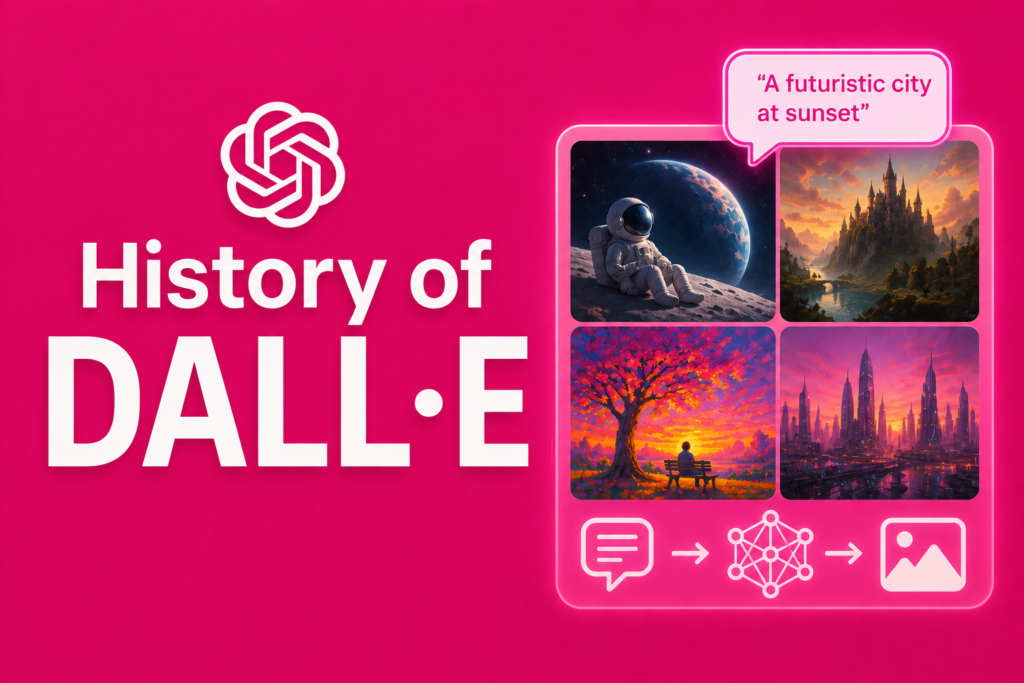
In January 2021, OpenAI introduced a system that could take a sentence like “an armchair in the shape of an avocado” and produce an image matching that description, an image that had never existed before, of a concept that had never been photographed because it did not exist in the physical world. The history of dall·e is the story of how that capability came to be, how it evolved through multiple major versions, and how it became one of the most recognizable names in the broader history of ai image generation.
What DALL-E Set Out to Do
Before DALL-E, AI image generation systems, including those built on Generative Adversarial Networks, could produce realistic images, but generally within narrow categories the network had been specifically trained on, faces, landscapes, or particular object types. The question DALL-E was designed to answer was different and more ambitious: could a single system generate images across an essentially unlimited range of subjects, simply by describing what you wanted in natural language?
History of zero shot text to image generation captures this ambition precisely. Zero shot, in this context, means generating images for descriptions the system had never seen paired with an image during training, combining familiar concepts in novel ways based on language understanding rather than memorized examples.
The Name: DALL-E Portmanteau Origin
DALL-E portmanteau name origin is a small but telling detail about the project’s identity. The name combines Salvador Dalí and WALL-E, referencing both the surrealist painter known for dreamlike, impossible imagery, and the Pixar robot character. This combination captured something essential about the system’s purpose: producing imaginative, often surreal visual content through an artificial intelligence system, blending artistic creativity with computational technology in a single memorable name.
DALL-E 1: The First Release (2021)
OpenAI DALL-E release history timeline begins in January 2021, when OpenAI first introduced DALL-E publicly through a research blog post and accompanying paper. The original DALL-E was built around a Discrete Variational Autoencoder (dVAE), a generative architecture related to the broader family of Variational Autoencoders that had been explored in earlier history of ai image generation research.
OpenAI image generator parameter scale history places the original DALL-E at approximately 12 billion parameter weights, a substantial model size for its time, trained on a large dataset of text-image pairs. This scale was part of what allowed DALL-E to demonstrate such a wide range of generation capabilities, from realistic objects to clearly impossible or surreal combinations of concepts.
The original DALL-E worked by treating image generation as similar to a language modeling problem. Just as a language model predicts the next word in a sequence based on previous words, DALL-E was trained to predict the next piece of an image’s compressed representation based on both the text description and the image content generated so far. This approach, while computationally intensive, allowed the model to learn rich relationships between language and visual content.
The original demonstrations of DALL-E captured enormous attention precisely because of how well it handled novel combinations, generating coherent, often charming images for prompts describing things that had never existed and were certainly never photographed, demonstrating a kind of generalization that felt qualitatively different from earlier generative systems.
CLIP: The Partner Technology
Although not DALL-E itself, Contrastive Language-Image Pre-training, commonly known as CLIP, was developed by OpenAI around the same time and became deeply intertwined with the history of dall·e. CLIP was trained on a massive dataset of images paired with text captions, learning to understand how visual content and language descriptions relate to each other.
CLIP latent steering became an important technique in later versions of DALL-E, using CLIP’s understanding of the relationship between text and images to help guide and refine the generation process, helping ensure that generated images more closely matched the intent of a given text prompt. This connection between DALL-E and CLIP also reflects the broader trend toward the history of multimodal AI, where systems increasingly combine understanding across both language and vision.
DALL-E 2: A Major Leap Forward (2022)
DALL-E 2 diffusion model upgrade history marks a significant architectural shift in the history of dall·e. Released in 2022, DALL-E 2 moved away from the discrete autoencoder approach of the original DALL-E toward a diffusion-based architecture, the same general family of techniques that would soon power the history of stable diffusion and influence the history of midjourney.
This architectural shift brought substantial improvements in image quality, resolution, and prompt fidelity optimization, the degree to which generated images accurately reflected the specific details described in a text prompt. DALL-E 2 images were noticeably more detailed, more coherent, and more photorealistic when appropriate, compared to the often more abstract or stylized outputs of the original model.
Resolution scale upgrades were a notable practical improvement with DALL-E 2, allowing for higher resolution outputs that were more usable for practical creative applications, from concept art to marketing materials to personal creative projects.
Inpainting, Outpainting, and Editing Capabilities
Image inpainting and outpainting represented some of DALL-E 2’s most practically significant features. Inpainting allowed users to select a specific region of an existing image and have DALL-E generate new content for that region based on a text description, effectively editing parts of an image while leaving the rest unchanged. This made DALL-E useful not just for generating entirely new images, but for modifying existing ones in targeted ways.
Uncrop and variation features extended this further. Outpainting allowed users to extend an image beyond its original borders, generating new content that extended the scene in a way consistent with the existing image. Variation features allowed users to generate multiple alternative versions of a given image, exploring different interpretations or stylistic directions while maintaining some connection to the original.
These editing capabilities moved DALL-E beyond pure generation into a broader creative tool, more analogous to traditional image editing software but powered by generative AI rather than manual pixel manipulation.
DALL-E 3 and ChatGPT Integration (2023)
DALL-E 3 ChatGPT integration development represents the most recent major chapter in the history of dall·e. Released in 2023, DALL-E 3 brought further improvements in image quality and, perhaps more significantly, much stronger prompt fidelity optimization, meaning generated images more reliably reflected the specific details, including text rendered within images, spatial relationships between objects, and complex compositional instructions, described in a prompt.
OpenAI text to image API launch history reflects how DALL-E became increasingly integrated into broader OpenAI products. DALL-E 3 was made available not just as a standalone tool, but integrated directly into ChatGPT, allowing users to generate images through natural conversation, refining and iterating on image concepts through a back-and-forth dialogue rather than crafting a single, carefully worded prompt in isolation.
Synthetic data captioning played an important role in DALL-E 3’s training process. Rather than relying solely on existing image captions from the internet, which are often brief, generic, or inaccurate, OpenAI used AI systems to generate more detailed and accurate captions for training images, helping DALL-E 3 learn more precise relationships between detailed language descriptions and corresponding visual content.
Content Provenance and Responsible Use
Content provenance metadata (C2PA) became an increasingly important consideration as DALL-E and similar systems became more capable and more widely used. As AI-generated images became increasingly difficult to distinguish from photographs, particularly with DALL-E 3’s improved photorealism, the need for ways to indicate that an image had been AI-generated became more pressing.
This concern connects directly to broader issues explored in the history of deepfakes and facial recognition and privacy, where the increasing realism of AI-generated content raises questions about misinformation, consent, and trust in visual media. Content provenance approaches, which embed metadata indicating an image’s origin and editing history, represent one approach to addressing these concerns, though adoption and standardization across the industry remains an ongoing process.
Impact of DALL-E on the Digital Art Industry
Impact of DALL-E on the digital art industry has been significant and, at times, contentious. DALL-E and similar tools have been adopted by artists, designers, and creative professionals as tools for rapid concept generation, ideation, and exploration, allowing creative work that previously might have taken hours of manual effort to be explored in seconds.
At the same time, these tools have raised significant questions within creative communities about training data, attribution, and the economic impact of AI-generated content on professional artists. These debates connect to broader conversations happening across the history of ai image generation more generally, as the technology’s capabilities have expanded faster than the social, legal, and economic frameworks for addressing its implications.
History of OpenAI image generation service, viewed as a whole, reflects a broader pattern within the deep learning transformed computer vision narrative: rapid technical progress, enthusiastic adoption, and ongoing, often unresolved, debates about the broader implications of that progress.
Frequently Asked Questions
When was DALL-E first released?
DALL-E was first introduced by OpenAI in January 2021, demonstrating the ability to generate images from text descriptions using a discrete variational autoencoder architecture trained on a large dataset of text-image pairs.
What does the name DALL-E mean?
DALL-E is a portmanteau combining Salvador Dalí, the surrealist painter known for dreamlike imagery, and WALL-E, the Pixar robot character, reflecting the system’s combination of artistic creativity and artificial intelligence technology.
How is DALL-E 2 different from the original DALL-E?
DALL-E 2, released in 2022, moved from the discrete autoencoder architecture of the original DALL-E to a diffusion-based architecture, similar to the approach used by Stable Diffusion. This brought significant improvements in image quality, resolution, and how accurately generated images matched the details of a text prompt, and also introduced inpainting, outpainting, and variation features for editing images.
How does DALL-E 3 integrate with ChatGPT?
DALL-E 3, released in 2023, was integrated directly into ChatGPT, allowing users to generate and refine images through natural conversation. This allows for iterative image creation, where a user can describe an image, see the result, and then ask for adjustments in subsequent messages, rather than needing to craft a single perfect prompt.
What is the relationship between DALL-E and CLIP?
CLIP, or Contrastive Language-Image Pre-training, is a separate model developed by OpenAI that learns relationships between images and text descriptions. CLIP has been used in connection with DALL-E to help guide and refine the image generation process, helping ensure generated images align closely with the intent of a text prompt, reflecting the broader trend toward multimodal AI systems that combine language and vision understanding.
Conclusion
The history of dall·e traces a path from an ambitious research demonstration in 2021 to a deeply integrated creative tool used by millions of people through ChatGPT by 2023. Each major version brought significant architectural changes, from the original discrete autoencoder approach to the diffusion-based architecture of DALL-E 2 and the improved prompt fidelity of DALL-E 3, while consistently pushing forward what it meant for a machine to create images directly from language.
DALL-E’s influence extends throughout the broader landscape of computer vision technology, demonstrating how understanding developed for image recognition and analysis could be turned toward generation and creativity. Understanding the history of dall·e means understanding one of the clearest examples of how quickly AI capabilities can move from research curiosity to a tool used daily by millions of people around the world.