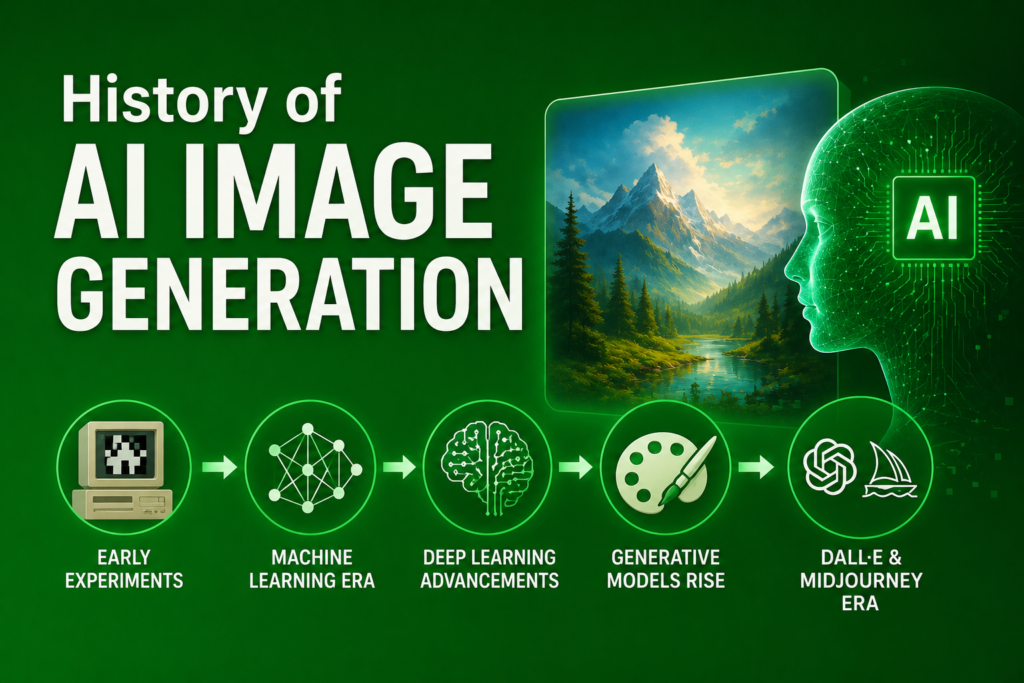
For most of computer vision’s history, the goal was understanding images, identifying what was in them, where objects were located, and what a scene meant. The history of ai image generation flips that goal on its head. Instead of asking machines to interpret existing images, researchers asked a much stranger question: could a machine create images that had never existed before? This article traces that question from its earliest, often unintentional beginnings, through the architectures that made generation possible, to the text-to-image systems that have become a cultural phenomenon.
Computational Creativity Before Deep Learning
Computational creativity as a concept predates modern AI image generation by decades. Early computer art experiments, dating back to the 1960s, used algorithmic rules and mathematical functions to produce visual patterns, often abstract geometric designs generated by simple programs.
These early efforts were closely tied to the broader history of computer vision and the history of image processing, since generating an image and processing one share underlying mathematical foundations involving pixels, transformations, and digital representations. However, these early systems were not learning to generate images in any meaningful sense. They followed fixed rules and parameters set by human programmers, producing variations within tightly constrained possibilities rather than learning what images should look like from examples.
The history of ai image generation in any sense involving learning from data would have to wait for the broader developments in neural networks and, eventually, the deep learning transformed computer vision revolution that began around 2012.
Neural Style Transfer: Art Meets Algorithms (2015)
One of the first widely noticed examples of AI generating genuinely novel visual content came through neural style transfer, introduced in 2015. This technique used a convolutional neural network, originally trained for image classification tasks related to the history of imagenet, in an unexpected way: rather than classifying an image, the network was used to separate an image’s content from its artistic style.
By combining the content of one image with the style of another, often a famous painting, neural style transfer could produce images that looked like photographs reimagined in the brushwork of Van Gogh or Picasso. This was not generation from nothing, the system needed an existing photograph as its starting point, but it represented a striking demonstration that neural networks, trained for one purpose, could be repurposed for genuinely creative tasks.
DeepDream by Google (2015) emerged around the same time and took a related but different approach. Rather than blending content and style from two images, DeepDream amplified and exaggerated patterns that a trained image classification network already detected within an image, often producing surreal, dreamlike, and sometimes unsettling visual hallucinations. DeepDream captured significant public attention precisely because its outputs looked so unlike anything a traditional computer program might produce, hinting at the strange, often unpredictable creative potential hidden within neural networks trained for entirely different purposes.
Generative Adversarial Networks Change the Game (2014 – 2018)
History of deep learning image creators truly begins with Generative Adversarial Networks (GANs), introduced by Ian Goodfellow and collaborators in 2014. GANs represented a fundamentally new approach to generation, built around a clever adversarial setup involving two neural networks competing against each other.
One network, the generator, attempted to create images. The other network, the discriminator, attempted to distinguish between real images from a training dataset and fake images produced by the generator. Through this adversarial process, the generator gradually improved at producing images realistic enough to fool the discriminator, while the discriminator simultaneously improved at detecting increasingly subtle flaws, pushing the generator to improve further still.
Major breakthroughs in AI image models followed quickly. StyleGAN development history, beginning around 2018 with research from NVIDIA, introduced architectural innovations that allowed GANs to generate remarkably realistic human faces, among other subjects, with fine control over specific visual attributes. StyleGAN and its successors became widely known for producing faces of people who do not exist, images realistic enough that distinguishing them from photographs of real people became genuinely difficult for human observers.
Variational Autoencoders (VAEs) represented another important generative architecture developed during this period, offering a different mathematical approach to learning compressed representations of images that could then be used to generate new examples. While VAEs generally produced somewhat blurrier results than GANs for image generation specifically, the underlying ideas, learning a compressed latent representation of data, influenced later generative architectures significantly.
Text-to-Image Synthesis: Connecting Words and Pictures (2021)
Text-to-image synthesis represents perhaps the single most consequential development in the entire history of ai image generation. The history of dall·e, beginning with OpenAI’s release in 2021, demonstrated that a system could take a written description, a sentence describing a scene, an object, or a concept, and generate an image matching that description, often with surprising creativity and coherence.
This capability depended on Contrastive Language-Image Pre-training (CLIP), also developed by OpenAI and released around the same time. CLIP was trained on a massive dataset of images paired with text descriptions, learning to understand how visual content and language relate to each other. This connection between language understanding and visual understanding represented a significant step toward the broader history of multimodal AI that would become increasingly important throughout the 2020s.
DALL-E’s ability to combine concepts in novel ways, generating images of things that had never existed and were not present in any training image directly, captured enormous public attention and represented a qualitative shift in what AI image generation systems could do. Rather than simply transforming or recombining existing images, these systems appeared to genuinely understand, at some level, the relationship between concepts described in language and how those concepts should look visually.
Diffusion Models Take Over (2022)
From GANs to diffusion models timeline marks one of the most significant architectural shifts in the history of ai image generation. Diffusion models work through a process that, at first glance, seems almost backward: they are trained to gradually remove noise from an image, starting from pure random noise and progressively refining it, step by step, into a coherent image.
The history of stable diffusion, released in 2022, brought this approach to a wide audience by making a high-quality diffusion model available as open source software that could run on consumer graphics hardware, dramatically lowering the barrier to entry for AI image generation compared to earlier systems that required substantial cloud computing resources.
Latent diffusion architecture, the specific approach used by Stable Diffusion, performed the noise removal process not directly on pixel-space rendering of the full image, but within a compressed latent representation of the image, similar in spirit to the latent representations used by Variational Autoencoders. This made the computationally expensive diffusion process significantly more efficient, since the compressed representation contained far fewer values to process than the full pixel grid of a high-resolution image.
The history of midjourney, which developed alongside Stable Diffusion during 2022, took a different approach to deployment, offering AI image generation through a chat-based interface that made the technology accessible to a broad audience without requiring any technical setup. Midjourney became particularly well known for producing images with a distinctive, often painterly aesthetic quality, demonstrating that different implementations of similar underlying diffusion techniques could produce noticeably different stylistic outputs.
The Cultural Impact of AI Image Generation (2021 – 2026)
AI image generation software milestones throughout this period extended far beyond the technical architectures themselves. Tools based on DALL-E, Stable Diffusion, and Midjourney became widely used across creative industries, marketing, game development, and personal creative projects, fundamentally changing how visual content could be produced and by whom.
Chronological history of neural network art shows a rapid acceleration in both capability and accessibility. What had required substantial machine learning expertise and computational resources in the early days of GANs became, within just a few years, accessible through simple text prompts typed into a chat interface, available to anyone with an internet connection.
This accessibility also brought significant attention to the history of deepfakes, a related but distinct application of generative AI techniques focused specifically on realistically altering or fabricating images and videos of real people. The same underlying generative architectures that enabled exciting creative applications also raised serious concerns about misinformation, consent, and the increasing difficulty of distinguishing genuine images and videos from artificially generated ones, concerns that connect directly to the broader facial recognition and privacy debates occurring across computer vision more generally.
Frequently Asked Questions
What was the first AI image generation technology?
Early computer art experiments using algorithmic rules date back to the 1960s, though these were not learning-based systems in the modern sense. The first learning-based generative approach widely recognized in the history of ai image generation is the Generative Adversarial Network, introduced in 2014, which used a competing generator and discriminator network to learn to produce realistic images.
How does DALL-E generate images from text?
DALL-E generates images from text by combining language understanding, developed through systems like CLIP that learn relationships between images and their text descriptions, with generative architectures capable of producing images matching those descriptions. This allows the system to interpret a written prompt and generate a corresponding image, even for combinations of concepts never seen together during training.
What is the difference between GANs and diffusion models?
GANs use two competing neural networks, a generator that creates images and a discriminator that tries to distinguish real from generated images, with both networks improving through this competition. Diffusion models work differently, learning to gradually remove noise from an image, starting from random noise and progressively refining it into a coherent image. Diffusion models, popularized by Stable Diffusion in 2022, have generally become the dominant approach for high-quality text-to-image generation.
Why was Stable Diffusion such an important release?
Stable Diffusion was important because it was released as open source software capable of running on consumer graphics hardware, dramatically lowering the barrier to entry for AI image generation. This allowed a much broader community of developers, artists, and researchers to experiment with, modify, and build upon the technology compared to earlier systems that required significant cloud computing resources.
How is AI image generation connected to deepfakes?
AI image generation and the history of deepfakes share underlying generative technologies, including GANs and diffusion models. While AI image generation is often used for creative purposes like art and design, the same techniques can be applied to realistically alter or fabricate images and videos of real people, raising significant concerns about misinformation and consent that are distinct from, but related to, the creative applications of these technologies.
Conclusion
The history of ai image generation is a story of machines moving from following fixed rules to learning, from data, what images should look like, and eventually to understanding the relationship between language and visual content well enough to create images from written descriptions alone. From early algorithmic art and neural style transfer, through the competitive dynamics of GANs, to the diffusion models behind Stable Diffusion and Midjourney, each step represented a genuine expansion of what machines could create.
This history is deeply intertwined with the broader story of computer vision technology, since the same architectures, datasets, and insights that allowed machines to understand images also, eventually, allowed them to generate entirely new ones. Understanding the history of ai image generation means understanding how a field built around interpretation became, almost unexpectedly, a field capable of genuine creation.