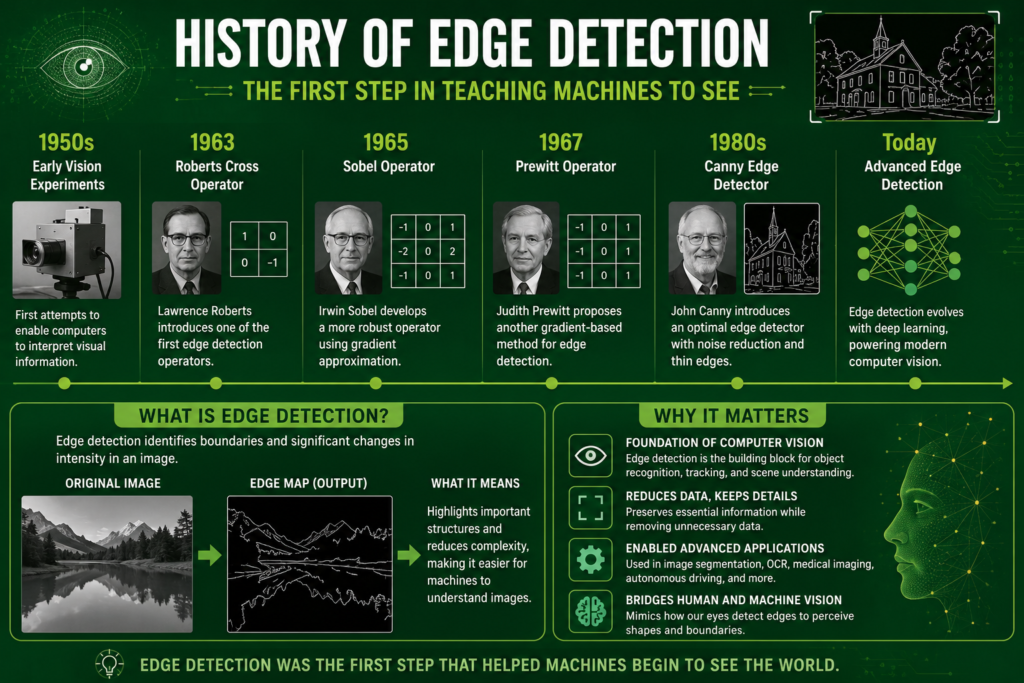
Every object a computer vision system recognizes begins with a boundary. Before a machine can identify a face, a car, or a tumor, it first needs to know where one thing ends and another begins. The history of edge detection is the story of how researchers solved this seemingly simple but actually profound problem, and in doing so, built the foundation for nearly every computer vision technique that followed. This article traces that history from the earliest mathematical operators to the algorithms still used in production systems today.
What Edge Detection Actually Does
An edge in an image is a place where brightness changes sharply, usually because one object ends and another begins, or because of a shadow, texture change, or surface boundary. Mathematically, edges correspond to spatial intensity discontinuities, points where the value of neighboring pixels changes abruptly rather than gradually.
The history of edge detection is fundamentally about finding mathematical ways to locate these discontinuities reliably, even in the presence of noise, varying lighting, and complex textures. Early researchers realized that if a machine could reliably find edges, it would have a foundation for nearly everything else: identifying shapes, segmenting objects, tracking motion, and eventually recognizing what it was looking at.
The Earliest Ideas (1960 – 1968)
The history of edge detection begins with Lawrence Roberts at MIT. His 1963 Ph.D. thesis on machine perception of three-dimensional solids included one of the very first edge detection operators, now known as the Roberts Cross operator. It worked by computing a simple approximation of the image gradient vectors using small 2×2 pixel windows, highlighting regions where brightness changed rapidly between diagonally adjacent pixels.
Roberts’s operator was simple and computationally cheap, which mattered enormously given the limited processing power available at the time. It was also noisy and imprecise compared to later methods, but it proved the core concept: a small mathematical filter applied across an image could highlight boundaries automatically, without a human marking them by hand.
This early work was part of the broader first computer vision experiments of the era, which focused on simple geometric scenes under controlled lighting. The block world approach made edge detection tractable because the edges in those images were sharp, high-contrast, and predictable, very different from the messy edges found in natural photographs.
Gradient Operators Take Shape (1968 – 1970)
The history of edge detection took a significant step forward in 1968 when Irwin Sobel (1968), then a graduate student at Stanford, introduced what became known as the Sobel operator. Rather than using a tiny 2×2 window like Roberts’s approach, the Sobel operator used 3×3 convolution kernels to estimate the image gradient in both the horizontal and vertical directions.
The Sobel operator combined a smoothing effect with differentiation, making it noticeably more robust to noise than earlier methods. By computing the gradient magnitude and direction at each pixel, the Sobel operator could highlight edges while also indicating which way they ran, information that later algorithms would use for more sophisticated processing.
Around the same period, the Prewitt operator was developed using a similar approach with slightly different kernel weights. Prewitt edge detection history runs in parallel with the Sobel story, and the two operators are often taught together as examples of simple gradient-based edge detection. Both methods are grounded in differential geometry, the branch of mathematics that studies how functions change across a surface, applied here to the two-dimensional surface of pixel intensity values.
These gradient operators became standard tools in early image processing software throughout the 1970s. They were fast, easy to implement, and good enough for many practical tasks, even though they struggled with noisy images and produced edges that were often thicker and less precise than what later algorithms would achieve.
Smoothing Before Detecting: The Marr-Hildreth Approach (1980)
By the late 1970s, researchers had recognized a fundamental tension in edge detection. Operators sensitive enough to detect subtle edges were also sensitive to noise, producing false edges everywhere. Operators robust to noise tended to blur or miss real edges. Something needed to bridge this gap.
David Marr and Ellen Hildreth proposed an elegant solution in 1980: smooth the image first, then look for edges in the smoothed result. Their approach applied a Gaussian smoothing filter to reduce noise, then computed the Laplacian of Gaussian (LoG), a second-derivative operator that responds strongly at points where intensity changes rapidly.
Edges in the Marr-Hildreth approach correspond to zero crossing detection in the LoG response, points where the second derivative changes sign. This was a conceptually elegant idea because it connected directly to David Marr’s broader theory of vision, in which the primal sketch, an early representation built from edges and boundaries, served as the foundation for all later visual processing.
The Marr-Hildreth method was an important milestone in the history of edge detection because it introduced the idea of multi-scale analysis, applying smoothing at different levels to detect edges of different sizes and types. This idea of analyzing images at multiple scales would echo throughout the rest of computer vision history.
The Canny Edge Detector: A Defining Moment (1986)
If there is one single algorithm most associated with the history of edge detection, it is the one developed by John F. Canny (1986) while he was a graduate student at MIT. The Canny edge detector was designed from first principles around three explicit goals: good detection of real edges, good localization of where those edges actually are, and a single response per edge rather than multiple overlapping detections.
The Canny algorithm works in several carefully designed stages. First, it applies a Gaussian smoothing filter to reduce noise, similar to the Marr-Hildreth approach. Second, it computes image gradient vectors using a Sobel-like operator to find the magnitude and direction of intensity changes at each pixel. Third, it applies non-maximum suppression, a process that thins out the detected edges by keeping only the pixels that represent local maxima in gradient magnitude along the direction of the gradient, producing thin, precise edge lines rather than thick blurry bands.
The final and most distinctive stage is hysteresis thresholding. Rather than using a single threshold to decide which gradient values count as edges, Canny’s algorithm uses two thresholds. Pixels with gradient values above the high threshold are immediately accepted as edges. Pixels below the low threshold are rejected. Pixels in between are accepted only if they are connected to a pixel already accepted as an edge. This clever approach allows the algorithm to follow faint edges that connect to strong ones, while rejecting isolated noise.
The result was an algorithm that produced cleaner, more accurate, and more useful edge maps than anything that came before it. The Canny edge detector became, and remains, one of the most widely used algorithms in image processing, included in virtually every computer vision library, including the history of OpenCV, where it remains a default tool for countless applications.
Edge Detection in the Era of Feature-Based Vision (1990 – 2010)
Through the 1990s and 2000s, edge detection became a building block rather than an end in itself. Researchers built more sophisticated systems on top of edge maps, using them to identify corners, contours, and shapes that fed into recognition pipelines.
High pass filtering for images, a broader category of techniques that includes edge detection as a special case, became a standard preprocessing step in many computer vision pipelines. Edges extracted from images were used to initialize segmentation algorithms, to align images for stereo vision and panorama stitching, and to detect simple shapes like lines and circles using techniques such as the Hough transform.
The history of pattern recognition during this period often relied on edge-derived features as inputs to classifiers. A face detector, for example, might use edge information to identify the rough outline of eyes, nose, and mouth before applying more specific classification logic.
Even as more sophisticated feature descriptors like SIFT emerged, which captured richer local information than simple edges, the underlying mathematics of gradient computation and intensity discontinuities remained central. SIFT and similar descriptors are, at their core, built on top of gradient information very similar to what Sobel and Canny computed decades earlier.
Edge Detection in the Deep Learning Era (2012 – 2026)
When deep learning transformed computer vision after 2012, many assumed that hand-designed edge detectors like Canny would become obsolete, replaced entirely by learned features. The reality has been more nuanced.
Convolutional neural networks do, in fact, learn edge-like filters automatically in their earliest layers. Visualizations of the first layer of trained networks like AlexNet consistently show filters that resemble oriented edge detectors, very similar in spirit to the Sobel and Prewitt operators developed half a century earlier. In a sense, deep learning rediscovered edge detection as a useful first step, but learned the specific filters from data rather than deriving them mathematically.
At the same time, classical edge detection algorithms like Canny remain heavily used in practical applications, particularly where computational efficiency matters, where interpretability is important, or where a quick preprocessing step is needed before a more complex deep learning pipeline. Many computer vision in manufacturing systems still rely on classical edge detection for tasks like measuring part dimensions or detecting simple defects, because these methods are fast, predictable, and do not require training data.
Modern vs traditional edge detection history shows an interesting pattern: rather than one approach completely replacing the other, both coexist, often in the same pipeline. A modern system might use a deep neural network for high-level object recognition while still relying on classical edge detection for precise geometric measurements.
Frequently Asked Questions
What is the most important algorithm in the history of edge detection?
The Canny edge detector, published by John Canny in 1986, is widely considered the most important and influential algorithm in the history of edge detection. Its combination of Gaussian smoothing, gradient computation, non-maximum suppression, and hysteresis thresholding produced results that were significantly better than earlier methods and remain in active use today.
What is the difference between the Sobel and Canny edge detectors?
The Sobel operator computes image gradients using a simple 3×3 convolution kernel and applies a single threshold to identify edges. The Canny edge detector builds on similar gradient computation but adds Gaussian smoothing before gradient calculation, non-maximum suppression to thin edges, and a two-threshold hysteresis process to produce cleaner, more connected edge maps. Canny generally produces more accurate results but requires more computation.
Are edge detection algorithms still used today?
Yes. Despite the rise of deep learning, classical edge detection algorithms like Canny and Sobel remain widely used in industrial inspection, robotics, medical imaging preprocessing, and any application where fast, interpretable, and training-free edge information is needed. They are also conceptually related to the filters that convolutional neural networks learn automatically.
How does edge detection relate to object detection?
Edge detection identifies boundaries within an image, while the history of object detection is concerned with locating and classifying entire objects. Early object detection systems often used edges as a first step, grouping them into shapes and regions that could then be matched against object templates. Modern deep learning based object detectors learn their own internal representations, but these representations still rely on edge-like information in their early processing layers.
What is non-maximum suppression in edge detection?
Non-maximum suppression is a step used in algorithms like Canny to thin out detected edges. After computing the gradient magnitude and direction at each pixel, the algorithm checks whether each pixel’s gradient magnitude is the largest among its neighbors along the gradient direction. If it is not the largest, the pixel is suppressed, leaving only thin, single-pixel-wide edge lines rather than thick bands of high-gradient pixels.
Conclusion
The history of edge detection is, in many ways, the history of computer vision in miniature. It begins with simple, computationally cheap operators developed by researchers working with extremely limited hardware. It progresses through increasingly sophisticated mathematical approaches grounded in differential geometry and signal processing. It reaches a defining moment with the Canny algorithm in 1986, which remains in use to this day. And it continues into the deep learning era, where the same fundamental insight, that meaningful information lives at points of intensity discontinuity, gets rediscovered automatically by neural networks trained on millions of images.
Every system built on computer vision technology today, whether it is a self-driving car, a medical imaging tool, or a smartphone camera, depends on some form of edge information at its foundation. Understanding the history of edge detection is understanding how the field learned to ask its very first question: where does one thing end and another begin?