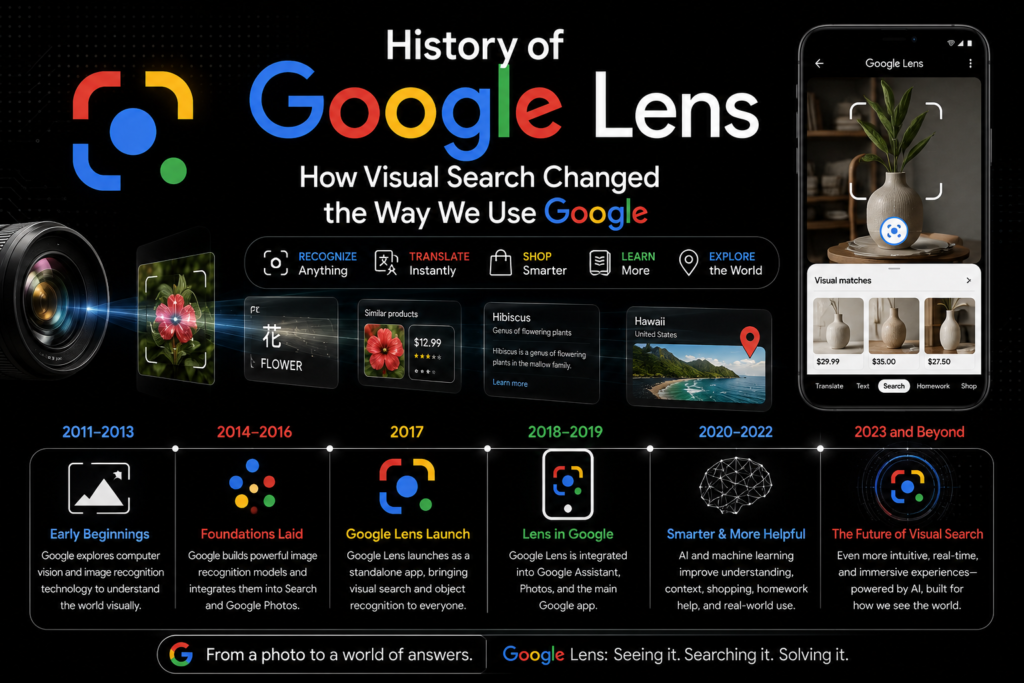
The true history of google lens is a mesmerizing journey of technological breakthroughs and relentless innovation. For decades, engineers dreamed of a tool that could interpret the physical world exactly as human eyes do. This aspiration drove much of the history of computer vision, culminating in the incredible tools we take for granted today. Through the lens of our smartphones, we can now interact with our physical surroundings seamlessly. This was not an overnight miracle. The Evolution of Google visual search technology took immense resources, brilliant minds, and an ever evolving digital infrastructure to finally master Semantic image understanding. Understanding the history of google lens means exploring how artificial intelligence shifted from being a massive, room sized calculator into a sleek, portable assistant resting comfortably in our pockets. With every update, Google brought us closer to a future where our camera lenses serve as an interactive query box, bridging the massive gap between physical reality and digital knowledge.
Early Foundations (1990 – 2010)
Before Google Lens became a household name, early researchers had to conquer the immense difficulties of digitizing visual data. The history of image processing was incredibly slow, as computers struggled to distinguish even basic shapes or contrasting shadows. Early experiments required vast amounts of processing power just to verify simple patterns, let alone perform comprehensive object recognition in a chaotic, unpredictable environment. During this early era, engineers focused heavily on establishing the basic building blocks required to interpret an image, essentially figuring out how to translate a photograph into a binary language that a microprocessor could read and calculate. These pioneering steps were fundamentally crucial because they established the core mathematical rules that modern machine learning algorithms still follow today.
As these initial hurdles were slowly overcome, the concept of scanning physical text began to take a practical shape. The history of optical character recognition showcases how developers painstakingly trained software to distinguish between different letters, numbers, and fonts printed on a piece of paper. This foundational work laid the absolute groundwork for How Google Lens changed mobile text extraction several decades later. Early Optical Character Recognition (OCR) pipeline systems were quite rigid, requiring perfect lighting and crisp, standardized fonts to function correctly. Without these early, frustrating experiments, the seamless, real time translations we enjoy today would be completely impossible. Dedicated researchers spent years refining these text algorithms, ensuring they could eventually handle sloppy handwriting, strange typography, and poorly lit signs.
The Goggles Era (2010 – 2017)
The next major milestone in the history of google lens involves its direct and famous predecessor. The Google Goggles vs Google Lens development history perfectly illustrates how rapidly the tech industry was moving. Released in 2010, Google Goggles was a remarkably ambitious project for its time. It allowed users to capture a photo of a famous landmark, a piece of artwork, or a product barcode, and the app would try to retrieve relevant information. While it featured rudimentary Barcode and QR decoding, the technology was still heavily limited by the hardware capabilities of early smartphones and notoriously slow internet connections. Processing a single image could take upwards of twenty seconds, which felt like an eternity for mobile users expecting instant results. Users often found the experience magical but highly inconsistent.
Despite its obvious technical limitations and eventual stagnation, Goggles successfully proved that a massive consumer demand existed for visual query tools. Developers learned critical lessons about the sheer complexity of the real world, realizing that future tools needed a completely redesigned Machine learning architecture behind Google Lens to function reliably. Goggles struggled tremendously with recognizing variations in lighting, odd angles, and obscured objects, highlighting the need for much more sophisticated analytical algorithms. It became obvious that relying on basic pattern matching was a dead end because the system needed true artificial intelligence to understand broad visual context. Google eventually ceased updates for Goggles, turning their vast resources toward a more powerful, deeply integrated solution that could actually deliver on the grand promise of instant visual search.
The Official Launch (2017 – 2020)
The history of google lens truly began when it was officially introduced to the eager public. The Google Lens launch date and history officially kicked off during the highly anticipated Google I/O announcement (2017). The presentation unveiled a radically reimagined approach to visual search, replacing the aging Goggles application with a much faster, smarter, and deeply integrated service. This new platform heavily leveraged cloud computing and advanced neural networks to provide near instantaneous results to the end user. A pivotal change was the Integration of Google Lens in smartphone cameras, initially starting with the flagship Google Pixel lineup. This meant users did not even need to open a separate application because the intelligence was built directly into the phone native viewfinder, making the experience beautifully frictionless.
During these crucial years, the history of object detection reached astounding new heights. The software learned to effortlessly draw an invisible Real-time bounding box projection around recognized items on a user screen. If you pointed your camera at a dog, it did not just see a generic animal; it confidently identified the specific breed by connecting the visual data to a massive backend database. This was achieved through seamless Google Knowledge Graph retrieval, instantly pulling up facts, care instructions, and related images. The History of real time visual translation algorithms also advanced tremendously during this specific period, allowing users to point their camera at a foreign street sign and watch the text instantly morph into their native language right on the screen.
Deep Learning Expansions (2020 – 2023)
As deep learning algorithms continued to drastically evolve, the core capabilities of the platform expanded exponentially. Core updates in Google Lens image recognition significantly improved the app ability to recognize highly complex, overlapping objects in chaotic, real world environments. The underlying architecture shifted heavily toward Unified Transformer models, which allowed the artificial intelligence to process visual and textual data simultaneously rather than treating them as disconnected separate tasks. This meant the history of google lens was now characterized by an unprecedented level of contextual awareness, giving the software an almost human like understanding of the physical environment and user intent.
This era also revolutionized the commercial and retail aspect of visual search. The Google Lens product recognition software history reached a major breakthrough, fundamentally changing how regular users shop online. By creating incredibly vast Visual shopping search indexes, the software could intelligently analyze a user photograph of a friend stylish jacket and immediately find exactly where to purchase that exact item, or intelligently suggest stylistically similar alternatives. This was made entirely possible by calculating complex Visual search embedding spaces, where the software mathematically measured the similarity between millions of different consumer products. Furthermore, the Camera viewfinder overlay UI was continuously refined to be less intrusive, offering subtle, helpful suggestions without cluttering the screen or confusing the active user.
Multisearch and Beyond (2023 – 2030)
The most recent chapters in the history of google lens are heavily defined by the incredible merging of text and image queries. The Google Lens multisearch feature evolution completely redefined how we actively find information. Users can now take a picture of a physical object, like a shirt, and type the word green alongside the image, prompting the engine to find that exact same style of shirt but in a different color. This incredibly powerful combination of visual and textual input marks a massive leap forward, proving that the software truly understands the complex, nuanced relationship between physical items and human language descriptors. The history of google lens proves that internet search is no longer rigidly confined to simply typing keywords into a blank white box.
Looking ahead, the history of augmented reality will heavily influence the future trajectory of this magnificent tool. As society slowly transitions toward wearable smart glasses and hands free headsets, the underlying algorithms powering Lens will become the primary way we interact with our daily environment. The history of google lens has always been fundamentally about removing the friction between the user curiosity and the vast knowledge of the internet. Whether you are solving a complex algebraic equation directly from a textbook or quickly identifying a strange rash on your arm, the continued evolution of this amazing platform guarantees that answers will be instantly available, simply by opening your eyes and looking.
FAQs:
What is the core purpose behind the history of google lens?
The primary goal has always been to actively allow users to search the internet using visual input rather than traditional text. By effectively leveraging a smartphone camera, it instantly identifies physical objects, translates foreign text, and provides highly relevant, contextual information about the physical world. It essentially turns your camera into a highly intelligent search engine capable of understanding complex visual queries instantly.
When did the history of google lens officially start?
The service was officially announced to the world during the 2017 developer conference. However, its true origins intimately trace back to an earlier, much more rudimentary application called Google Goggles, which was originally launched back in 2010. Lens was explicitly designed as the vastly superior, AI driven successor to that early ambitious experiment.
How does it accurately translate foreign text in real time?
It actively utilizes a highly sophisticated optical character recognition engine combined seamlessly with robust machine translation algorithms. It quickly identifies the text characters hidden within the image, securely translates them in the remote cloud servers, and then seamlessly overlays the correctly translated text right back onto the original image on your active screen.
Is it strictly available only on Android devices?
No, it is currently widely available across multiple mobile platforms. While it is deeply integrated into the native camera applications of many modern Android phones, Apple iOS users can also easily access its powerful visual search features through the official Google app or the highly popular Google Photos application.
Conclusion
The remarkable history of google lens perfectly illustrates the immense power and limitless potential of artificial intelligence. What originally started as frustrating, incredibly slow experiments in early software laboratories has ultimately evolved into a remarkably fast, universally accessible tool used by billions of people worldwide. We have actively traced this incredible technological evolution from the very first attempts at basic character recognition to the highly sophisticated, multimodal search engines we absolutely rely upon today. These massive leaps forward were entirely dependent on the relentless advancement of computer vision technology, which finally granted our digital devices the profound ability to truly comprehend what they are actively looking at. As we eagerly anticipate the next exciting decade of spatial computing and intelligent wearables, the ongoing history of google lens will undoubtedly continue to shape our daily lives. It proudly stands as a brilliant testament to human ingenuity, forever changing how we explore, interact with, and genuinely understand the beautiful, complex world around us.