The history of multimodal ai is an epic narrative of how machines transitioned from narrow, single task software programs into versatile, dynamic intelligences. For several decades, computer science kept text and image processing in entirely separate silos. Text was strictly handled by linguistics experts and database engineers, while images were processed by optical engineers and dedicated visual software. This deep fragmentation meant that a software algorithm could either read a document or recognize a face, but it could never accomplish both simultaneously. To truly grasp how we arrived at today’s highly advanced systems, we must explore the Chronological history of multimodal deep learning. This comprehensive journey reveals the massive engineering hurdles that developers successfully overcame to allow computers to synthesize the world just as humans do. By studying the history of multimodal ai, we can clearly see how the Evolution of multimodal artificial intelligence models shifted the technological landscape forever.
Early Explorations In The Industry (1990 – 2010)
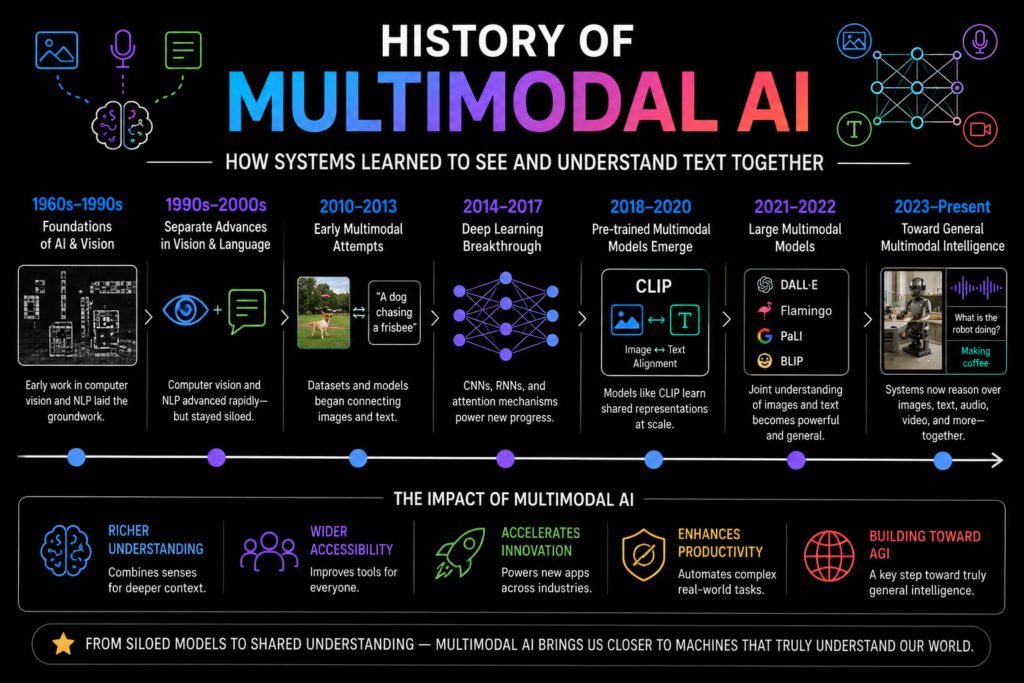
When we examine the broader history of computer vision, the initial efforts to combine different data types were incredibly rudimentary and often struggled with severe hardware limitations. During the late twentieth century, moving From early audio visual models to multimodal LLMs seemed like an impossible leap for most researchers. Early laboratory systems relied heavily on manual data annotation, where humans had to label every single pixel and corresponding text description by hand. Researchers enthusiastically experimented with Multi-sensor data fusion history in computer vision by trying to link basic audio cues to simple visual triggers in early robotics experiments.
However, these early systems were exceptionally fragile and broke down outside of highly controlled environments. The Evolution of cross modal data alignment software was painfully slow because traditional algorithms could not automatically find reliable mathematical correlations between a spoken word and a digital pixel. Engineers frequently debated the merits of Late vs early feature fusion, which was a conceptual argument about whether it was better to combine different data types at the very beginning of the processing pipeline or after each individual sensor had already processed its own independent feed. Because hardware processors were incredibly limited during this era, most applications defaulted to late fusion, keeping the data isolated until the very last computation step.
The Deep Learning Shift And Feature Fusion (2010 – 2018)
The entire technological landscape fundamentally changed when deep learning transformed computer vision and natural language processing simultaneously. The history of multimodal ai gained incredible momentum as deep neural networks proved they could extract dense, meaningful features from raw visual data without requiring any human intervention or manual feature engineering. During this critical era of discovery, researchers realized that if a neural network could understand the contents of an image, and another neural network could understand the syntax of a sentence, they could theoretically map these understandings together.
The History of vision language models fusion accelerated rapidly as scientists began designing complex architectures that could project both text and images into a single mathematical realm. This intensive research marked the dawn of the Joint image text embedding space history, a fascinating concept where a digital picture of a dog and the written word for dog would share the exact same mathematical coordinate in a digital matrix. Brilliant engineers developed advanced Cross-modal vector matching techniques to train models to accurately measure the distance between a visual object and a textual description. As machines learned to see with far greater accuracy using deep convolutional layers, the linguistic side of the industry was rapidly catching up using recurrent neural networks. The history of multimodal ai during these years was characterized by relentless trial and error, as aligning these two vastly different data structures required massive amounts of computational power and perfectly labeled datasets.
The Transformer Architecture Era (2018 – 2021)
The groundbreaking introduction of the transformer architecture revolutionized every single aspect of artificial intelligence. Initially designed purely for text translation tasks, the transformer algorithm proved to be highly adaptable to almost any kind of sequential data. The creation of powerful vision transformers allowed researchers to process complex images not as whole pixel grids, but as ordered sequences of image patches. This mathematical breakthrough successfully enabled the Tokenization of image pixels, meaning an image could be fed into a machine learning model in the exact same format as a string of text.
By utilizing robust Large Language Model backbones as the foundational reasoning engine, the history of multimodal ai took a massive leap forward. Advanced systems like the Perceiver IO model foundations demonstrated that a single unified architecture could process audio signals, text strings, and visual data simultaneously by relying on unified mathematical attention mechanisms. Dedicated developers began engineering highly sophisticated Multimodal attention alignment layers, which effectively allowed the software to focus its processing power on specific parts of an image while reading a corresponding word in an attached sentence. This era conclusively proved that the original internal structure of the raw data did not matter, so long as the neural network could discover the hidden mathematical correlations between the inputs.
Contrastive Learning And Massive Scale (2021 – 2023)
Perhaps the most pivotal turning point in the history of multimodal ai was the dramatic industry shift toward contrastive training methods and massive scale. The Development of contrastive vision language frameworks elegantly solved the persistent problem of relying on highly expensive, human annotated datasets. The History of OpenAI CLIP multimodal training perfectly illustrates this monumental breakthrough. By scraping hundreds of millions of image and text pairs directly from the open internet, researchers trained immense models to simply predict which text description belonged to which specific image.
This highly effective method utilized massive Contrastive learning target matrices to push matching data pairs mathematically closer together while simultaneously pushing mismatched data pairs further apart. This intense training regimen resulted in a highly robust Shared semantic text image latent space that could understand broad concepts rather than just specific memorized examples. For the very first time in computing history, models reliably achieved Zero-shot image text retrieval, meaning they could accurately identify rare objects in an image based on a text prompt they had never explicitly been trained on. This breakthrough completely redefined the history of multimodal ai because it proved beyond a doubt that massive computational scale and internet wide data harvesting were the ultimate keys to unified machine understanding.
Modern Agent And Action Integration (2023 – 2026)
The most recent and thrilling chapters in the history of multimodal ai are heavily dominated by the seamless integration of physical action and dynamic logical reasoning. Following the explosive history of ai image generation, global researchers rapidly moved beyond simply generating text summaries or static pictures. The incredible Breakthroughs in unified multimodal foundation networks allowed artificial intelligence to act as autonomous, independent agents in the physical world.
The successful emergence of Vision-Language Action (VLA) networks took the remarkable capabilities of previous perception systems and applied them directly to robotics and embodied machines. A physical robot could now independently see a cluttered room, hear a spoken human command, and execute a complex physical task using the exact same underlying neural framework. The history of multimodal ai clearly shows that once the initial perceptual barrier between text and vision was broken, adding physical embodiment was the most logical next step. These advanced systems represent the absolute cutting edge of the global technology industry, capable of seamlessly processing live video streams while conducting complex logical reasoning in real time. The timeline from basic pattern matching to fully embodied artificial intelligence highlights one of the greatest engineering feats in modern history.
FAQs:
What exactly is the core concept behind these unified networks?
The core concept is to create software that can process multiple types of data simultaneously. Instead of having one program read text and another look at photos, a unified model places all data types into a single mathematical space so it can reason about them together naturally.
How does the history of multimodal ai impact modern software?
When reviewing the history of multimodal ai, researchers note that it directly enables the seamless applications we use today. Features like searching your phone’s photo gallery by typing a description or using a smart assistant to describe a live video feed are all born from this history.
Why was the transformer architecture so critical to this evolution?
The transformer architecture was critical because it provided a universal way to process data. Before transformers, engineers had to build entirely different mathematical structures for images and text. Transformers allowed developers to tokenize images exactly like words, making unified processing possible.
What is the role of contrastive learning in these modern systems?
Contrastive learning is a specialized training technique where the model learns by comparing data. It looks at an image and a text caption, and the algorithm learns to pull matching pairs closer together in its mathematical memory while pushing unrelated concepts far apart.
What are Vision Language Action networks capable of doing?
These advanced networks take perception a step further by adding physical movement. They allow robotic systems to interpret a visual scene, read a textual instruction, and then generate the exact motor commands required to successfully interact with objects in the real world.
Conclusion
The history of multimodal ai has proven that the boundaries between different forms of digital information are entirely artificial. Over the past few decades, we have witnessed an extraordinary transformation from isolated, narrow algorithms into deeply interconnected foundation networks that can see, read, and act with startling proficiency. The relentless pursuit of unified data fusion has allowed developers to bridge the gap between human language and digital perception. As we look ahead, the continuous refinement of these intelligent models will undoubtedly reshape the future of robotics, automated assistants, and digital analysis. The ongoing evolution of computer vision technology promises a world where machines can finally comprehend the rich, complex tapestry of our environment, interacting with us more naturally and intuitively than ever before.