
Introduction
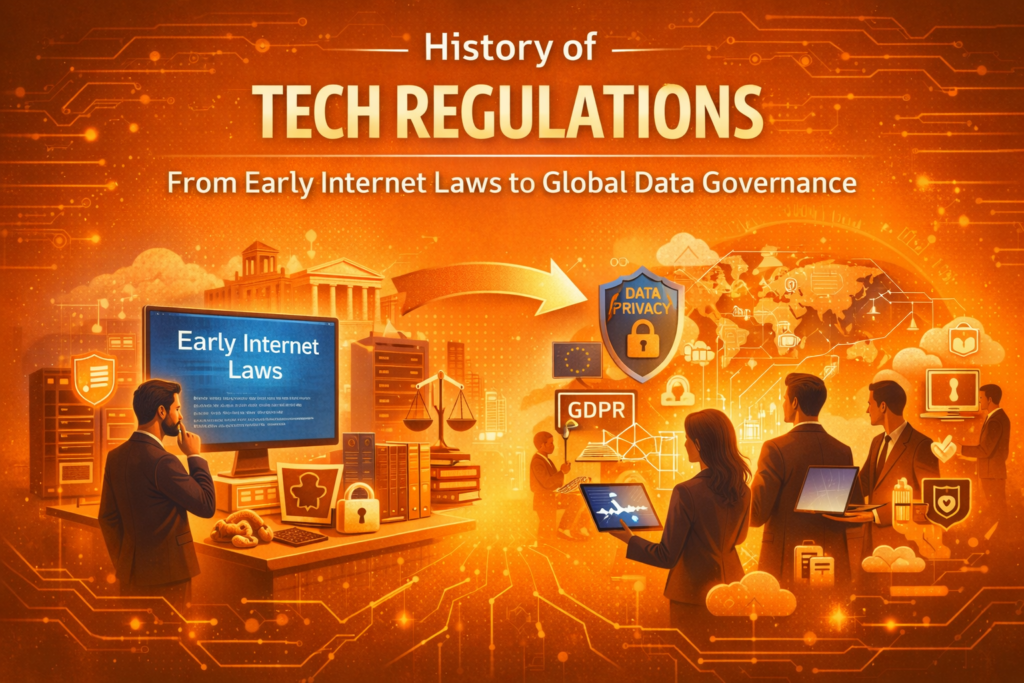
The internet was not built with lawyers in mind. It grew from a research network into a global commerce and communication platform so quickly that laws struggled to keep pace. The history of tech regulations is a powerful story of governments catching up to innovation, sometimes helping and sometimes harming. What began with simple rules about email and copyright has evolved into a complex web of data privacy laws, antitrust cases, and AI governance frameworks. The history of tech regulations reveals a constant tension between protecting users and enabling innovation. Understanding this journey helps technologists, entrepreneurs, and citizens navigate the legal landscape that shapes our digital lives.
The Dawn of Internet Law (1990 – 1996)
Before the commercial web exploded, there were few laws governing online activity. The history of the Internet was still academic. But as America Online, CompuServe, and Prodigy brought the internet to millions of homes, regulators took notice. The first major battle was over who was responsible for user generated content. If someone posted something illegal on your service, were you liable like a newspaper publisher? Or were you neutral like a telephone company?
The history of tech regulations found its answer in 1996. The US Congress passed the Communications Decency Act, which included Section 230. This tiny provision became one of the most important internet laws ever written. Section 230 says that online platforms are not liable for content posted by users. It also protects platforms that moderate content in good faith. Without Section 230, every comment, review, and social media post would expose the platform to lawsuits. The history of tech regulations shows that Section 230 enabled the modern internet. Facebook, Twitter, YouTube, and Yelp exist because of this protection.
However, Section 230 has become deeply controversial. Critics argue it allows platforms to avoid responsibility for harmful content. Supporters argue it enables free expression online. The history of tech regulations continues to debate this 1996 law. Multiple reform proposals have been introduced in Congress. No consensus has emerged.
The Copyright Wars (1998)
The next major milestone in the history of tech regulations was the DMCA (Digital Millennium Copyright Act) . Passed in 1998, the DMCA updated copyright law for the digital age. Two provisions mattered most. First, the DMCA made it illegal to circumvent digital rights management (DRM). If a DVD had encryption, breaking that encryption was a crime regardless of whether you owned the DVD. Second, the DMCA created a safe harbor for online services. If a platform removed copyrighted material when notified by the rights holder, the platform was not liable for that infringement.
The history of tech regulations showed both good and bad consequences of the DMCA. The safe harbor provision enabled platforms like YouTube to host user generated content. Rights holders could send takedown notices for specific videos. This balanced system worked reasonably well for years. However, the anti circumvention provision was heavily criticized. Researchers could not study DRM systems without breaking the law. Archivists could not preserve old software. The history of tech regulations includes ongoing debates about copyright reform.
The DMCA also created the “notice and takedown” system. A copyright holder sends a takedown notice to a platform. The platform removes the content and notifies the uploader. The uploader can file a counter notice. If the copyright holder does not file a lawsuit within a specific period, the platform restores the content. This system processes millions of takedown notices annually. The history of tech regulations shows that automated systems often send erroneous notices. Fair use is rarely considered. Reform advocates continue pushing for changes.
Children’s Privacy and COPPA (1998 – 2000)
As children flocked to websites and online games, concerns about data collection grew. The history of tech regulations responded with COPPA (Children’s Privacy) . The Children’s Online Privacy Protection Act took effect in 2000. COPPA applies to websites and online services directed at children under 13. It also applies to general audience sites that have actual knowledge they are collecting data from children.
COPPA requires operators to post clear privacy policies. They must obtain verifiable parental consent before collecting personal information from children. They must allow parents to review and delete their child’s data. They must maintain reasonable security procedures. The history of tech regulations made COPPA a model for later privacy laws. The Federal Trade Commission enforces COPPA. Violations can result in significant fines.
However, COPPA had unintended consequences. Many websites simply banned users under 13 rather than comply with the requirements. Children lied about their ages to access services. The history of tech regulations shows that well intentioned laws can create perverse incentives. The history of digital identity intersects here, as age verification remains technically and politically challenging.
Net Neutrality Battles (2005 – 2018)
The principle of Net Neutrality holds that internet service providers should treat all traffic equally. No blocking. No throttling. No paid prioritization. The history of tech regulations saw fierce battles over this principle. In 2005, the FCC issued a policy statement endorsing net neutrality principles. But the statement was not legally binding. In 2010, the FCC adopted formal net neutrality rules. Verizon sued, and in 2014 a court struck down the rules.
The FCC tried again in 2015, reclassifying broadband as a Title II telecommunications service. This gave the FCC clear legal authority to enforce net neutrality. The history of tech regulations seemed to have settled the issue. But the 2016 election changed everything. The new FCC chairman, Ajit Pai, proposed repealing the rules. In 2017, the FCC voted to repeal net neutrality protections. The repeal took effect in 2018.
The history of tech regulations shows that net neutrality remains unresolved. Several states passed their own net neutrality laws. The FCC attempted to preempt them. Courts issued mixed rulings. In 2024, the FCC voted to restore net neutrality rules, reclassifying broadband again. Lawsuits followed immediately. The history of computer networking shows that infrastructure regulation is always political. Net neutrality debates will likely continue for years.
The Rise of Data Privacy (2016 – 2018)
The modern era of data privacy regulation began with a scandal. In 2016, it was revealed that Cambridge Analytica had harvested personal data from millions of Facebook users without their consent. The data was used for political advertising. The public outrage was immense. The history of tech regulations responded with the strongest privacy law ever enacted.
The GDPR (General Data Protection Regulation) took effect in May 2018. The European Union’s GDPR applies to any organization that processes data of EU residents, regardless of where the organization is located. GDPR grants individuals eight specific rights. The right to be informed. The right of access. The right to rectification. The right to erasure (the Right to be forgotten). The right to restrict processing. The right to data portability. The right to object. Rights related to automated decision making.
GDPR also requires organizations to obtain explicit consent before collecting personal data. Consent must be freely given, specific, informed, and unambiguous. Pre checked boxes are not allowed. Organizations must appoint a Data Protection Officer if they process large amounts of sensitive data. Data breaches must be reported within 72 hours. Fines can reach 20 million euros or 4 percent of global annual revenue, whichever is higher.
The history of tech regulations shows that GDPR had global impact. Companies worldwide updated their privacy practices to comply. The “GDPR popup” became ubiquitous. However, compliance costs were significant. Some smaller companies blocked EU visitors entirely. The history of cloud computing and history of databases both had to adapt to GDPR’s data localization and deletion requirements.
California Leads the US (2018 – 2020)
The United States has no comprehensive federal privacy law. The history of tech regulations in America has been sector specific. Health data is covered by HIPAA. Financial data is covered by GLBA. Student data is covered by FERPA. But general consumer data had no federal protection. California filled the gap.
The CCPA (California Consumer Privacy Act) took effect in 2020. The California Consumer Privacy Act gave California residents rights similar to GDPR. The right to know what personal data is collected. The right to delete personal data. The right to opt out of the sale of personal data. The right to non discrimination for exercising privacy rights. CCPA applied to for profit businesses that collect California residents’ data and meet certain revenue or data volume thresholds.
The history of tech regulations saw other states follow. Virginia passed the Consumer Data Protection Act. Colorado passed the Privacy Act. Connecticut, Utah, and Iowa passed their own laws. Each state law is slightly different. Compliance across multiple states is complex. The history of tech regulations increasingly points toward the need for a federal privacy law. Multiple bills have been proposed. None have passed.
Antitrust and Big Tech (2019 – Present)
The history of tech regulations entered a new phase with renewed antitrust enforcement against Antitrust laws (Big Tech) . The US Department of Justice sued Google in 2020, alleging monopolization of search and search advertising. The Federal Trade Commission sued Facebook (now Meta) in 2020, alleging illegal monopolization of personal social networking. Additional lawsuits targeted Amazon and Apple.
The European Union has been even more aggressive. The Digital Markets Act (DMA) designates certain platforms as “gatekeepers” and imposes strict obligations. Gatekeepers must allow interoperability with their services. They cannot self prefer their own products in search results. They cannot track users across different services without consent. They must allow users to uninstall pre installed apps. Fines can reach 20 percent of global revenue.
The history of tech regulations shows that antitrust enforcement against technology companies is not new. Microsoft faced a landmark antitrust case in the 1990s. The company was found to have maintained a monopoly on PC operating systems through anticompetitive conduct. The remedy included requiring Microsoft to offer a version of Windows without Internet Explorer. The case shaped Microsoft’s behavior for years. The history of software engineering at Microsoft changed significantly after the case.
Today’s tech giants face similar scrutiny. The question is whether existing antitrust laws are adequate for digital markets. Network effects, data advantages, and zero price products make traditional antitrust analysis difficult. The history of tech regulations is still being written on this front.
Data Residency and Sovereignty (2018 – Present)
As cloud computing grew, governments demanded that certain data stay within their borders. Data residency laws require that specific types of data be stored on servers within a particular country. Russia requires personal data of Russian citizens to be stored on Russian servers. China has similar requirements. India’s data protection law includes data localization provisions.
The history of tech regulations on data residency creates challenges for global businesses. A multinational company cannot simply use a single cloud region. It must deploy infrastructure in multiple countries. Data cannot flow freely across borders. This fragments the global internet. The history of cloud computing shows that data residency requirements were a major factor in cloud providers expanding their global footprint. AWS, Azure, and Google Cloud now operate regions in dozens of countries specifically to comply with local laws.
The history of digital payments intersects here because financial data often has the strictest residency requirements. Payment card data, bank account information, and transaction records may need to stay within national borders. Companies that fail to comply face fines and potential loss of operating licenses.
The AI Act and Algorithmic Regulation (2021 – Present)
The history of tech regulations has entered its most ambitious chapter with artificial intelligence. The European Union’s AI Act (EU) is the world’s first comprehensive AI law. The AI Act takes a risk based approach. Unacceptable risk AI systems are banned. These include social scoring by governments, real time biometric surveillance in public spaces (with narrow exceptions), and AI that manipulates human behavior. High risk AI systems face strict requirements for risk management, data governance, technical documentation, transparency, and human oversight.
Limited risk AI systems have lighter transparency obligations. Chatbots must disclose they are AI. Deepfakes must be labeled. Minimal risk AI systems have no obligations under the Act. The history of tech regulations will likely see other jurisdictions follow the EU’s lead. China has already implemented AI regulations focused on recommendation algorithms and deep synthesis. The US has no federal AI law but several states have passed AI related legislation.
The AI Act (EU) also addresses general purpose AI models like large language models. Providers must document training data sources, comply with copyright law, and publish summaries of training data. Models that present systemic risk have additional obligations. The history of tech regulations shows that regulating rapidly evolving technology is extremely difficult. The AI Act will likely be revised frequently as capabilities advance.
Content Moderation and Platform Governance (2020 – Present)
The history of tech regulations has grappled with how to handle harmful content online. Illegal content is relatively straightforward. Child sexual abuse material must be removed. Terrorist content must be removed. Copyright infringing content must be removed. But legal but harmful content is harder. Disinformation. Harassment. Hate speech that does not meet legal thresholds. Self harm content. Each platform has its own content moderation policies.
The European Union’s Digital Services Act (DSA) imposes new obligations on platforms. Very large platforms must assess systemic risks like the spread of illegal content, disinformation, and gender based violence. They must put in place mitigation measures. They must give users more control over content recommendations. They must provide transparency reports. They must allow researchers access to platform data.
The history of tech regulations in content moderation is deeply contested. Governments disagree on where to draw lines. The history of cybersecurity intersects because moderators face harassment and psychological trauma. Automated moderation tools are imperfect. The history of tech regulations will likely see ongoing evolution in this area.
The Future of Tech Regulations
What comes next in the history of tech regulations ? Several trends are clear. First, data privacy laws will continue spreading. More US states will pass privacy laws, increasing pressure for federal legislation. Second, AI regulation will intensify. The AI Act (EU) is just the beginning. Expect laws addressing AI liability, AI transparency, and AI safety. Third, antitrust enforcement against tech giants will continue. Breakups are possible but unlikely. Behavioral remedies are more likely.
Fourth, children’s online safety laws will expand. The UK’s Age Appropriate Design Code and California’s Age Appropriate Design Code Act are models. Expect more laws requiring platforms to consider children’s wellbeing in product design. Fifth, cross border data flows will become more restricted. The history of tech regulations shows a trend toward data localization. The era of free data flows may be ending.
The evolution of the first digital computer from specialized hardware to general purpose platform shows how technology transforms society. The same is happening with tech regulations. Early internet laws were reactive and narrow. Modern tech regulations are proactive and comprehensive. The history of tech regulations is the story of society learning to govern powerful technologies. The journey is far from complete.
Frequently Asked Questions (FAQs)
Q1: What is Section 230 and why is it controversial?
Section 230 is a US law that protects online platforms from liability for user generated content. It also protects platforms that moderate content in good faith. Critics say it allows platforms to avoid responsibility for harmful content. Supporters say it enables free expression online. Reform proposals have been introduced but no consensus has emerged.
Q2: How does GDPR affect companies outside Europe?
GDPR (General Data Protection Regulation) applies to any company that processes data of EU residents, regardless of where the company is located. A company in Japan, Brazil, or the US must comply if it has EU customers or users. Noncompliance can result in fines up to 20 million euros or 4 percent of global revenue.
Q3: What rights do consumers have under CCPA?
CCPA (California Consumer Privacy Act) gives California residents the right to know what personal data is collected, the right to delete personal data, the right to opt out of the sale of personal data, and the right to non discrimination for exercising privacy rights. Businesses must provide two or more methods for consumers to submit requests.
Q4: What is the difference between net neutrality and data residency?
Net Neutrality requires internet service providers to treat all traffic equally without blocking or throttling. Data residency laws require specific data to be stored on servers within a particular country. Net neutrality is about how data moves. Data residency is about where data rests.
Q5: How does the AI Act classify risk levels?
The AI Act (EU) uses four risk levels. Unacceptable risk (banned) includes social scoring and real time biometric surveillance. High risk includes AI used in critical infrastructure, education, employment, and law enforcement. Limited risk requires transparency obligations. Minimal risk has no obligations.
Q6: Can I request deletion of my data under the right to be forgotten?
The Right to be forgotten under GDPR allows individuals to request deletion of personal data when the data is no longer necessary, when consent is withdrawn, or when the data was unlawfully processed. However, the right is not absolute. Exceptions include exercising free expression, legal obligations, and public health purposes.
Q7: What tech regulations are coming next?
Expect more Digital governance laws addressing AI transparency, children’s online safety, and cross border data flows. The US may finally pass a federal privacy law. The EU will enforce the Digital Markets Act and Digital Services Act. China will expand its AI and data regulations. The history of tech regulations is accelerating, not slowing.
Conclusion
The history of tech regulations from Section 230 to the AI Act is a powerful story of adaptation and conflict. Early internet laws enabled the digital revolution by protecting platforms from liability. Copyright laws balanced creator rights with innovation. Privacy laws gave individuals control over their data. Antitrust enforcement sought to maintain competition. AI regulation is now attempting to govern the most transformative technology since the internet itself. The history of tech regulations shows that law always lags behind technology. But eventually, society catches up. The challenge is to regulate in ways that protect users without stifling innovation. That balance remains elusive but essential.