What are Knowledge Graphs
Imagine a web of connected information where every piece of data knows how it relates to every other piece. That is the power of knowledge graphs. These remarkably powerful structures represent information not as isolated facts but as an interconnected network of entities and relationships. In 2026, knowledge graphs have become essential for artificial intelligence, search engines, and modern data management.
A knowledge graph is a structured representation of information that captures entities and the relationships between them. Unlike traditional databases that store data in rigid tables, knowledge graphs model the world as a network. This network structure mirrors how humans actually think, making knowledge graphs intuitive and powerful.
The term knowledge graph was popularized by Google in 2012, but the underlying concepts have deeper roots in artificial intelligence research. Today, knowledge graphs power everything from search engines to recommendation systems to AI assistants. The fascinating history of knowledge representation in artificial intelligence shows how knowledge graphs evolved from earlier semantic network research.
Definition and Concept
A knowledge graph is a structured representation of knowledge that uses a graph based data model. It consists of nodes that represent entities and edges that represent relationships between those entities. This structure allows knowledge graphs to capture complex, real world information in a way that is both human readable and machine understandable.
Knowledge graph examples are everywhere once you start looking. Google’s Google knowledge graph SEO feature displays information about people, places, and things directly in search results. When you search for “Leonardo da Vinci,” the box on the right showing his birth date, notable works, and related figures comes from a knowledge graph.
Semantic knowledge graph structures go beyond simple facts. They capture the meaning and context of information. For example, a knowledge graph doesn’t just know that “Paris” and “France” are connected. It knows that Paris is the capital of France, that France is a country in Europe, and that the Eiffel Tower is located in Paris. These rich, typed relationships make knowledge graphs invaluable for AI applications.
Entities and Relationships
The building blocks of any knowledge graph are entities and relationships. Entities and relationships form the nodes and edges of the graph.
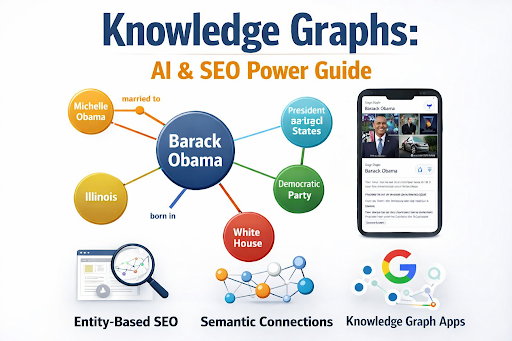
Entities are the things in the world that matter. A person, a place, an organization, a product, a concept. In a knowledge graph, each entity has a unique identifier. This allows the same entity to be referenced consistently across different contexts. For example, the entity for “Barack Obama” is the same whether it appears in a news article, a biography, or a political database.
Relationships are the connections between entities. They describe how entities interact or relate. Common relationship types include “is a,” “located in,” “works for,” “produced by,” and “influenced by.” Each relationship has a direction and often a specific meaning.
The power of knowledge graphs comes from combining entities and relationships into a network. This network captures the richness of human knowledge in a structured, queryable form. The evolution of machine learning algorithms has made knowledge graphs increasingly important for training AI systems that understand context and meaning.
How Knowledge Graphs Work
Understanding how knowledge graphs work requires looking at their technical foundations and the principles that make them effective.
RDF and Data Structure
The Resource Description Framework, or RDF, is the standard data model for knowledge graphs. RDF represents information as triples: subject, predicate, object. Each triple is a simple statement of fact.
For example, the triple (Paris, is capital of, France) states that Paris has the relationship “is capital of” to France. Every triple in a knowledge graph follows this pattern. The subject is an entity. The predicate is a relationship. The object is another entity or a literal value.
RDF and OWL are standards that extend this basic model. OWL, the Web Ontology Language, allows knowledge graphs to define classes, properties, and logical constraints. This enables reasoning about the data. If a knowledge graph knows that all capital cities are cities, and Paris is a capital, it can infer that Paris is a city.
Graph databases are the storage technology behind most knowledge graphs. Unlike relational databases that store data in tables, graph databases store data as nodes and edges. This makes queries about relationships much faster. A knowledge graph database can traverse connections in milliseconds, even across millions of entities.
Semantic Connections
Semantic connections are what make knowledge graphs intelligent. A semantic knowledge graph understands not just that two things are connected, but what that connection means.
This semantic understanding enables linked data principles. Linked data means that entities in a knowledge graph can be connected to entities in other knowledge graphs across the web. This creates a global web of data that machines can navigate and understand.
The ontology of a knowledge graph defines the types of entities and relationships it contains. An ontology might specify that a “Person” has properties like “birth date” and “nationality.” It might define that “works for” can only connect a Person to an Organization. These constraints ensure data consistency and enable reasoning.
Knowledge Graph in SEO
Knowledge graphs have transformed search engine optimization. Understanding Google knowledge graph SEO is essential for anyone serious about search visibility.
Google Knowledge Graph
The Google knowledge graph launched in 2012 and changed search forever. Instead of just returning blue links, Google started providing direct answers to questions. These answers come from its massive knowledge graph containing billions of facts about millions of entities.
When you search for a famous person, the Google knowledge graph displays a knowledge panel with key facts. When you search for a movie, it shows cast, release date, and ratings. When you ask a question, it might display a direct answer pulled from the knowledge graph.
The Google knowledge graph collects information from many sources. Wikipedia is a major contributor. So are Wikidata, the CIA World Factbook, and structured data from websites. By aggregating information, Google builds a comprehensive picture of the world’s entities.
Entity-Based SEO
Entity based SEO is the evolution of keyword based SEO. Instead of optimizing for specific strings of words, entity based SEO optimizes for entities and their relationships.
A keyword focused approach might optimize for “best Italian restaurant in Chicago.” An entity based SEO approach optimizes for the entities: Italian Restaurant, Chicago, and the relationship “located in.” This allows search engines to understand the true meaning and context of a page.
Structured data is essential for entity based SEO. By adding schema markup to your web pages, you help search engines understand the entities on your page and their relationships. Schema markup uses vocabulary from knowledge graphs to describe content in machine readable format.
Structured data can identify a page as being about a specific person, product, event, or organization. It can specify relationships like “author of,” “works for,” or “located at.” This structured information feeds directly into search engines’ knowledge graphs.
Applications of Knowledge Graphs
Knowledge graph applications span industries and use cases. Their ability to connect information makes them invaluable for modern AI systems.
Search Engines
Search engines were the first major adopters of knowledge graphs. Beyond Google, Bing and other search engines maintain their own knowledge graphs to improve search quality.
Knowledge graphs help search engines understand user intent. When someone searches for “Apple,” is it the fruit or the company? A knowledge graph provides context. If the user also searched for “iPhone” recently, the knowledge graph knows that Apple the company is more relevant.
Knowledge graphs also enable featured snippets and direct answers. When a user asks “how tall is the Eiffel Tower,” the knowledge graph provides the answer directly. No need to click through to another website.
Recommendation Systems
Recommendation systems power much of the modern web. Amazon recommends products. Netflix recommends shows. Spotify recommends music. Knowledge graphs make these recommendations smarter.
Traditional recommendation systems used collaborative filtering, finding users with similar tastes. Knowledge graphs add content based understanding. If a user likes a movie, the knowledge graph knows other movies with the same director, genre, or lead actor. This provides more diverse and relevant recommendations.
The powerful history of AI recommendation systems shows how knowledge graphs have evolved from simple collaborative filtering to sophisticated semantic understanding.
AI Assistants
AI assistants like Siri, Alexa, and Google Assistant rely heavily on knowledge graphs. When you ask “who was the president of the United States in 1995,” the assistant needs to understand the entities (President, United States, 1995) and their relationship.
Knowledge graphs provide the factual backbone for AI assistants. They store the billions of facts that assistants need to answer questions. When a question requires reasoning across multiple facts, the knowledge graph supports the necessary inference.
The inspiring history of AI assistants and chatbots demonstrates how knowledge graphs have enabled conversational AI to become genuinely useful.
Benefits and Challenges
Knowledge graphs offer tremendous benefits but also come with significant challenges.
Improved Data Understanding
The primary benefit of knowledge graphs is improved data understanding. Traditional databases store data but lose meaning. Knowledge graphs preserve and enhance meaning.
Knowledge graphs enable better search and discovery. Users can find information not just by exact matches but by exploring relationships. “Show me all movies directed by Christopher Nolan” is a natural query for a knowledge graph.
Knowledge graphs also enable inference. A knowledge graph can deduce new facts from existing ones. If the graph knows that Christopher Nolan directed Inception and that Inception won an Oscar, it can infer that a film directed by Christopher Nolan won an Oscar. This inference capability is incredibly valuable for AI systems.
Complexity in Implementation
The biggest challenge of knowledge graphs is complexity in implementation. Building a knowledge graph from scratch is difficult and expensive.
Knowledge graph vs database is a common debate. Traditional relational databases are simpler to implement and query. Knowledge graphs require specialized expertise and infrastructure. For many applications, a database is sufficient.
Building knowledge graphs requires solving hard problems. How do you extract entities and relationships from unstructured text? How do you resolve different names for the same entity? How do you handle uncertainty and conflicting information? These challenges remain active research areas.
Knowledge graph database technology has matured, but it still requires skilled engineers. The ecosystem of tools and best practices is less developed than for traditional databases.
Frequently Asked Questions
1. What is a knowledge graph in simple terms?
A knowledge graph is a way of storing information as a network of connected facts, like a map of knowledge where every piece of information knows how it relates to others.
2. How is a knowledge graph different from a database?
A database stores data in tables. A knowledge graph stores data as entities and relationships, making it better for understanding connections and context.
3. What is the Google knowledge graph?
The Google knowledge graph is Google’s massive database of entities and facts that powers knowledge panels, featured snippets, and direct answers in search results.
4. How does entity based SEO work?
Entity based SEO optimizes for entities and their relationships rather than specific keywords, using structured data and schema markup to help search engines understand content.
5. What are common knowledge graph applications?
Common applications include search engines, recommendation systems, AI assistants, fraud detection, and life sciences research.
6. What is RDF in knowledge graphs?
RDF, or Resource Description Framework, is the standard data model for knowledge graphs that represents information as subject-predicate-object triples.
Conclusion
Knowledge graphs have transformed how artificial intelligence understands and organizes information. These remarkably powerful structures capture the richness of human knowledge in a form that machines can process, reason with, and learn from. From Google search to AI assistants to recommendation systems, knowledge graphs power the intelligent applications that define modern life.
The journey of knowledge graphs from academic research to mainstream technology reflects the broader evolution of artificial intelligence. The fascinating history of the turing test reminds us that AI has always sought to understand and communicate knowledge. Knowledge graphs provide a practical, scalable approach to achieving that goal.
For those interested in complementary AI technologies, exploring self supervised learning in artificial intelligence reveals how machines learn representations from unlabeled data. Additionally, the history of AI agents shows how autonomous systems use structured knowledge to operate in complex environments.
For SEO professionals, understanding entity based SEO and structured data is essential for visibility in the era of Google knowledge graph SEO. For AI practitioners, knowledge graphs offer a foundation for building systems that truly understand the world. Whether you are optimizing a website or building the next generation of intelligent applications, mastering knowledge graphs is a powerful step forward.