Introduction to Computer Vision Models
Imagine a machine that can look at a photograph and describe everything in it. A system that watches a live video feed and spots suspicious activity. An algorithm that examines a medical scan and detects early signs of disease. These capabilities come from computer vision models, one of the most remarkably powerful branches of artificial intelligence. In 2026, computer vision models are transforming industries from healthcare to transportation to security.
Computer vision models are algorithms that enable machines to interpret and understand visual information from the world. They process images and videos, extract meaningful features, and make decisions based on what they see. This is incredibly challenging because raw visual data is complex. A single image contains millions of pixels, each with color and intensity values. Making sense of this flood of information requires sophisticated mathematical and computational techniques.
The journey of computer vision models from academic research to practical deployment has been remarkable. The history of computer vision in artificial intelligence shows how far the field has come, from simple edge detection to models that can rival human performance on specific tasks.
What is Computer Vision
Computer vision is the field of artificial intelligence that trains computers to interpret and understand the visual world. Using computer vision AI models, machines can identify objects, people, text, and actions in images and videos. They can analyze facial expressions, read handwritten notes, and navigate through physical spaces.
The goal of computer vision is to replicate the capabilities of human vision. But machines approach this task very differently from humans. While humans rely on billions of years of evolution, computer vision models rely on mathematical operations, statistical learning, and massive amounts of training data.
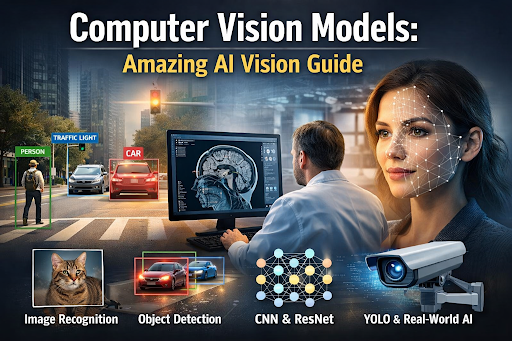
Image recognition is one of the most fundamental tasks in computer vision. An image classification model takes an image as input and outputs a label describing what the image contains. Is this a picture of a cat or a dog? Does this medical scan show signs of pneumonia? These are classification tasks.
Importance in AI
Computer vision models are essential to modern artificial intelligence for several compelling reasons.
First, visual data is everywhere. The world generates billions of images and videos every day. Security cameras, smartphones, medical devices, satellites, and autonomous vehicles all produce visual data. Computer vision models unlock the value hidden in this data.
Second, many critical tasks are inherently visual. A self-driving car cannot rely on text descriptions of the road. It must see the road. A quality control system cannot read reports about defects. It must see the products.
Third, deep learning computer vision models have achieved remarkable accuracy. In many tasks, they now match or exceed human performance. This makes them practical for real world deployment.
Types of Computer Vision Models
Computer vision models can be categorized by the tasks they perform. Each type has different architectures and evaluation metrics.
Image Classification Models
Image classification models are the most fundamental type of computer vision models. Their task is simple: given an input image, predict a single label that describes the image.
For example, an image classification model might look at a photo and output “golden retriever” or “mountain landscape” or “sports car.” The model is trained on thousands or millions of labeled images, learning to associate visual patterns with specific categories.
The mathematical formulation of image classification involves learning a function f that maps an input image x to a probability distribution over classes. The model outputs the class with the highest probability.
Image classification models have many applications. They organize photo libraries, moderate content on social media, identify plants from photographs, and screen medical images for abnormalities.
Object Detection Models
Object detection models go beyond classification. They not only identify what objects are in an image, but also where they are located. Each detected object is enclosed in a bounding box.
If an object detection model looks at a street scene, it might output: a person at coordinates (100, 150) to (200, 300), a car at (300, 200) to (450, 280), and a traffic light at (500, 100) to (520, 150).
Object detection models are essential for applications that need to locate and track objects. Autonomous vehicles use them to detect other cars, pedestrians, and obstacles. Security systems use them to identify intruders. Retail analytics use them to track customer movement.
Segmentation Models
Segmentation models take object detection to the pixel level. Instead of drawing bounding boxes around objects, image segmentation models classify every single pixel in the image.
There are two main types of segmentation. Semantic segmentation assigns a class label to each pixel. All pixels belonging to cars get one label, all pixels belonging to roads get another. Instance segmentation goes further, distinguishing between different instances of the same class. Car number one and car number two get different labels.
Image segmentation is the most detailed form of visual understanding. It is used in medical imaging to outline tumors, in autonomous driving to identify drivable surfaces, and in satellite imagery to map land use.
Popular Architectures
The architectures of computer vision models have evolved dramatically over time. Each new generation has brought improvements in accuracy, speed, and efficiency.
CNN (Convolutional Neural Networks)
Convolutional neural networks (CNN) are the foundation of modern computer vision models. They were inspired by the biological visual cortex, where neurons respond only to stimuli in limited regions of the visual field.
A convolutional neural network (CNN) uses mathematical operations called convolutions to process images. Convolution applies a small filter, or kernel, across the entire image, detecting specific features like edges, corners, or textures.
The mathematical operation of convolution for a filter K and image I is:
(I * K) (x,y) = sum over i sum over j of I ( x+i , y+j ) × K (i, j)
This operation is repeated across many layers. Early layers detect simple features like edges. Deeper layers combine these into complex features like eyes, wheels, or letters.
Convolutional neural networks (CNN) have revolutionized computer vision models. They are the backbone of virtually all modern systems.
ResNet and VGG
ResNet and VGG are two of the most influential computer vision architectures. They represent different approaches to building deep networks.
ResNet, short for Residual Network, solved a critical problem in training very deep networks. As networks got deeper, performance paradoxically got worse. ResNet introduced skip connections, or residual connections, that allow information to flow directly from earlier layers to later layers. This enables training of networks with hundreds of layers.
The residual connection is mathematically simple but powerful. Instead of learning H(x) directly, the network learns F(x) = H(x) – x. The output is F(x) + x.
This reformulation makes optimization much easier.
VGG took a different approach. It used very simple architecture with only 3×3 convolutions stacked many times deep. While effective, VGG is computationally expensive and has been largely superseded by more efficient architectures.
Pretrained computer vision models based on ResNet and VGG are widely available. They can be used for transfer learning, adapting to new tasks with minimal additional training.
YOLO and Faster R-CNN
Object detection models have their own specialized architectures. YOLO and Faster R-CNN represent two different philosophies.
YOLO, which stands for You Only Look Once, is designed for speed. It processes the entire image in a single forward pass, predicting bounding boxes and class probabilities simultaneously. This makes YOLO suitable for real time applications like video analysis and autonomous driving.
Faster R-CNN takes a two stage approach. The first stage proposes regions that might contain objects. The second stage classifies those regions and refines the bounding boxes. This is slower than YOLO but often more accurate.
The choice between YOLO and Faster R-CNN involves the classic tradeoff between model accuracy vs speed. For real time applications, YOLO is preferred. For applications where accuracy is paramount and speed less critical, Faster R-CNN may be better.
Applications of Computer Vision
Computer vision models are deployed across industries, solving problems that were impossible just a few years ago.
Healthcare Imaging
Healthcare imaging is one of the most impactful applications of computer vision models. Radiologists examine X rays, CT scans, and MRI images to detect diseases. Computer vision models can assist by flagging suspicious areas, quantifying abnormalities, and even making primary diagnoses.
In cancer detection, computer vision models analyze mammograms for signs of breast cancer, lung CT scans for nodules, and skin photos for melanoma. Studies have shown that AI can match or exceed human radiologists in some tasks.
The incredible AI in healthcare history and evolution demonstrates how computer vision models are saving lives by enabling earlier and more accurate diagnosis.
Autonomous Vehicles
Autonomous vehicles are perhaps the most demanding application of computer vision models. A self driving car must understand its environment in real time, detecting pedestrians, vehicles, traffic signs, lane markings, and obstacles.
Object detection models identify other vehicles and pedestrians. Image segmentation models distinguish drivable road surfaces from sidewalks and obstacles. Computer vision models also read traffic signs and recognize traffic light colors.
The remarkable history of artificial intelligence in autonomous vehicles shows how computer vision models have enabled cars to navigate increasingly complex environments.
Security Systems
Security and surveillance systems increasingly rely on computer vision models. Traditional systems simply record video for human review. Modern systems actively analyze video feeds in real time.
Computer vision models can detect unauthorized entry, identify suspicious behavior, recognize license plates, and track individuals across multiple cameras. They can alert security personnel to potential threats instantly, rather than after the fact.
Facial recognition, a specialized computer vision model, identifies individuals from their facial features. It is used for access control, law enforcement, and personal device unlocking.
Challenges in Computer Vision
Despite remarkable progress, computer vision models still face significant challenges.
Data Labeling Issues
Data labeling issues are a major bottleneck for computer vision models. Training accurate models requires massive datasets of labeled images. For object detection, each image must have bounding boxes around every object. For segmentation, every pixel must be labeled.
Labeling is expensive and time consuming. Expert labelers are needed for medical imaging. For general images, labeling is tedious and prone to errors.
Data labeling also introduces bias. If the training data underrepresents certain groups, the computer vision models will perform poorly on those groups. This has been documented in facial recognition systems that work less accurately for women and people with darker skin tones.
Model Accuracy vs Speed
The tradeoff between model accuracy vs speed is a constant challenge in computer vision models. More accurate models tend to be larger and slower. Faster models tend to be less accurate.
For autonomous driving, both accuracy and speed are critical. The model must be accurate enough to avoid accidents and fast enough to react in milliseconds. Achieving both requires careful architecture design and optimization.
For medical imaging, accuracy is paramount. Speed is less critical because diagnosis is not real time. Heavier, slower models are acceptable. For mobile applications, both speed and model size matter because of limited battery and computational resources.
Frequently Asked Questions
1. What are computer vision models?
Computer vision models are AI algorithms that enable machines to interpret and understand visual information from images and videos.
2. What is the difference between image classification and object detection?
Image classification assigns a single label to an entire image. Object detection identifies multiple objects and their locations with bounding boxes.
3. What is a convolutional neural network (CNN)?
A CNN is a neural network architecture that uses mathematical convolutions to process images, detecting features at multiple scales.
4. What is YOLO in computer vision?
YOLO stands for You Only Look Once. It is a fast object detection model that processes images in a single pass, ideal for real time applications.
5. How are computer vision models used in healthcare?
They analyze medical images like X rays, CT scans, and MRIs to detect diseases, flag abnormalities, and assist radiologists with diagnosis.
6. What is image segmentation?
Image segmentation classifies every pixel in an image, providing detailed understanding of object boundaries and shapes.
Conclusion
Computer vision models have transformed the landscape of artificial intelligence. These remarkably powerful algorithms enable machines to see, understand, and interpret the visual world. From healthcare imaging to autonomous vehicles to security systems, computer vision models are solving problems that were science fiction just a generation ago.
The journey from simple edge detection to deep learning computer vision models capable of exceeding human performance has been remarkable. The history of computer vision shows how each architectural innovation has expanded what is possible.
For those interested in related AI technologies, explore self supervised learning in artificial intelligence to understand how models learn representations without explicit labels.
Whether you are a researcher pushing the boundaries of computer vision architectures or a practitioner deploying pretrained computer vision models, the field offers endless opportunities. The challenges of data labeling and the tradeoff between accuracy and speed remain, but the trajectory is clear. Computer vision models will continue to improve, enabling machines to see the world with ever greater understanding.