Introduction to Leibniz’s Philosophy of Logic
What if human disagreements could be settled not with arguments or wars, but with simple calculation? What if every philosophical dispute could be resolved by picking up a pencil and saying, “Let us calculate”? This audacious vision was the lifelong obsession of Gottfried Wilhelm Leibniz, one of history’s most brilliant and versatile thinkers. While Leibniz is celebrated for his leibniz calculus discovery and his work on the leibniz binary system, his deepest passion was not mathematics or physics but logic—specifically, the dream of creating a universal language that could represent all human thought.
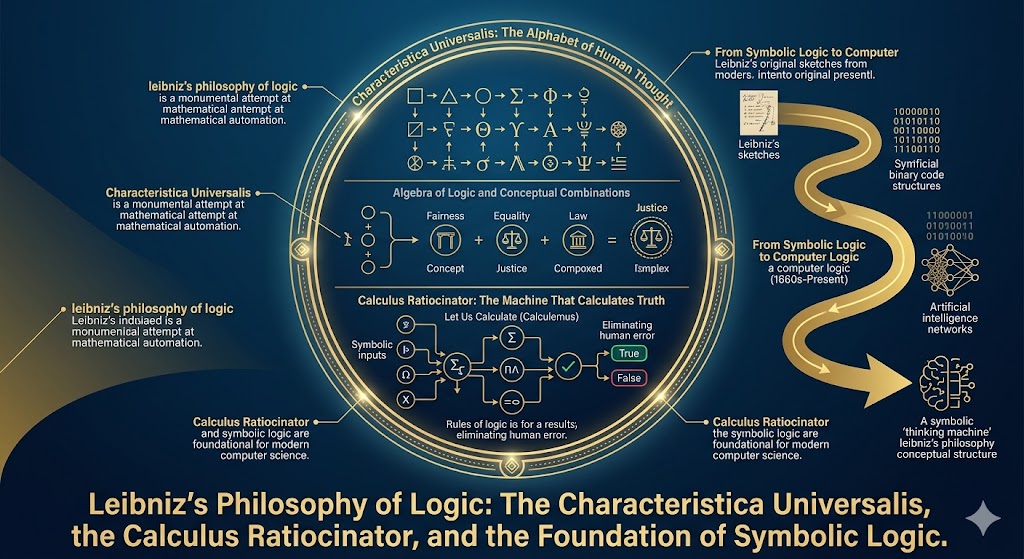
Leibniz believed that human reasoning, despite its apparent complexity, could be reduced to a formal system of symbols and rules. He called this system the characteristica universalis (universal characteristic) and its companion method of calculation the calculus ratiocinator (calculus of reasoning). Together, these concepts formed the core of leibniz universal logic, a framework so advanced that it anticipated modern symbolic logic, computer science, and even artificial intelligence by more than two centuries.
The story of leibniz universal logic is both inspiring and tragic. Leibniz never completed his grand project. He left behind hundreds of fragments, sketches, and letters outlining his ideas, but the definitive work was never published. Yet these fragments contain some of the most profound insights in the history of philosophy and logic. They reveal a thinker who glimpsed the digital future centuries before it arrived.
The Characteristica Universalis: Mapping Human Thought
At the heart of leibniz universal logic was the concept of a characteristica universalis, a universal language composed of symbols that would directly represent concepts. Leibniz envisioned this language as a kind of philosophical alphabet, where each basic concept would be assigned a unique symbol. Complex ideas would be built by combining these basic symbols, much as numbers are built from digits or words from letters.
Leibniz was inspired by the success of mathematical notation. He noted that the symbols used in algebra allowed mathematicians to manipulate quantities with remarkable ease. The leibniz calculus notation he developed for calculus (dy/dx and the integral sign) was itself an example of this principle in action. Leibniz believed that if the same approach could be applied to all human knowledge, reasoning would become as reliable as arithmetic.
The characteristica universalis would serve two purposes. First, it would provide a precise language for expressing ideas without ambiguity. Ordinary language, Leibniz observed, was full of vagueness and confusion. The same word could mean different things to different people, leading to endless disputes. A universal symbolic language would eliminate this problem by fixing the meaning of every term.
Second, the characteristica universalis would reveal the logical structure of concepts. By analyzing how concepts combined, Leibniz believed we could discover the fundamental building blocks of human thought. He called these building blocks the “alphabet of human thought” (alphabetum cogitationum humanarum). Once this alphabet was discovered, all knowledge could be derived from it through logical rules.
This idea, radical in the 17th century, now seems remarkably prescient. Modern efforts to create formal ontologies, knowledge graphs, and semantic web languages are essentially attempts to realize Leibniz’s dream of a characteristica universalis.
The Calculus Ratiocinator: Calculating Truth and Error
The characteristica universalis was only half of leibniz universal logic. The other half was the calculus ratiocinator, a formal method for manipulating symbols to derive true conclusions from true premises. Where the characteristica universalis provided the language of thought, the calculus ratiocinator provided the grammar and rules of inference.
Turning Arguments into Mathematical Equations
Leibniz’s genius was to see that logical arguments could be treated like mathematical equations. Just as algebra allows us to solve for unknown quantities, logical calculus would allow us to determine the validity of arguments through pure calculation.
Consider a simple logical argument:
- All humans are mortal. (Premise 1)
- Socrates is human. (Premise 2)
- Therefore, Socrates is mortal. (Conclusion)
In Leibniz’s logical calculus, this argument would be expressed symbolically. Let us define:
- H(x): x is human
- M(x): x is mortal
- s: Socrates
Premise 1 becomes:
Premise 2 becomes:
Conclusion becomes:
Using the rule of modus ponens (if P→Q and P, then Q), we derive the conclusion. In Leibniz’s system, this derivation would be a mechanical operation, as straightforward as adding two numbers.
Leibniz developed a formal algebra of concepts that used numerical coefficients to represent logical relationships. For two concepts A and B, he would write:
to mean that the concepts are identical. He also introduced operations that resemble modern Boolean algebra. For example, he defined the “addition” of concepts to represent conjunction:
This represented the concept combining A and B. If A is “rational” and B is “animal,” then A+B is “rational animal,” or “human.”
Leibniz also explored the logical relationships between concepts using what we now recognize as set theory. The relationship “all A are B” could be expressed as:
meaning that A contains B. This insight anticipated the Boolean algebra that George Boole would develop nearly 200 years later.
The Dream of “Let Us Calculate” (Calculemus)
Leibniz’s most famous phrase in logic is “calculemus”—”let us calculate.” He envisioned a future where philosophers, when faced with a disagreement, would not resort to endless debate. Instead, they would take out their pencils, translate their arguments into the characteristica universalis, and perform the logical calculations necessary to determine who was correct.
Leibniz wrote: “If controversies were to arise, there would be no more need of disputation between two philosophers than between two accountants. For it would suffice to take their pencils in their hands, and say to each other: ‘Let us calculate.'”
This statement reveals the astonishing ambition of leibniz universal logic. Leibniz was not merely proposing a better system of logic; he was proposing to replace human reasoning with mechanical calculation. He believed that truth itself could be reduced to computation.
The calculus ratiocinator would have rules for combining concepts, deriving implications, and detecting contradictions. If a set of premises led to a contradiction, they would be known to be false. If a conclusion followed necessarily from true premises, it would be known to be true. All of this would be accomplished through the manipulation of symbols according to fixed rules.
The Law of Identity and the Principle of Sufficient Reason
Leibniz’s logical system rested on two fundamental principles that he considered axiomatic. These principles underpinned leibniz universal logic and connected it to his broader metaphysical system.
The law of identity states that everything is identical to itself. In logical terms, for any x, x=x. This principle seems trivial, but it has profound implications. From it, Leibniz derived the principle of the identity of indiscernibles: if two things share all the same properties, they are actually the same thing. Mathematically, this can be expressed as:
If x and y have exactly the same properties, then x and y are identical.
The principle of sufficient reason is even more central to Leibniz’s philosophy. It states that nothing happens without a reason. For every fact, there is a reason why it is so rather than otherwise. In logical terms, for every true proposition P, there exists a reason R such that R explains P.
Leibniz applied this principle to everything from physics to theology. In his leibniz discoveries across mathematics and philosophy, he consistently sought the underlying reasons that explained why things were the way they were. The calculus ratiocinator was designed to uncover these reasons through logical analysis.
How Leibniz Predicted Modern Artificial Intelligence and Data Science
Perhaps the most astonishing aspect of leibniz universal logic is how closely it anticipated modern developments in artificial intelligence and data science. Leibniz’s vision of a formal language for thought, combined with a mechanical method for deriving conclusions, is essentially the blueprint for modern symbolic AI.
In the 20th century, the development of formal logic by Gottlob Frege, Bertrand Russell, and Alfred North Whitehead built directly on Leibnizian foundations. Their work showed that mathematics itself could be reduced to logic, fulfilling Leibniz’s dream of a universal logical calculus.
The field of artificial intelligence began in the 1950s with the assumption that human reasoning could be simulated by machines. This assumption is a direct inheritance from Leibniz. The early AI pioneers, including Herbert Simon and Allen Newell, explicitly acknowledged Leibniz as a precursor. Their Logic Theorist program, which proved theorems from Whitehead and Russell’s Principia Mathematica, was a modern implementation of the calculus ratiocinator.
Today, the dream of leibniz universal logic lives on in fields like knowledge representation, natural language processing, and automated reasoning. Ontologies like the Semantic Web attempt to create a universal language for representing information, much as Leibniz envisioned. Machine learning algorithms perform calculations on vast datasets, discovering patterns and making predictions. While these systems operate differently than Leibniz imagined, they embody the same fundamental insight: that thought can be formalized and computation can reveal truth.
Leibniz also anticipated the ethical dimensions of automated reasoning. He worried about the misuse of logical systems and insisted that the characteristica universalis should be used to promote understanding rather than conflict. This concern resonates today as we grapple with the ethical implications of artificial intelligence and data science.
Frequently Asked Questions (FAQs)
1. What is leibniz universal logic?
leibniz universal logic refers to Leibniz’s vision of a formal system combining a universal symbolic language (characteristica universalis) with a method of logical calculation (calculus ratiocinator). It aimed to reduce all reasoning to mechanical computation.
2. What is the characteristica universalis?
The characteristica universalis is Leibniz’s proposed universal language composed of symbols representing basic concepts. Complex ideas would be formed by combining these symbols, eliminating ambiguity and revealing logical structure.
3. What does “calculemus” mean?
“Calculemus” is Latin for “let us calculate.” Leibniz used this phrase to express his vision that philosophical disputes could be resolved by translating arguments into symbolic form and performing logical calculations.
4. How did leibniz universal logic influence modern computing?
Leibniz’s ideas directly influenced symbolic logic, which became the foundation of computer science. His vision of mechanical reasoning anticipated artificial intelligence, knowledge representation, and automated theorem proving.
5. Why was leibniz universal logic never completed?
Leibniz left his logical work unfinished, publishing only fragments during his lifetime. His ideas were scattered across thousands of unpublished manuscripts and only fully appreciated by later generations of logicians and computer scientists.
Conclusion: The Unfinished Quest for a Universal Logic
Leibniz died in 1716 without completing his grand project. The characteristica universalis and the calculus ratiocinator remained fragments, scattered across thousands of pages of unpublished manuscripts. For over two centuries, much of his work in logic remained unknown, overshadowed by his achievements in mathematics and physics.
Yet the ideas Leibniz planted grew slowly but powerfully. In the 19th century, logicians rediscovered his work and recognized its importance. In the 20th century, computer scientists realized that Leibniz had described the essential principles of computation. Today, as we build machines that reason, learn, and communicate, we are building on foundations laid by Leibniz more than 300 years ago.
The leibniz universal logic was not merely a philosophical theory; it was a vision of what human knowledge could become. Leibniz believed that by creating a universal language of thought, humanity could achieve a new level of understanding and cooperation. Disputes would be resolved not by violence but by calculation. Truth would be discovered not through authority but through demonstration.
Just as copernicus solar system model transformed our understanding of the physical cosmos by revealing its mathematical order, leibniz universal logic transformed our understanding of the intellectual cosmos by revealing the mathematical structure of thought itself. Leibniz’s unfinished quest for a universal logic remains one of the most inspiring endeavors in intellectual history, a testament to the power of human reason to imagine its own perfection.