In the quiet confines of a monastery garden, a astonishing discovery was made that would forever alter the course of biology. This was no ordinary horticultural experiment. Between 1856 and 1863, a scientist monk named Gregor Mendel performed a series of meticulous crossbreeding experiments on pea plants. From those humble vines emerged a powerful mathematical pattern, a numerical ghost in the machine of life. That pattern is known as mendel’s ratio, specifically the astonishing 3 to 1 phenotypic split. This simple fraction did more than just count plants; it revealed the hidden, discrete nature of heredity, proving that traits are passed down via inviolable units. Today, we understand those units as genes. The statistical elegance of mendel’s ratio provides the statistical blueprint of life, and understanding its magic is essential for grasping how you became who you are.
The Garden That Changed Science (1856 – 1863)
Before Mendel, the prevailing theory of inheritance was blending. Scientists believed that offspring represented a smooth, uniform mixture of parental traits. If you crossed a tall plant with a short one, blending theory predicted a medium height plant. While this seemed logical on the surface, it had a fatal flaw: over time, variation would disappear, and all individuals would look the same. Mendel suspected otherwise. He spent eight years cultivating and testing nearly 29,000 pea plants in his controlled monastery garden. He focused on seven distinct characteristics, including seed shape (round vs. wrinkled) and flower color (purple vs. white). Why did he succeed where others failed? Because he counted. He didn’t just look at the offspring; he meticulously tallied every single plant. This quantitative approach led him directly to the 3 to 1 phenotypic ratio.
The Mathematics of Heredity: Why 3 and 1?
To understand mendel’s ratio, you must first understand the parental generation. Mendel began with true breeding plants. A true breeding tall plant (TT) always produces tall offspring. A true breeding short plant (tt) always produces short offspring. When Mendel crossed these two (TT x tt), the first filial generation, or F1, was astonishing. Contrary to blending theory, every single plant was tall. This led to Mendel’s first insight: the law of dominance. Some traits, which he called dominant, mask the presence of recessive traits. However, the real magic appeared in the next generation.
Mendel then allowed the F1 hybrids to self pollinate. The resulting second filial generation (F2) produced a startling mix: 787 tall plants and 277 short plants. Let us examine the mathematical distribution here:
- Total plants: 787 + 277 = 1,064
- Ratio of tall to short: 787 / 277 ≈ 2.84 : 1
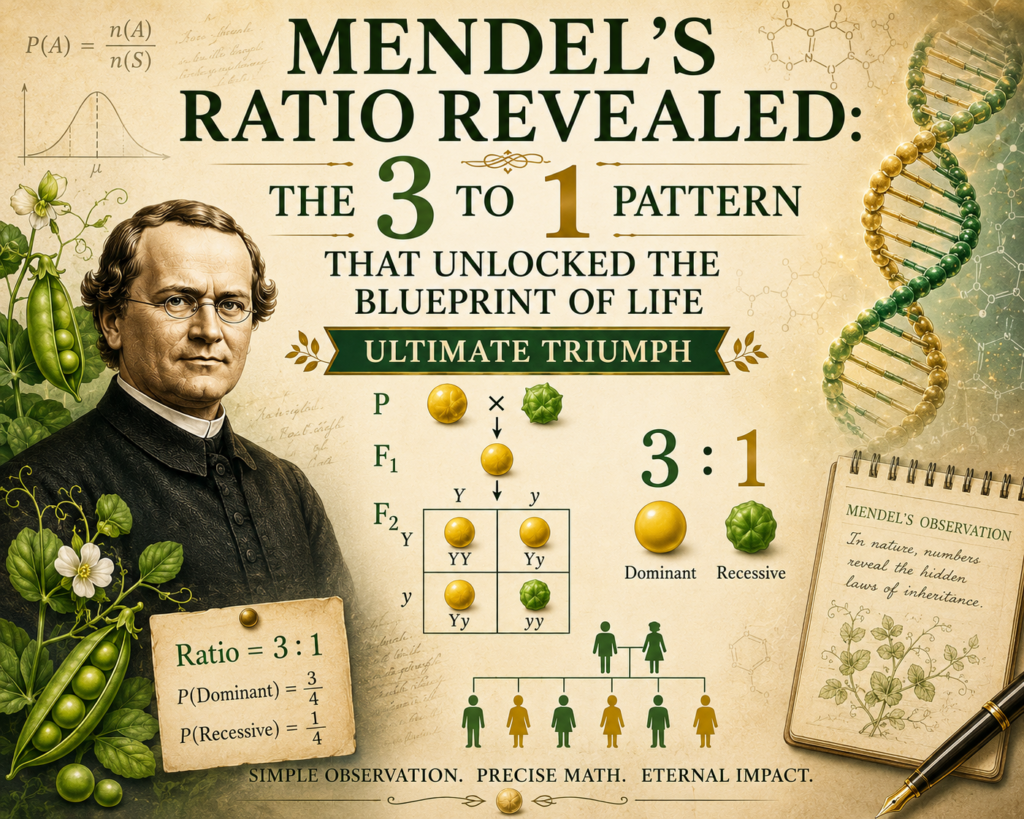
This is statistically indistinguishable from 3:1. This structural symmetry is the heart of mendel’s ratio. But why does this happen? The answer lies in probability. Each F1 plant carries one dominant allele (T) and one recessive allele (t). When two F1 plants cross, the possible combinations of alleles in the gametes follow precise rules.
We can represent this using a Punnett square, a tool derived directly from Mendel’s work:
- Female gametes: T (50% probability) or t (50% probability)
- Male gametes: T (50% probability) or t (50% probability)
The frequency of trait expression in the offspring is calculated as:
- Probability of TT (tall): 1/2 × 1/2 = 1/4
- Probability of Tt (tall): (1/2 × 1/2) + (1/2 × 1/2) = 1/2
- Probability of tt (short): 1/2 × 1/2 = 1/4
Summing the tall probabilities (TT + Tt): 1/4 + 1/2 = 3/4
Probability of short (tt): 1/4
Thus, the 3 to 1 phenotypic ratio emerges directly from the underlying genotypic ratio of 1:2:1 (TT : Tt : tt). This statistical proof of inheritance was revolutionary. It proved that hereditary factors are discrete, not fluid. The quarter probability of a recessive trait reappearing after disappearing in the F1 generation shattered the blending hypothesis completely.
Decoding the 3:1 Pattern: From Phenotype to Genotype
The visible phenotypic split of 3:1 is merely the surface layer. The real treasure is the hidden 1:2:1 genotypic ratio. Why is this distinction crucial? Because an organism with a dominant trait could be either homozygous dominant (TT) or heterozygous (Tt). These two genotypes are biologically different, even though they look identical. This is where mendel’s ratio becomes a tool for prediction. By performing a test cross (crossing an unknown dominant individual with a homozygous recessive), scientists can use the ratio of offspring to determine the unknown parent’s genotype.
- If the unknown parent is TT (homozygous dominant), crossing with tt yields:
- All Tt offspring → 0% recessive phenotype, 100% dominant phenotype.
- If the unknown parent is Tt (heterozygous), crossing with tt yields:
- 1/2 Tt (dominant) and 1/2 tt (recessive) → A 1:1 ratio.
This mathematical logic demonstrates that mendel’s ratio is not just a number; it is a diagnostic fingerprint. The magic numbers of genetics allow us to see the invisible. The ratio of dominant to recessive traits in a population is not random. It follows predictable genetic constant proportions as long as certain conditions (like large population size and random mating) are met. This universal biological constant applies to countless organisms, from pea plants to fruit flies to humans.
Extending the Pattern: The Dihybrid Cross and Independent Assortment
Mendel did not stop with one trait. He asked a deeper question: How do two different traits, such as seed color and seed shape, get passed down together? This led to his greatest mathematical work. He crossed plants that were true breeding for round yellow seeds (RRYY) with plants that had wrinkled green seeds (rryy).
- The F1 generation all had round yellow seeds (RrYy).
- When the F1 plants self pollinated, the F2 generation phenotypic distribution produced a much more complex result.
The probability for each trait individually still followed mendel’s ratio of 3:1:
- Round (3/4) vs. Wrinkled (1/4)
- Yellow (3/4) vs. Green (1/4)
But because the genes assort independently (law of independent assortment), the combined probability is the product of the individual probabilities. The mathematical distribution for a dihybrid cross is:
- Round, Yellow: (3/4) × (3/4) = 9/16
- Round, Green: (3/4) × (1/4) = 3/16
- Wrinkled, Yellow: (1/4) × (3/4) = 3/16
- Wrinkled, Green: (1/4) × (1/4) = 1/16
This produces the famous 9:3:3:1 ratio. Notice that the 3 to 1 phenotypic ratio is nested inside this larger pattern. If you sum the two yellow categories (9+3=12) and the two green categories (3+1=4), you get 12:4, which simplifies to 3:1. The same is true for shape. This mathematical harmony confirms that mendel’s ratio is a fundamental unit of genetic prediction. The statistical blueprint of life is built from these repeating, predictable fractions.
Why Science Ignored Mendel and the Shocking Rediscovery
Despite the brilliance of his work, why science ignored mendel for 35 years is a tragic lesson in scientific communication. In 1865, Mendel presented his findings to the Natural History Society of Brünn. He published his paper, “Experiments on Plant Hybridization,” in 1866. It was sent to 120 libraries worldwide. Yet, almost no one read it. Why? Several reasons:
- He was ahead of his time: The concept of “discrete inheritance units” (genes) did not fit the scientific paradigm.
- He was a monk, not a professor: The academic establishment often dismissed clerics as serious scientists.
- He used mathematics: Biologists in the 1860s were naturalists and observers. They rarely used statistical probability. The mathematical patterns in nature were not a fashionable area of study.
- Charles Darwin’s influence: Darwin’s theory of pangenesis, which suggested that traits from all over the body blend in the gemmules, was widely accepted. Mendel and Darwin were contemporaries, but Darwin never read Mendel’s paper. Had he done so, it would have solved the largest flaw in his theory of natural selection: the source of heritable variation.
It was not until 1900, three separate scientists (Hugo de Vries, Carl Correns, and Erich von Tschermak) independently rediscovered mendel’s ratio while conducting their own experiments. Correns, after reading Mendel’s paper, published his results and explicitly credited the long dead monk. This rediscovery launched the age of modern genetics. Gregor Mendel predicted modern genetics with nothing more than a garden, a counting board, and a profound understanding of probability.
The Legacy: From Peas to DNA
Today, the principles first revealed by mendel’s ratio underpin everything we know about heredity. The legacy of the mendelian ratio extends into agriculture, medicine, and evolutionary biology. When we talk about genetic screening for diseases like cystic fibrosis or sickle cell anemia, we are using the logic of recessive and dominant alleles. The three laws of inheritance (segregation, independent assortment, and dominance) are the bedrock of classical genetics.
Consider a real world medical example: Cystic fibrosis is caused by a recessive allele (let’s call it ‘c’). If two unaffected carriers (Cc) have a child, the probability of that child having the disease (cc) is precisely 1/4. The probability of the child being a carrier (Cc) is 1/2. This is a direct application of mendel’s ratio in a clinical setting. The frequency of trait expression for recessive diseases follows this exact pattern.
Mendel’s garden was a laboratory of abstract thought. He demonstrated that the ratio of dominant to recessive is not arbitrary; it is a law. The discrete inheritance units he hypothesized are what we now sequence in high tech genomics labs. From mendel to DNA, the journey has been a continuous line of mathematical discovery. The Human Genome Project, CRISPR gene editing, and personalized medicine all stand on the shoulders of that simple 3:1 count.
FAQs
Why is the 3:1 ratio so important in genetics?
The 3 to 1 phenotypic ratio is important because it provides the statistical proof of inheritance for a monohybrid cross between two heterozygotes. It directly disproves the blending theory of inheritance and confirms that hereditary factors (genes) are discrete particles that do not mix but are passed on intact. This ratio reveals the underlying genotypic ratio of 1:2:1.
Is mendel’s ratio always perfect in real life?
In real life, mendel’s ratio is often a statistical approximation, not a perfect whole number. This deviation occurs due to small sample sizes, random chance, lethal alleles (where one combination kills the offspring), or incomplete dominance (where heterozygotes show a blended phenotype, like pink flowers). However, over large F2 populations, the magic numbers of genetics consistently approach the predicted 3:1 split.
What is the difference between the phenotypic and genotypic ratio?
The phenotypic split (3:1) describes what you can physically observe (e.g., 3 tall plants for every 1 short plant). The genotypic ratio (1:2:1) describes the unseen genetic makeup (e.g., 1 homozygous dominant : 2 heterozygous : 1 homozygous recessive). Mendel’s ratio typically refers to the 3 to 1 phenotypic ratio, which masks the more complex structural symmetry of the genotype.
Can mendel’s ratio be applied to humans?
Yes, absolutely. The mathematical distribution of many single gene traits in humans follows mendel’s ratio. Examples include wet vs. dry earwax, the ability to roll your tongue, and genetic disorders like Huntington’s disease (dominant) or phenylketonuria (recessive). However, ethical constraints prevent controlled human breeding experiments, so we rely on family pedigrees to see the 3 to 1 phenotypic ratio in practice.
Conclusion
The journey from a quiet monastery garden to the cutting edge of genomic science is a testament to the power of pattern recognition. Mendel’s ratio, that astonishing 3 to 1 split, is far more than a historical curiosity. It is the statistical blueprint of life, the mathematical patterns in nature that govern how traits pass through generations. By looking past the visible chaos of nature and finding the universal biological constant within, Gregor Mendel unlocked the blueprint of life. Every time a geneticist calculates a probability, every time a breeder predicts a trait, they are whispering the same silent numbers that Mendel found in his peas. The decoding the 3:1 ratio was not just an achievement; it was the birth of a new way of seeing the living world. The legacy of the mendelian ratio endures in every cell of every organism, a perfect mathematical echo of a monk who simply decided to count.