In the history of science, few decisions have proven as astonishingly fruitful as a simple 19th century monk’s choice of research subject. While other naturalists studied complex animals or unpredictable wildflowers, Gregor Mendel turned to the common garden pea. This was no accident. It was a powerful display of scientific genius. Understanding why mendel chose peas reveals the very foundation of modern genetics. He did not stumble upon success. He engineered it through rigorous logic, mathematical foresight, and an obsessive attention to experimental control. The humble pea plant, Pisum sativum, possessed a perfect storm of biological features that allowed Mendel to see patterns no one else could. This article uncovers the brilliant reasoning behind that choice, a decision that transformed a quiet monastery garden into the birthplace of heredity science.
The Model Organism: Why Pisum Sativum Was Perfect (1854 – 1856)
Before Mendel began his famous crosses, he spent two years testing and selecting his experimental organism. He evaluated 34 different varieties of peas from seed merchants across Europe. His goal was to find a model organism Pisum sativum that met strict scientific criteria. Most researchers of his era failed because they chose organisms that were too complex, too slow, or too unpredictable. Mendel understood something fundamental: the organism must simplify nature, not replicate its chaos. The advantages of pea plants in science became immediately clear. Peas were inexpensive, easy to grow, and could be cultivated in large numbers within a small monastery garden. But these practical benefits were only the beginning. The real brilliance lay in the plant’s reproductive anatomy and its predictable patterns of inheritance.
The Flower That Guarded Its Secrets: Understanding Pea Reproduction
The central reason why mendel chose peas revolves around the flower’s unique structure. Pea flowers are hermaphroditic flowers, meaning each flower contains both male (stamen) and female (carpel) reproductive organs. More critically, the petals enclosing reproductive organs form a tight, sealed chamber. This structure naturally prevents pollen from entering from other flowers. In nature, pea plants primarily self-fertilize before the flower even opens. For a scientist, this was a gift. It meant Mendel could obtain true-breeding cultivars with absolute certainty. A plant that self-pollinates for generations will become pure for all its traits. Let us examine the mathematical implication of this purity:
- Probability of heterozygosity after 1 generation of selfing: 1/2
- After 2 generations: 1/4
- After 3 generations: 1/8
- After n generations: (1/2)^n
After just 10 generations of selfing, the probability of remaining heterozygous is less than 0.1%. This mathematical certainty allowed Mendel to start his experiments with plants that were genetically identical for specific traits. Without this purity, why mendel chose peas would have been pointless because any observed variation could have been due to existing genetic diversity rather than his experimental crosses.
The Seven Distinct Contrasting Traits
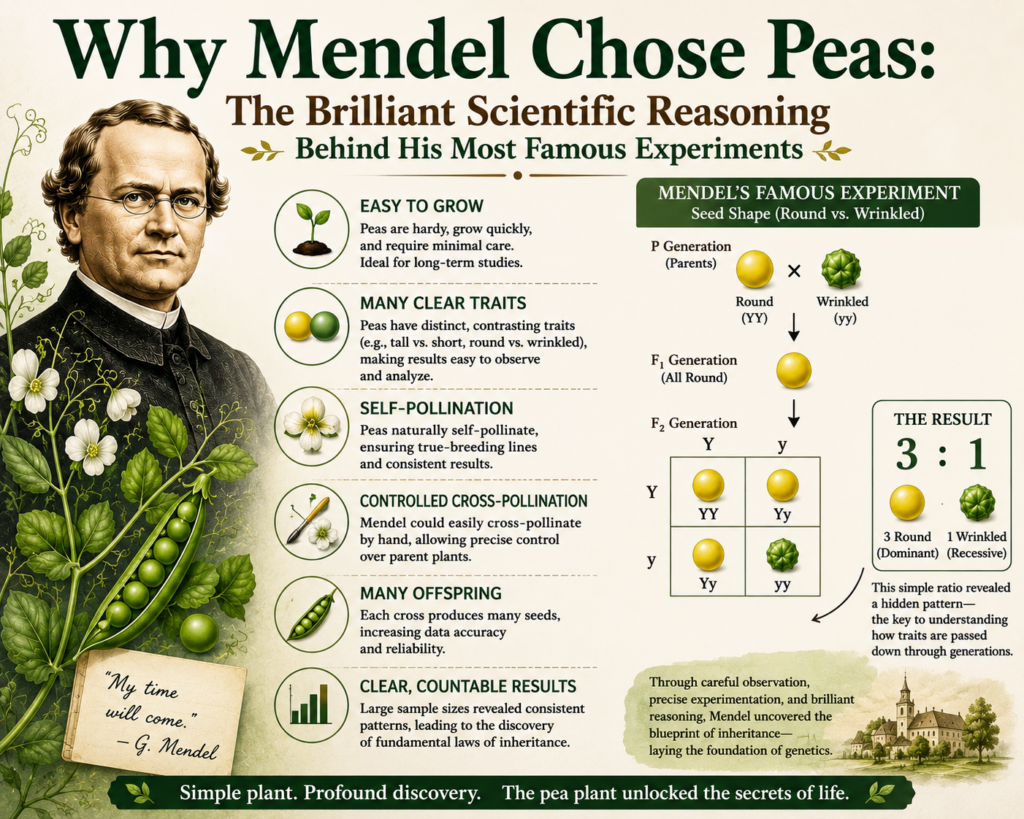
Another critical factor in why mendel chose peas was the existence of clear, non overlapping trait pairs. Mendel identified seven characteristics, each appearing in two easily distinguishable forms with no intermediate shapes. These distinct contrasting traits included:
- Seed shape (round vs. wrinkled)
- Seed color (yellow vs. green)
- Flower color (purple vs. white)
- Pod shape (inflated vs. constricted)
- Pod color (green vs. yellow)
- Flower position (axial vs. terminal)
- Stem length (tall vs. dwarf)
These clear dichotomous traits were essential. If traits blended or showed continuous variation, counting and ratio analysis would be impossible. Mendel needed discrete plant characteristics that could be sorted into either/or categories. The selection criteria for biological research demanded traits that were:
- Invariant within a pure line
- Expressed completely without environmental modification
- Easy to score without specialized equipment
The pea plant satisfied every requirement. This ideal species for genetic study provided the visual clarity needed to perceive the underlying mathematical order.
Controlled Self-Pollination and Artificial Cross-Pollination
Mendel mastered two distinct reproductive techniques. The first was controlled self-pollination, which allowed him to maintain pure lines. The second was artificial cross-pollination, which allowed him to create hybrids between different varieties. Here is the step by step procedure he developed:
- Select a flower bud before it opens (the petals enclosing reproductive organs protect the unripe anthers).
- Carefully open the bud using fine forceps.
- Remove all anthers (the male parts) from the flower using a small pair of scissors. This is called emasculation. It ensures no self-pollination can occur.
- Collect pollen from the desired male parent flower.
- Transfer that pollen to the stigma of the emasculated flower using a fine brush.
- Cover the pollinated flower with a cloth bag to prevent accidental pollination prevention from insects or wind.
This technique required extraordinary manual dexterity. A single mistake could ruin months of work. Yet Mendel performed thousands of such crosses with precision. The ability to switch between selfing and crossing at will explains why mendel chose peas over any wild plant. Wild plants often have mechanisms to promote cross-pollination, making controlled breeding nearly impossible.
Rapid Lifecycle Plants and Large Offspring Numbers
Science requires replication. To achieve statistical significance, Mendel needed thousands of individual plants. This demanded rapid lifecycle plants that could produce multiple generations within a single year. Peas germinate in spring, flower in early summer, and produce mature seeds by late summer. Mendel could grow one generation outdoors, then plant a second generation in pots inside the monastery during winter. This accelerated his research timeline considerably.
Equally important was the large offspring yield botany of the pea plant. A single healthy pea plant produces between 10 and 100 seeds. Consider the mathematical requirements for detecting a 3:1 ratio. If Mendel had worked with an organism that produced only 2 or 3 offspring per mating, random chance would completely obscure the pattern. Let us calculate the statistical power needed:
To detect a 3:1 ratio (probability of dominant = 0.75, recessive = 0.25) with confidence:
- With 4 offspring, the probability of seeing exactly 3:1 by chance is low, but deviation is common
- Standard deviation = √(n × p × q) = √(40 × 0.75 × 0.25) = √7.5 ≈ 2.74
- With 40 offspring, the expected dominant count is 30, and counts between 25 and 35 are statistically acceptable
Mendel’s actual experiment with seed shape examined 7,324 peas. Of these, 5,474 were round and 1,850 were wrinkled. The ratio is 5,474 : 1,850 = 2.96 : 1. This precision would have been impossible with a low yield organism. Why mendel chose peas is therefore partly a question of sample size mathematics.
Easy Cultivation Model Organisms and Experimental Control
The monastery garden provided a controlled environment, but Mendel also grew plants in pots, greenhouses, and under different soil conditions. Easy cultivation model organisms reduce the number of uncontrolled variables. Peas require no special fertilizer, no temperature regulation, and no complex care. Mendel could focus entirely on counting traits rather than keeping plants alive.
He also performed rigorous validation experiments. Before any cross, he tested each potential parent plant through two generations of self-pollination to confirm varietal purity. This verification process eliminated hidden genetic variation. The historical plant hybridization literature before Mendel was filled with errors because researchers used untested seeds from commercial sources. Mendel’s insistence on purity was revolutionary.
Why Mendel Succeeded Where Others Failed
The question of why mendel chose peas connects directly to why Mendel succeeded where others failed. Several contemporary scientists, including John Goss and Thomas Andrew Knight, had also bred peas and observed similar ratios. However, they failed to recognize the significance. Why? Because they did not count systematically, and they worked with poorly characterized starting material. Mendel’s selection criteria for biological research included:
- Absolute genetic purity of starting lines
- Large sample sizes across multiple generations
- Quantitative recording of every single individual
- Replication of experiments across different trait pairs
The pea plant anatomy genetics facilitated each of these requirements. The large, easily visible seeds allowed rapid sorting. The short generation time allowed three generations per two years. The high seed yield provided the necessary numbers for statistical analysis.
Mathematical Validation Through Replication
Mendel did not trust single experiments. He replicated each cross multiple times across different years and different growing conditions. For the trait of stem length, his data showed:
- F1 generation: All 1,064 plants were tall
- F2 generation: 787 tall, 277 short
- Calculated ratio: 787 ÷ 277 = 2.84
For flower color:
- F2 generation: 705 purple, 224 white
- Calculated ratio: 705 ÷ 224 = 3.15
The average ratio across all seven traits was 2.98 : 1, astonishingly close to the theoretical 3:1. The mathematics of heredity demands that if inheritance were blending, the ratio would move toward 1:1 over generations. Instead, Mendel observed stable mendel 3 to 1 ratio that remained consistent across every experiment. This consistency provided the proof.
The Brilliant Insight: Discrete Units of Inheritance
Because why mendel chose peas allowed him to see clear dichotomous traits, he proposed that hereditary factors (what we now call genes) are discrete particles that do not blend. Each parent contributes one factor, and the offspring’s traits depend on which combination of factors it receives. This particle theory explained why the recessive trait (white flower) could disappear in the F1 generation and reappear unchanged in the F2 generation. If blending had occurred, the white trait would have become a washed out purple forever.
FAQs
Why did Mendel specifically choose peas over other plants like beans or maize?
Mendel chose peas primarily because they possess distinct contrasting traits that are easy to score, they have hermaphroditic flowers that naturally self-pollinate, and they allow artificial cross-pollination without specialized equipment. Beans were also considered but have fewer clear dichotomous traits. Maize (corn) has separate male and female flowers, which makes emasculation easier but prevents natural self-pollination, requiring more manual intervention. The advantages of pea plants in science outweighed these alternatives for Mendel’s specific research questions.
What mathematical advantage did the pea plant’s large offspring yield provide?
The large offspring yield botany of peas allowed Mendel to achieve statistical significance. For a single trait cross, detecting the mendel 3 to 1 ratio requires a minimum sample size of approximately 40 offspring to have 95% confidence that observed deviations are due to chance rather than experimental error. A single pea plant produces up to 100 seeds. A single maize plant produces 200 to 400 seeds. However, peas mature faster, allowing more generations per calendar year. The combination of speed and yield was unique.
Could Mendel have made his discoveries using any other plant?
Very few plants in Europe during the 1850s would have worked. The ideal plant needed true-breeding cultivars readily available from seed merchants, clear dichotomous traits with no environmental variation, rapid lifecycle plants allowing multiple generations, and tolerance for inbreeding without reduced fertility. Peas satisfy all these criteria. Other candidates like lettuce lack clear trait contrasts. Brassicas (cabbage family) suffer severe inbreeding depression. Why mendel chose peas specifically relates to this unique combination of features that no other common garden plant possessed.
How did Mendel prevent accidental pollination during his experiments?
Mendel developed a rigorous accidental pollination prevention protocol. Before the flower opened, he removed the anthers using fine forceps. He then covered the emasculated flower with a small paper or cloth bag. This bag blocked insects and wind borne pollen. He only removed the bag after the flower had been pollinated artificially and the petals had withered, indicating successful fertilization. For his self-pollination controls, he covered unopened flowers without removing anthers, allowing natural selfing while blocking external pollen. This level of strict experimental control was unprecedented in plant hybridization at the time.
Conclusion
The decision why mendel chose peas was not a matter of convenience. It was a masterpiece of experimental design. Every biological feature of Pisum sativum the hermaphroditic flowers, the clear dichotomous traits, the rapid lifecycle plants, the large offspring yield botany, and the easy cultivation model organisms was leveraged to reveal the hidden mathematical laws of heredity. Gregor Mendel predicted modern genetics precisely because he selected the perfect tool for the job. He understood that nature speaks in patterns, but only when you ask the right question using the right instrument. The pea plant was that instrument. From those humble seeds grew the entire edifice of genetic science, a powerful legacy that continues to shape medicine, agriculture, and our understanding of life itself.