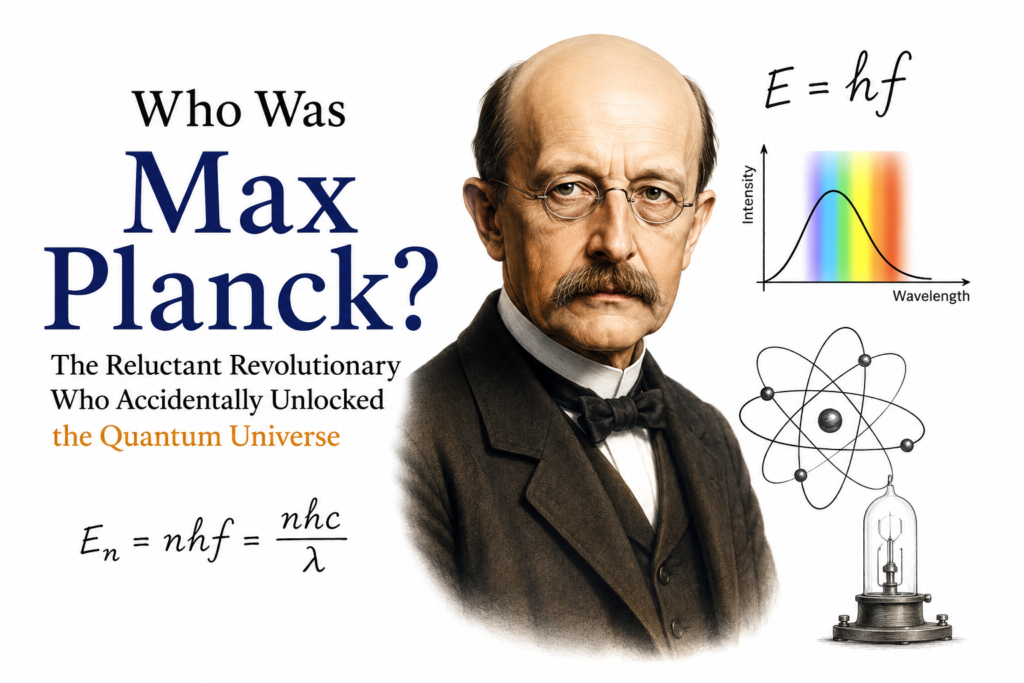
Few scientists in history have changed the course of physics while trying to preserve the old order rather than overthrow it. That is exactly what makes the question who was max planck so fascinating. He was not a rebel by temperament. He was a cautious, deeply traditional German theoretical physicist who respected classical physics above almost everything else. Yet in the year 1900, this same conservative thinker introduced an idea so radical that it eventually gave birth to an entirely new branch of science: quantum mechanics.
To understand who was max planck, you have to understand a man who never intended to be a revolutionary. He simply wanted to solve a nagging mathematical puzzle. Instead, he cracked open the door to a universe governed by discrete packets of energy, uncertainty, and probability, a universe far stranger than anything classical physics had imagined.
Who Was Max Planck? A Brief Introduction (1858 – 1947)
Max Karl Ernst Ludwig Planck was born on April 23, 1858, in Kiel, Germany, into a family with a long tradition of academics, lawyers, and clergymen. He grew up surrounded by discipline, structure, and intellectual seriousness, values that would define his entire career.
If you are still asking who was max planck in simple terms, think of him as the theoretical physicist who introduced the concept of energy quanta, the idea that energy is not continuous but comes in fixed, indivisible units. This single insight, born from an attempt to solve a technical problem in thermodynamics, became the foundation of modern quantum mechanics.
Planck lived through an extraordinary span of history, from the unification of Germany to two devastating world wars, and remained an active, respected voice in physics for more than five decades.
Early Life and Education of the Man Who Would Change Physics
Planck studied at the University of Munich and later the University of Berlin, where he was mentored by renowned physicists including Hermann von Helmholtz and Gustav Kirchhoff. Interestingly, one of his professors reportedly advised him against pursuing physics, claiming that most of the field’s major discoveries had already been made. Planck ignored this advice, driven by a genuine love for thermodynamics and the laws governing energy and heat.
He earned his doctorate in 1879 with a dissertation on the second law of thermodynamics, a subject that would quietly shape the rest of his scientific journey. Anyone researching who was max planck academically will find that his early obsession with entropy and energy conservation directly paved the way toward his most famous discovery decades later.
The Crisis That Sparked a Revolution: The Blackbody Radiation Problem (1859 – 1900)
By the late 1800s, physicists were struggling with a genuine crisis in classical physics known as the blackbody radiation problem. A blackbody is a theoretical object that absorbs all radiation that hits it and re-emits energy purely based on its temperature. Scientists wanted to predict exactly how much energy a blackbody would emit at each wavelength of light.
Using classical physics, particularly the Rayleigh-Jeans law, the predicted results matched observations reasonably well at longer wavelengths, but completely broke down at shorter, ultraviolet wavelengths. Classical equations predicted that a blackbody should emit infinite energy as wavelength decreased, a result that made no physical sense whatsoever. Physicists later nicknamed this glaring contradiction the ultraviolet catastrophe.
This was the exact puzzle that consumed Planck’s attention. Solving the blackbody radiation problem became his obsession, and understanding this crisis is essential to understanding who was max planck as a scientist.
The Quantum Hypothesis: Planck’s Radical Idea (1900)
In December 1900, Planck presented a solution to the German Physical Society that would forever alter the direction of physics. Instead of assuming energy could be emitted or absorbed continuously, he proposed that energy could only be emitted in discrete packets, which he called “quanta.”
This was the quantum hypothesis, and it directly contradicted more than two centuries of classical physics built on the work of Isaac Newton and James Clerk Maxwell. Planck himself was reportedly uncomfortable with the implications of his own idea, viewing it initially as a mathematical convenience rather than a description of physical reality. This reluctance is precisely why many historians describe him as a reluctant revolutionary when explaining who was max planck to modern readers.
The Mathematics Behind Planck’s Law of Radiation
To solve the ultraviolet catastrophe, Planck introduced a formula now known as Planck’s law of radiation. It describes the spectral energy density of radiation emitted by a blackbody at a given temperature:
B(ν, T) = (2hν³ / c²) × 1 / (e^(hν / kT) − 1)
Where:
- B(ν, T) represents the spectral radiance at frequency ν and temperature T
- h is Planck’s constant
- ν (nu) is the frequency of radiation
- c is the speed of light
- k is the Boltzmann constant
- T is the absolute temperature
The critical breakthrough was the assumption that energy is quantized according to the simple relation:
E = hν
This equation states that the energy (E) of a quantum of radiation is directly proportional to its frequency (ν), with planck’s constant (h) acting as the proportionality factor. The accepted value of h is approximately 6.626 × 10⁻³⁴ joule seconds, an extraordinarily small number that explains why quantum effects are invisible in everyday life but dominate at atomic scales.
This mathematical adjustment eliminated the divergence at high frequencies, perfectly matching experimental blackbody data and resolving the crisis that classical physics could not explain.
Planck’s Constant and Its Significance
Planck’s constant is now recognized as one of the fundamental constants of nature, alongside the speed of light and the gravitational constant. It sets the scale at which quantum effects become significant and appears in nearly every major equation of modern quantum theory, from the Schrödinger equation to Heisenberg’s uncertainty principle.
Understanding planck’s constant is essential to understanding who was max planck as a foundational figure, because this single number became the bridge connecting classical thermodynamics to the strange, probabilistic world of quantum mechanics.
Planck and Einstein: Building the Quantum Revolution (1900 – 1918)
Although Planck introduced energy quanta reluctantly, it was Albert Einstein who took the idea further. In 1905, Einstein used Planck’s quantum concept to explain the photoelectric effect, proposing that light itself behaves as discrete packets of energy called photons.
The relationship between planck and einstein was central to legitimizing quantum theory. While Planck remained cautious about the broader implications of his own hypothesis, Einstein embraced quantization as a genuine physical reality. Their intellectual partnership, along with contributions from Niels Bohr, transformed an obscure mathematical trick into a full-fledged scientific revolution now known as the quantum revolution.
Planck later became one of Einstein’s strongest supporters within the German scientific establishment, helping bring Einstein to Berlin and championing his work even when relativity faced skepticism.
The Nobel Prize and Recognition (1918)
In 1918, Planck was awarded the Nobel Prize in Physics for his discovery of energy quanta, a discovery that he initially viewed with hesitation. The Nobel committee recognized that his work had opened an entirely new field of physics, one that would eventually explain atomic structure, chemical bonding, semiconductors, and much of modern technology.
For anyone studying who was max planck through the lens of scientific achievement, the 1918 Nobel Prize stands as the formal acknowledgment that classical physics alone could no longer describe the universe.
Planck During the World Wars: Tragedy and Integrity
Planck’s personal life during the early twentieth century was marked by profound tragedy. He lost his son Karl in World War I, and later his twin daughters both died during childbirth years apart. During World War II, his son Erwin was executed in 1945 for alleged involvement in a plot against Adolf Hitler.
Despite living through Nazi Germany, Planck remained in the country and used his position to quietly protect Jewish scientists where possible, though his influence was limited under the regime. His home was destroyed by Allied bombing, and he lost most of his scientific papers and personal records. Even amid this devastation, Planck continued advocating for scientific integrity and rational thought until his death in 1947.
The Legacy: Max Planck Quantum Universe and Modern Physics
The influence of Planck’s work extends far beyond theoretical physics. The concept of energy quanta underpins semiconductors, lasers, medical imaging, solar panels, and quantum computing research today. The Max Planck Quantum Universe he unknowingly opened continues to expand nearly a century after his original discovery.
Germany’s premier scientific research organization, the Max Planck Society, was named in his honor, reflecting his lasting influence on global science. Understanding who was max planck today means recognizing him not just as a historical figure, but as the intellectual ancestor of nearly every modern technology built on quantum principles.
Frequently Asked Questions
Who was Max Planck and why is he important?
Max Planck was a German theoretical physicist who introduced the concept of energy quanta in 1900, laying the mathematical foundation for quantum mechanics and solving the blackbody radiation problem that classical physics could not explain.
What is Planck’s constant used for?
Planck’s constant relates the energy of a photon to its frequency through the equation E = hν. It is fundamental to quantum mechanics and appears throughout modern physics, chemistry, and engineering.
Did Max Planck believe in quantum theory?
Initially, Planck viewed his quantum hypothesis as a mathematical tool rather than a literal description of reality. It took years, along with contributions from Einstein and Bohr, before quantum theory was widely accepted as a genuine physical framework.
What award did Max Planck receive for his work?
Planck received the Nobel Prize in Physics in 1918 for his discovery of energy quanta, recognizing the discovery that reshaped the direction of twentieth century physics.
How is Max Planck connected to Albert Einstein?
Planck supported and promoted Einstein’s early work, including his use of quantum theory to explain the photoelectric effect. Their combined contributions helped establish quantum mechanics as a legitimate scientific field.
Conclusion
So, who was max planck, really? He was a careful, conservative physicist who never set out to challenge the scientific establishment, yet ended up dismantling more than two centuries of classical certainty with a single equation. His reluctant introduction of energy quanta solved an unsolvable problem and quietly launched the quantum revolution that defines modern science and technology. From smartphones to medical scanners to quantum computing, the fingerprints of Planck’s original 1900 insight are everywhere. Nearly eighty years after his death, the question of who was max planck remains one of the most important in the history of physics, because understanding him means understanding the very origins of the quantum age we now live in.