The seq2seq models history is one of the most fascinating stories in modern artificial intelligence. Long before large language models dominated headlines, a quieter revolution was happening inside research labs, where scientists were trying to teach machines to understand and generate human language, one sequence at a time.
If you have ever wondered how Google Translate went from clunky word swaps to surprisingly fluent sentences, or how voice assistants learned to respond in complete thoughts, you are looking at the legacy of sequence-to-sequence learning. This article walks you through the full journey, from the earliest ideas about temporal data processing to the neural breakthroughs that changed everything.
The Early Roots of Language Machines (1950 – 1966)
Long before anyone used the phrase seq2seq models history in a research paper, scientists were dreaming about machines that could process language. The groundwork began with simple ideas rooted in rule-based systems and Markov chains, where each word was predicted based only on the word before it.
In 1950, Alan Turing proposed his famous imitation game, planting the seed for machine understanding of language. By 1966, the ELIZA chatbot history was already capturing public imagination. ELIZA, built at MIT, used pattern matching and scripted responses to simulate conversation, but it had no real understanding. It could not handle dynamic input length or true language modeling evolution.
Statistical machine translation also emerged in this era. These early systems relied on counting word frequencies and using probability tables to guess translations. They worked for short phrases but collapsed under complex sentence structures. The bottleneck problem was already showing itself, even before anyone had a name for it.
Recurrent Neural Networks Enter the Picture (1980 – 1990)
The history of recurrent neural networks begins in earnest during the 1980s. Researchers realized that language is sequential. To understand a sentence, a model needs to remember what came before. This insight led to recursive architectures that could pass information forward through time.
Recurrent Neural Networks, or RNNs, were built around the idea of state-to-state mapping. Each word in a sequence would update a hidden state, which was then carried into the next step. This allowed the model to maintain context across time, a concept known as backpropagation through time.
However, RNNs had a critical flaw. When sequences grew long, gradients used during training would either explode or vanish. The vanishing gradient problem made it nearly impossible to train RNNs on anything longer than short phrases. Researchers could see the potential of temporal data processing, but the tools were not yet powerful enough to unlock it.
The LSTM Breakthrough (1997)
In 1997, Sepp Hochreiter and Jürgen Schmidhuber published their landmark paper introducing Long Short-Term Memory networks. LSTM was a direct answer to the vanishing gradient problem that had crippled RNNs.
LSTM units used special gates: an input gate, a forget gate, and an output gate. These gates allowed the network to selectively remember or forget information over long sequences. For the history of natural language processing, this was a defining moment. Suddenly, models could learn dependencies across dozens or even hundreds of time steps.
LSTM made real sequence-to-sequence learning possible. It formed the engine that would later power neural machine translation systems around the world. Alongside LSTM came Gated Recurrent Units, or GRU, introduced later by Cho et al. as a simpler but similarly powerful alternative that reduced computational cost while preserving performance on many tasks.
Word Embeddings and the Rise of Vector Representations (2003 – 2013)
To build useful seq2seq models, machines needed a way to represent words as numbers. The history of word embeddings traces back to early distributed representations, but the field truly exploded with neural language models in the early 2000s.
Bengio et al. in 2003 showed that words could be mapped into dense vector spaces where similar words clustered near each other. Then in 2013, Google researchers published Word2Vec, one of the most influential tools in the entire seq2seq models history. What is Word2Vec? It is a method that learns word embeddings from massive text corpora by predicting surrounding words, producing rich semantic representations that algorithms could actually use.
These hidden state vectors gave models a meaningful starting point. Instead of treating each word as an isolated symbol, the network could now understand that “king” and “queen” share structural similarity, that “Paris” and “France” are related in the same way as “Berlin” and “Germany.”
The Encoder-Decoder Breakthrough (2014)
The year 2014 marks a turning point in the seq2seq models history. Two independent research teams published papers that fundamentally changed how machines process language.
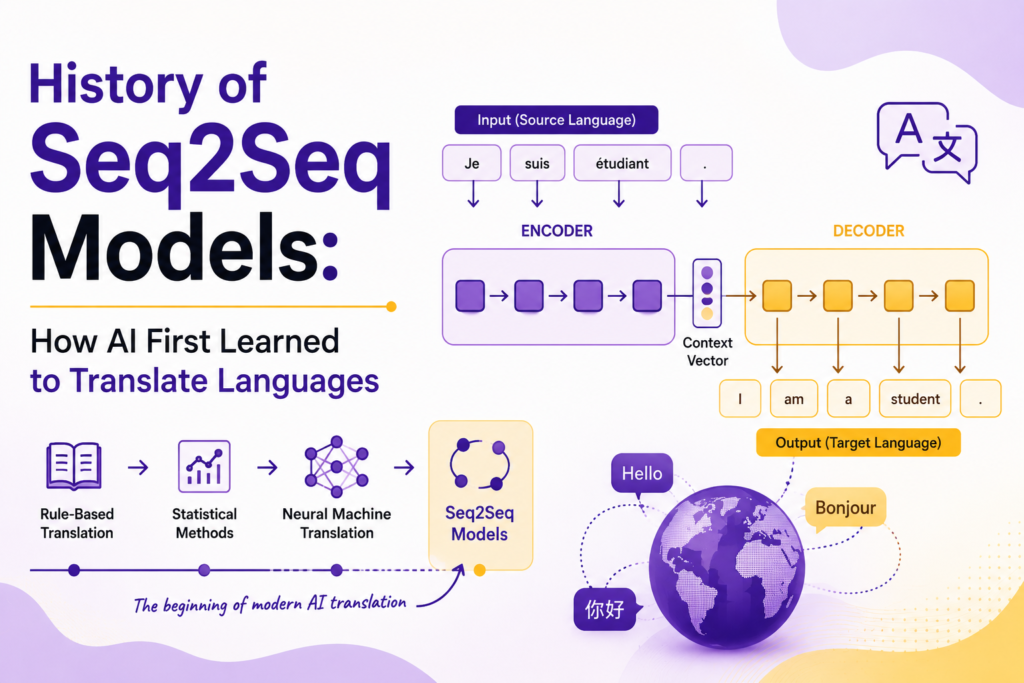
Ilya Sutskever, Oriol Vinyals, and Quoc Le, the group commonly referenced as Sutskever et al., introduced the sequence-to-sequence framework using LSTMs. Their model used an encoder-decoder paradigm: one LSTM network compressed an entire input sentence into a fixed-length context vector, and a second LSTM decoded that vector into the target language.
At nearly the same time, Kyunghyun Cho and colleagues proposed a similar architecture with Gated Recurrent Units. Their paper also introduced the attention mechanism concept in embryonic form. Together, these papers established neural machine translation as a serious field and gave researchers a clear architecture to build on.
The encoder-decoder paradigm was powerful but had one serious limitation. All the information from the source sentence had to be squeezed into a single fixed-length context vector. For long sentences, this created a bottleneck problem. The vector simply could not carry everything the decoder needed.
If you want to explore how these ideas connect to broader AI development, reading about the recurrent neural networks history gives you the full context of why this architecture was such a leap forward.
Attention Mechanism: Solving the Bottleneck (2015)
By 2015, researchers had identified the fixed-length context vector as a major weak point. Dzmitry Bahdanau, Kyunghyun Cho, and Yoshua Bengio published a paper that introduced alignment models, also known as the attention mechanism.
Instead of forcing the decoder to work from a single compressed vector, attention allowed the decoder to look back at all the encoder hidden states and decide which parts of the input to focus on at each step. This was a profound shift. Now, when translating a long sentence, the model could align specific output words with specific input words dynamically.
The attention mechanism solved the bottleneck problem and dramatically improved translation quality, especially for longer sentences. It also introduced a new form of interpretability. You could actually visualize which input words the model was paying attention to as it generated each output word.
Transformers and the End of Recurrence (2017)
In 2017, a team at Google Brain published a paper titled “Attention Is All You Need.” This paper, often referenced when discussing the attention mechanism explained in modern AI, introduced the transformer architecture and removed the need for recurrent networks entirely.
Transformers replaced sequential processing with parallel self-attention layers. Instead of processing words one at a time, the model could attend to all positions in the sequence simultaneously. This made training dramatically faster and allowed models to scale to sizes never before attempted.
The transformer architecture history begins here. From this point forward, almost every major AI language model would be built on the transformer framework. The encoder-decoder paradigm was preserved, but the underlying computation was entirely new.
For anyone researching the llm timeline, 2017 is the watershed year. Everything before was sequence processing with memory. Everything after was attention at scale.
From Seq2Seq to the Modern AI Era (2018 – Present)
The seq2seq models history did not end with transformers. It evolved into something larger. In 2018, Google released BERT, a transformer model trained on massive text using a technique called masked language modeling. BERT was not a seq2seq model in the traditional sense, it did not generate sequences, but it built directly on the encoder half of the encoder-decoder paradigm.
OpenAI released the GPT series beginning in 2018, using the decoder half. GPT models were trained to predict the next word in a sequence, which turned out to be a remarkably powerful form of pre-training. By the time GPT-3 arrived in 2020, the models were producing text indistinguishable from human writing in many contexts.
Today, applications ranging from customer service chatbots to code generation tools run on descendants of the original seq2seq architecture. If you are looking for practical tools that use this technology, exploring the best free ai tools 2026 can give you a sense of how widely these models have been deployed.
Why Seq2Seq Still Matters Today
Understanding the seq2seq models history matters because it reveals the logic behind modern AI. Every large language model today carries the DNA of these early sequence learning ideas. The encoder-decoder paradigm lives inside translation systems, summarization tools, and question-answering systems. The attention mechanism is now universal.
Fine tuning in AI, where a pre-trained model is adapted to a specific task, is a direct extension of the seq2seq approach. You train a model to understand sequences in general, then refine it for your use case. This technique has made AI accessible to thousands of developers who could not afford to train models from scratch.
The seq2seq models history also teaches an important lesson about progress. Each generation of researchers inherited a broken tool, the RNN with vanishing gradients, the encoder-decoder with its bottleneck, and turned the weakness into a new design principle.
Frequently Asked Quesions (FAQ)
What does seq2seq mean in AI?
Seq2seq stands for sequence-to-sequence. It refers to a class of models that take an input sequence, such as a sentence in French, and produce an output sequence, such as its translation in English. The model uses an encoder to process the input and a decoder to generate the output.
Who invented seq2seq models?
The foundational seq2seq framework was introduced in 2014 by Sutskever et al. at Google, alongside parallel work by Kyunghyun Cho and colleagues. However, the ideas build on decades of earlier research into recurrent neural networks and language modeling.
What problem did seq2seq models solve?
Early machine translation relied on statistical phrase tables and hand-crafted rules. Seq2seq models learned translation directly from data, handling variable-length inputs and outputs without rigid rule systems. This made translation far more flexible and accurate.
How is seq2seq different from a transformer?
A seq2seq model traditionally uses recurrent networks like LSTM to process sequences step by step. A transformer uses self-attention to process all positions simultaneously. Transformers are faster to train and perform better at scale, but the encoder-decoder structure they use was directly inherited from seq2seq research.
Is LSTM still used in 2026?
LSTM is used in specific applications where sequence length is moderate and computational resources are limited. However, for most state-of-the-art NLP tasks, transformers have largely replaced LSTM-based seq2seq models due to their superior scalability and performance.
Conclusion
The seq2seq models history is a story of patient problem-solving. From the primitive language machines of the 1960s to the LSTM networks of the late 1990s, from the encoder-decoder breakthrough of 2014 to the transformer revolution of 2017, every step built on the last.
Today, seq2seq models history sits at the foundation of a trillion-dollar AI industry. The same principles that helped a computer translate a sentence from French to English in 2014 now power systems that write essays, answer legal questions, and generate software code. Understanding where this all began is not just academic curiosity. It is the clearest way to understand where it is going next.
For those who want to go deeper into how these systems power today’s productivity stack, exploring resources around ai tools for productivity shows just how far the technology has traveled since the first seq2seq paper was published.