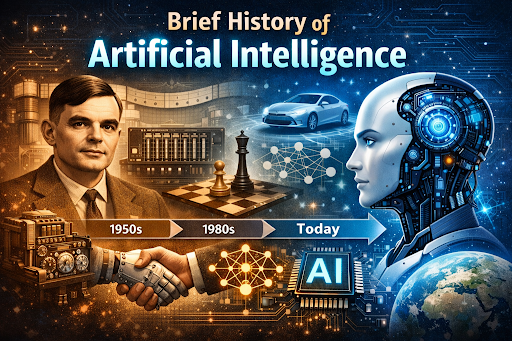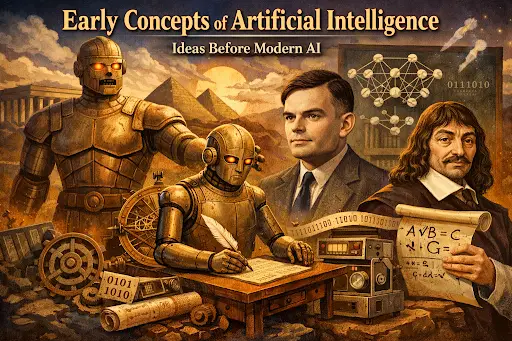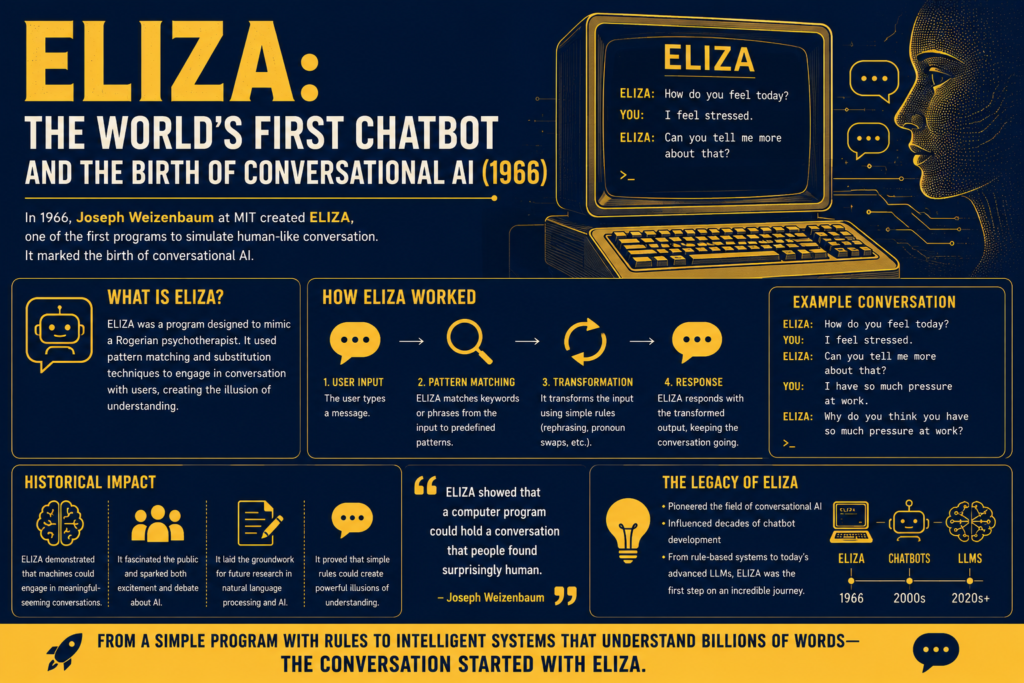
The eliza chatbot history is one of the most fascinating and surprising stories in the entire history of technology. Long before Siri, Alexa, or ChatGPT, a simple computer program created in 1966 made people cry, confide their deepest secrets, and genuinely believe they were talking to a human therapist. That program was ELIZA, and it changed the course of artificial intelligence forever.
Understanding the eliza chatbot history means understanding where conversational AI truly began, and why the lessons from that era still matter more than ever today.
Who Created ELIZA and Why (1964 – 1966)
ELIZA was created by Joseph Weizenbaum, a computer scientist at the MIT Artificial Intelligence Lab. He began developing the program around 1964 and published his landmark paper in 1966. Weizenbaum was not trying to create a believable AI. He was trying to demonstrate the superficiality of human-computer communication, to show how easily people could be fooled by simple pattern-matching tricks.
The name ELIZA came from the character Eliza Doolittle in George Bernard Shaw’s play Pygmalion, a woman who was taught to speak in a way that disguised her true nature. It was a perfectly chosen name for a program that appeared to understand without actually understanding anything at all.
Weizenbaum built ELIZA using SLIP, a Symmetric List Processor language he had developed himself. The program ran on an IBM 7094 computer at MIT, a machine that filled an entire room and cost more than most buildings.
How ELIZA Actually Worked: Pattern Matching and Scripts (1966)
At its core, the eliza chatbot history is a story about the remarkable power of illusion. ELIZA did not have intelligence. It had scripts. The most famous of these was the DOCTOR script, designed to simulate a Rogerian psychotherapist.
Rogerian psychotherapy is a non-directive form of therapy where the therapist mostly reflects the patient’s own words back to them and asks open-ended questions. It was the perfect model for a chatbot because it required almost no real knowledge. If someone said “I feel sad,” a Rogerian therapist might respond “Why do you feel sad?” ELIZA could do exactly that by identifying keywords and using templates to generate a response.
The pattern matching algorithms inside ELIZA would scan the user’s input for specific keywords. If it found “I am,” it might transform the sentence into a question. If it found “mother,” it would generate a response about family. If it found nothing useful, it would fall back on a safe, non-directional questioning response like “Please go on” or “Tell me more about that.”
This keyword-based responses system was simple, but it was shockingly effective at creating the appearance of understanding. The parsers and templates approach ELIZA used would go on to influence chatbot design for decades.
The ELIZA Effect: When Humans Fall for Machines (1966)
What happened next genuinely shocked Joseph Weizenbaum. People who interacted with ELIZA, including his own secretary who knew perfectly well it was a program, began treating it as a real therapist. They shared personal struggles, felt comforted by its responses, and in some cases became emotionally attached to it.
This phenomenon became known as the ELIZA effect, a term used to describe the human tendency toward anthropomorphism when interacting with machines. People project personality, understanding, and empathy onto systems that have none of these things. The chatbot mirror technique, where the program simply reflected the user’s own words back at them, was enough to trigger deep emotional responses in real people.
Weizenbaum was disturbed rather than proud. He later wrote a famous book called “Computer Power and Human Reason” in which he argued that certain human decisions should never be delegated to machines, no matter how convincing they appear. The eliza chatbot history, in his own telling, was as much a cautionary tale as a triumph.
ELIZA and the Turing Test Connection (1950 – 1970)
Alan Turing proposed his famous imitation game in 1950, suggesting that a machine able to pass as human in conversation could be considered intelligent. The Turing Test evolution became closely tied to programs like ELIZA, which seemed to pass informal versions of the test even while being fundamentally hollow.
ELIZA was never submitted to a formal Turing Test, but its real-world interactions raised serious questions. If users could not tell they were talking to a machine, did the distinction matter? Weizenbaum said absolutely yes. The appearance of understanding was not the same as real understanding.
This debate sits at the heart of computational linguistics roots and continues with renewed intensity today. When we talk to modern AI chatbots, are we experiencing genuine intelligence or a far more sophisticated version of the same trick ELIZA was playing back in 1966?
To understand how far the technology has come since ELIZA, it helps to look at the **[llm timeline](https://example.com)** that traces the journey from simple pattern matching to billion-parameter language models.
ELIZA’s Influence on Natural Language Understanding (1966 – 1980)
The eliza chatbot history had a profound impact on the development of natural language understanding as a serious research field. Before ELIZA, few people outside academia thought machines could ever simulate conversation convincingly. After ELIZA, the field began to grow rapidly and attract serious funding and talent.
Researchers started asking sharper questions about the relationship between language, meaning, and thought. Symbolic AI, which relied on logical rules and human-coded knowledge, dominated the field for years after ELIZA. The idea was that if you could write enough rules about language, you could capture enough structure to build a truly intelligent system.
The history of natural language processing through this period shows how ELIZA set the agenda for a generation of AI researchers, even as the limitations of rule-based systems became increasingly clear.
PARRY: The Chatbot That Played the Patient (1972)
ELIZA inspired a wave of similar programs. PARRY, created in 1972 by psychiatrist Kenneth Colby, was designed to simulate a patient with paranoid schizophrenia. Unlike ELIZA which played the therapist, PARRY played the patient. It had a model of emotional states and could respond with simulated suspicion, hostility, or fear depending on the conversation.
In one famous experiment, professional psychiatrists could not reliably distinguish PARRY from a real human patient in text-based interviews. This was a significant moment in the eliza chatbot history tradition, showing that rule-based systems could simulate not just therapists but patients with complex psychological profiles.
PARRY also introduced the idea that a chatbot could have a consistent personality and internal state, not just a set of response rules. This was a small but important step toward the more sophisticated AI personalities we interact with today.
The Scripting Language Legacy (1966 – 1990)
One of the most lasting technical contributions of the eliza chatbot history is the concept of the scripting language for chatbots. ELIZA separated the general language-processing engine from the specific scripts that defined the conversation topic. This was genuinely innovative architecture for its time.
It meant that anyone who learned the script format could create a new type of ELIZA conversation without touching the underlying code. You could write a script for a teacher, a doctor, or a customer service agent. The engine stayed the same; only the personality and topic changed.
This architecture influenced decades of rule-based chatbot design. The early customer service bots of the 1990s and 2000s, the ones that guided you through menus and asked you to “press 1 for billing,” are direct descendants of ELIZA’s scripting philosophy.
From ELIZA to Modern AI: A Massive Leap (1966 – 2024)
The journey from eliza chatbot history to today’s AI assistants covers more than half a century of research, failure, and breakthrough. After ELIZA, AI went through several boom and bust cycles known as AI winters, periods when funding dried up because the technology failed to deliver on its promises.
The rise of machine learning, deep neural networks, and eventually the transformer architecture changed everything. Modern systems like ChatGPT do not rely on scripts or pattern matching. They learn from billions of examples and develop probabilistic representations of language that allow them to generate responses no one ever wrote down.
Yet the ELIZA effect has not disappeared. People today still form emotional bonds with AI chatbots, prefer AI companions in some situations, and anthropomorphize AI systems with remarkable ease. Weizenbaum’s original concern, that the appearance of understanding can be as dangerous as the real thing, has never been more urgent.
Understanding how those modern systems actually work under the hood requires exploring what is rlhf, the technique that made modern AI chatbots genuinely helpful rather than just technically impressive.
ELIZA in Popular Culture and Education
The eliza chatbot history has taken on a life well beyond computer science labs. ELIZA has been referenced in novels, films, and academic courses around the world. It appears in introductory AI and cognitive science courses as the perfect illustration of how perception shapes our experience of intelligence.
In education, ELIZA is used to teach students about early human-computer interaction, the limits of symbolic AI, and the philosophical puzzles surrounding machine consciousness. It is a program that keeps asking important questions long after it stopped being technically impressive.
The openai history that led to ChatGPT shows how far the ambitions Weizenbaum accidentally sparked in 1966 have been carried forward by a new generation of researchers with vastly more powerful tools.
ELIZA and the Question of AI Consciousness
The eliza chatbot history raises questions that philosophy and neuroscience still cannot fully answer. If a machine produces outputs that are indistinguishable from a conscious being, does that mean it is conscious? Weizenbaum said no, emphatically. But not everyone agreed then, and not everyone agrees now.
John Searle’s famous “Chinese Room” thought experiment, published in 1980, was partly inspired by programs like ELIZA. Searle argued that manipulating symbols according to rules, no matter how cleverly done, is not the same as understanding meaning. The eliza chatbot history gave philosophers a perfect real-world example to argue about.
These debates matter more than ever as AI systems grow more capable. If you want to explore the best AI tools available today and see how far we have come from ELIZA’s simple scripts, checking out ai tools for productivity gives you a vivid sense of what decades of progress looks like in practice.
The Legacy of Joseph Weizenbaum
Joseph Weizenbaum spent much of his career warning against the uncritical embrace of AI. He believed humans were in danger of surrendering their judgment and responsibility to machines that only appeared to understand. He died in 2008, but his warnings feel more urgent than ever.
The eliza chatbot history is not just a technical footnote. It is a mirror held up to human psychology, showing how desperately we want to be heard and understood, and how easily we can be convinced that a machine is doing it.
Frequently Asked Questions (FAQs)
What was the purpose of ELIZA in AI development?
ELIZA was originally created to demonstrate how humans project meaning onto simple programs. It unintentionally launched the field of conversational AI and inspired decades of chatbot research around the world.
Who invented ELIZA and when was it created?
Joseph Weizenbaum at MIT created ELIZA between 1964 and 1966, publishing his findings in the journal Communications of the ACM in January 1966.
What is the ELIZA effect and why does it matter?
The ELIZA effect refers to the human tendency to anthropomorphize AI systems, attributing emotions, understanding, and personality to programs that actually have none of these qualities.
How did ELIZA differ from modern AI chatbots?
ELIZA used rigid pattern matching and scripts with no learning ability whatsoever. Modern chatbots use deep learning trained on billions of text examples to generate contextually rich and adaptive responses.
Did ELIZA pass the Turing Test?
ELIZA was never formally tested, but many users were genuinely fooled in informal interactions. Whether this counts as passing the Turing Test depends on how strictly you define the test and what you think it actually measures.
Conclusion
The eliza chatbot history is a story that contains multitudes. It is a technical achievement, a psychological experiment, a philosophical warning, and the unlikely starting point of one of the most powerful technologies ever built. Joseph Weizenbaum created ELIZA to show the limits of machines and instead revealed the limits of human skepticism. Every time you chat with an AI assistant today, you are in some small way talking to a distant descendant of that curious program from 1966. The eliza chatbot history reminds us that the line between appearing intelligent and being intelligent has always been far harder to draw than we think.