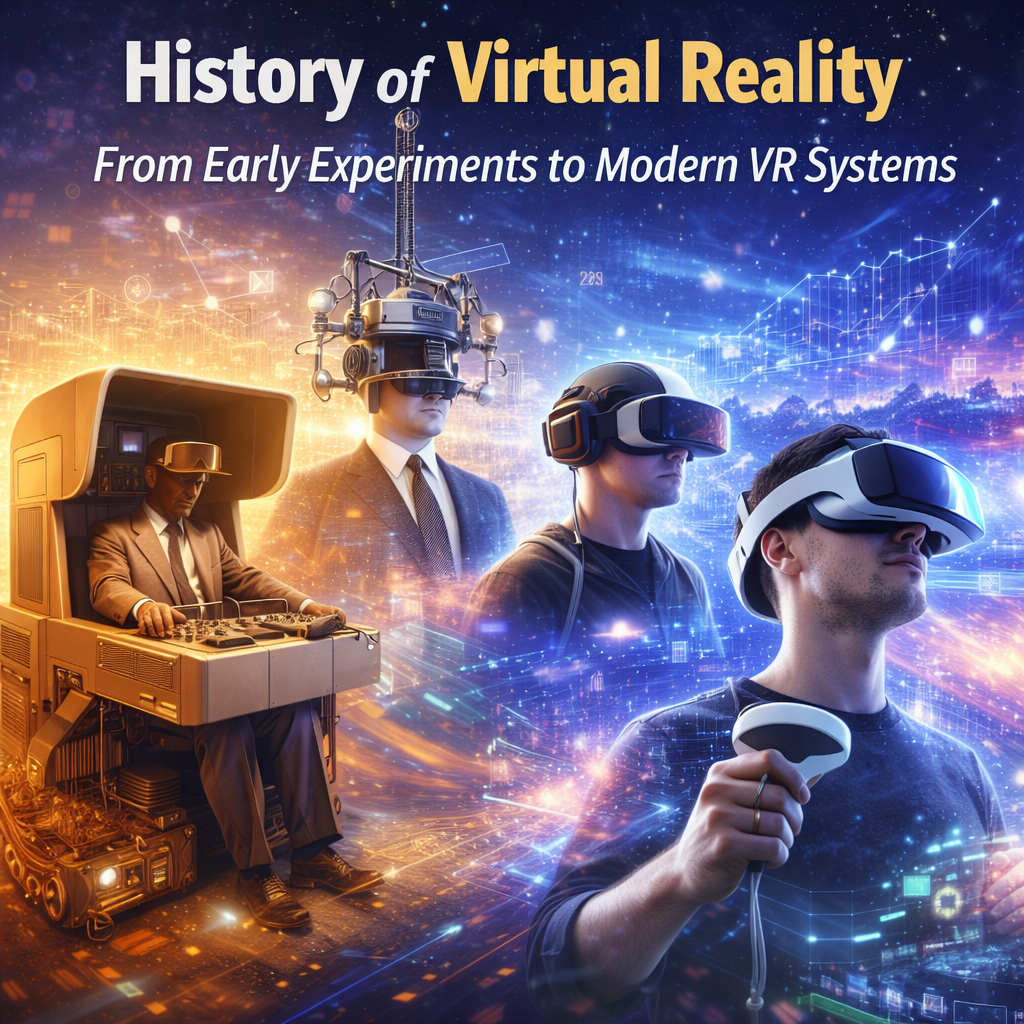
The dream of stepping into an entirely different world has captivated the human imagination for centuries, but the technical History of Virtual Reality only truly began when we learned to trick the human senses using electronics. Today, VR is a multi-billion dollar industry that powers everything from high-end gaming to surgical simulations. However, the virtual reality technology evolution was not a sudden burst of innovation; it was a slow, often difficult journey that relied on the simultaneous advancement of optics, processing power, and user interface design. By looking back at the History of Computer Hardware, we can see how each generation of engineers brought us one step closer to making the digital feel tangible.
Early VR Concepts and Experiments – 1950s
The foundations of immersive experiences were laid not by computer scientists, but by a cinematographer named Morton Heilig. In the mid-1950s, Heilig envisioned a “Cinema of the Future” that would encompass all the senses. This led to one of the most famous early VR experiments: the Sensorama (1956).
The Sensorama was a large, booth-like machine that featured a stereoscopic 3D display, fans to simulate wind, odor emitters to recreate smells, and a vibrating seat. While it was entirely mechanical and lacked the interactivity of modern systems, it proved that immersion was possible. During this era, the History of Computer Graphics was still in its infancy, consisting mostly of simple blips on radar screens, making Heilig’s mechanical approach the only way to achieve such a sensory-rich experience.
First VR Head-Mounted Display – 1960s
The 1960s marked the transition from mechanical booths to wearable technology. In 1968, Ivan Sutherland and his student Bob Sproull created the first VR head-mounted display history-making device: The Sword of Damocles. This system was so heavy that it had to be suspended from the ceiling to prevent the user’s neck from breaking—hence its ominous name.
Despite its weight, it was a breakthrough because it used computer-generated wireframe graphics that changed perspective as the user moved their head. This was the first time that the History of Computer Hardware and the History of Computer Graphics merged to create a reactive virtual environment. It established the “head-tracking” principle that remains the core of every modern headset today.
Virtual Reality Research and Simulation – 1980s
The 1980s saw the term “Virtual Reality” coined by Jaron Lanier, the founder of VPL Research. This decade shifted the focus from experimental laboratory prototypes to practical research and military simulation. NASA and the U.S. Air Force began using the Virtual Interface Environment Workstation (VIEW) to train pilots and astronauts.
As the virtual reality timeline progressed, we saw the introduction of the DataGlove and the EyePhone. These devices allowed users to “see” their hands in the digital space and interact with objects. This period was heavily influenced by the History of Data Science, as researchers began to analyze how the human brain processes spatial information and “presence.” Scientists realized that to make a world feel real, the data regarding head and hand movement had to be processed with zero perceivable lag.
Early Commercial VR Systems – 1990s
By the 1990s, the gaming industry believed that VR was ready for the masses. This decade was defined by a surge of early commercial VR systems, most notably from Sega and Nintendo. Sega announced the Sega VR headset for the Genesis console, but it was never released due to technical issues and fears of motion sickness.
Nintendo did release the Virtual Boy in 1995, but it was a commercial failure. It was bulky, used a headache-inducing red monochrome display, and wasn’t truly “portable.” The failure of these systems was largely because the History of Computer Hardware had not yet reached a point where it could provide high-resolution graphics at the high frame rates required for comfort. Many people also struggled with the lack of History of Cloud Storage at the time, as large-scale virtual environments required massive amounts of local data that early consoles simply couldn’t handle.
VR Revival and Consumer Devices – 2010s
After a decade of “VR winter,” the technology saw a massive revival in 2012. A young inventor named Palmer Luckey launched a Kickstarter campaign for the Oculus Rift. Unlike the systems of the 90s, the Rift benefited from the History of Mobile Technology. High-resolution, small-scale screens and tiny gyroscopes developed for smartphones were now cheap and powerful enough to be repurposed for VR headsets.
This sparked a gold rush in virtual reality technology evolution. Facebook (now Meta) acquired Oculus for $2 billion, and competitors like the HTC Vive and PlayStation VR entered the market. This era introduced “Room-Scale” VR, allowing users to physically walk around their virtual rooms. The History of Cloud Storage also became vital during this time, as developers began hosting massive multiplayer virtual worlds that could be updated in real-time across the globe.
Advanced VR Technology and the Metaverse – 2020s
As we look at the current state of modern VR systems in the 2020s, the focus has shifted toward standalone headsets like the Meta Quest and high-fidelity “spatial computing” devices like the Apple Vision Pro. We are no longer tethered to PCs by thick cables; the processing power is now built directly into the headset.
The future of virtual reality is increasingly tied to the concept of the “Metaverse”—a persistent, shared digital space where people work, play, and socialize. This requires a seamless integration of the History of Mobile Technology for portability and the History of Data Science for creating realistic avatars and environments. We are also seeing the rise of “Mixed Reality” (MR), where digital objects are overlaid onto the real world, blurring the lines between what is physical and what is virtual
Frequently Asked Questions (FAQs)
1. What was the first VR headset ever made?
The first VR head-mounted display (HMD) was the “Sword of Damocles,” created by Ivan Sutherland in 1968. It featured wireframe graphics and was suspended from the ceiling.
2. Why did VR fail in the 1990s?
The technology was not yet advanced enough. Hardware was too expensive, the graphics were low-resolution, and slow frame rates caused significant motion sickness for most users.
3. What is the difference between VR and AR?
Virtual Reality (VR) completely replaces your field of vision with a digital world. Augmented Reality (AR) overlays digital images or information onto the real world, like Pokémon GO.
4. How has mobile technology helped VR?
Modern VR headsets use the same high-resolution displays, powerful processors, and motion-tracking sensors that were originally developed and mass-produced for smartphones.
5. Who coined the term “Virtual Reality”?
Jaron Lanier, the founder of VPL Research, is credited with popularizing the term in the mid-1980s.
Conclusion
The History of Virtual Reality is a testament to human persistence. From the aromatic booths of Sensorama 1956 to the sleek, standalone modern VR systems of today, we have spent seventy years trying to transcend our physical reality. By leveraging the History of Computer Graphics and the History of Computer Hardware, we have finally reached a point where the digital world can be as convincing as the physical one. As we look toward the future of virtual reality, it is clear that we are only at the beginning of this journey. The dream of Ivan Sutherland and Morton Heilig hasn’t just been realized—it’s being expanded into a new dimension of human experience.