Introduction
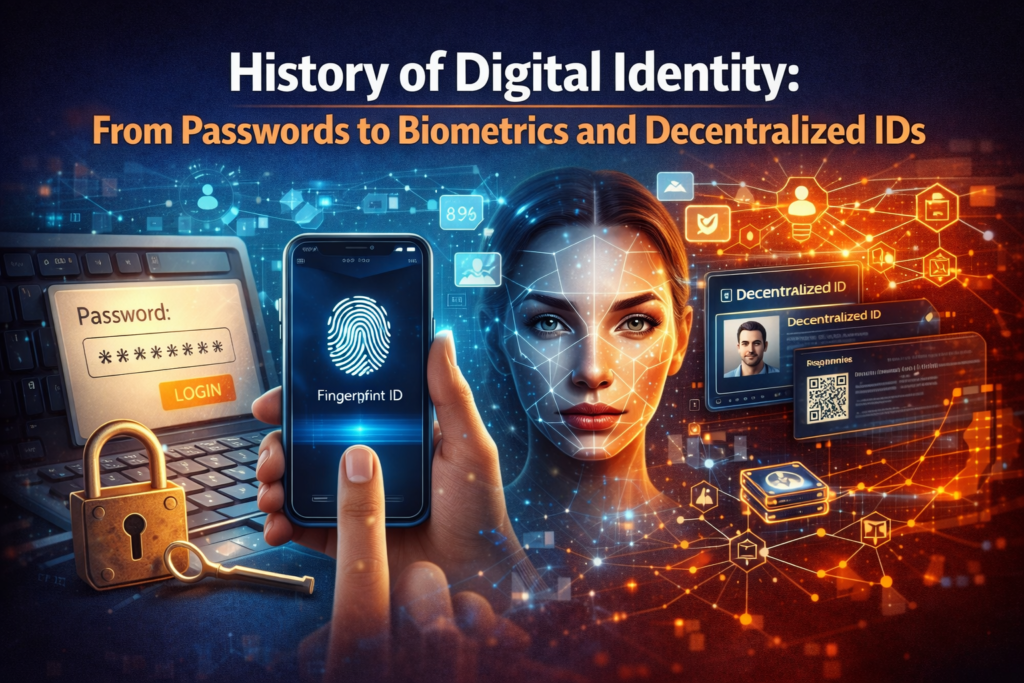
Every time you log into a website, unlock your phone, or swipe your badge at work, you are asserting your digital identity. The history of digital identity is a powerful story of constant tension between convenience and security. What began with simple passwords that users wrote on sticky notes has evolved into brilliant systems that recognize your face, your fingerprint, and even your behavior. Yet the journey is far from complete. Identity theft affects millions annually. Data privacy breaches expose billions of credentials. The history of digital identity reveals an arms race between authenticators and attackers, between usability and safety. Understanding this evolution helps us appreciate the amazing technologies that protect our digital lives and glimpse the passwordless future that awaits.
Before Digital: Physical Proof of Identity (Pre 1960)
Long before computers, humans needed ways to prove who they were. Governments issued passports and driver’s licenses. Employers provided photo ID badges. Banks required signatures and personal questions. These physical credentials shared a common flaw: they could be forged, stolen, or borrowed. The history of computers was still unfolding when the first digital identity systems emerged. Early mainframes required users to present themselves to an operator who verified their identity manually. This worked for a handful of researchers but could never scale. The history of digital identity began when computers needed to distinguish between legitimate users and unauthorized visitors without human intermediaries.
The Password Era Begins (1960 – 1970)
The password is the oldest digital identity mechanism still in widespread use today. In the early 1960s, MIT’s Compatible Time Sharing System (CTSS) became one of the first systems to require passwords for access. Researchers working on history of operating systems realized that multiple users sharing a single mainframe needed isolation. A password protected each user’s files from others. The concept was simple. Something you know. If you knew the secret word, the system trusted you.
The history of digital identity took a huge leap forward in the 1970s when cryptographer Robert Morris invented the Unix password system. Instead of storing passwords in plain text, Morris stored hashed versions. A cryptographic hash function converts a password into a fixed length string that is easy to compute but nearly impossible to reverse. When a user logged in, the system hashed the entered password and compared it to the stored hash. Even if an attacker stole the password file, they could not easily recover the actual passwords. This brilliant innovation protected millions of accounts and remains the foundation of User authentication today.
However, passwords had fatal weaknesses. Humans choose weak passwords like “password123” or “qwerty.” They reuse the same password across multiple sites. They write passwords on sticky notes attached to monitors. The history of cybersecurity shows that passwords are the single biggest attack vector for breaches. Phishing attacks trick users into revealing passwords. Keyloggers capture keystrokes. Database breaches expose millions of hashed passwords that attackers crack offline. The history of digital identity needed stronger methods.
The Birth of Single Sign On (1990 – 2000)
As users accumulated dozens of passwords, an obvious problem emerged: password fatigue. Users could not remember unique strong passwords for every service. The solution was Single Sign On (SSO) . With SSO, a user authenticates once and gains access to multiple applications without re entering credentials. The history of digital identity saw several early SSO attempts. Microsoft introduced Passport in 1999, a centralized identity service that would let users log into any participating website with a single Microsoft account. Privacy concerns and technical challenges limited adoption.
The real breakthrough came from the open source community. OAuth and OpenID Connect emerged as industry standards. OpenID, created in 2005, allowed users to authenticate using an existing account from a trusted provider. OAuth, published in 2007, focused on authorization rather than authentication. It allowed a user to grant a website access to their data stored on another site without sharing passwords. For example, “Log in with Google” or “Sign in with Facebook.” OAuth 2.0 and OpenID Connect, released in the early 2010s, became the dominant standards for Credential management across the web.
Active Directory , Microsoft’s directory service launched with Windows 2000, became the standard for enterprise SSO. Organizations could manage employee identities centrally. When an employee joined, the IT team created one account. That single identity granted access to email, file servers, internal websites, and business applications. When the employee left, disabling one account revoked all access. The history of digital identity had finally solved the proliferation problem, but SSO introduced a new risk: a single compromised credential could unlock everything.
Multi Factor Authentication Raises the Bar (2000 – 2015)
Security experts realized that passwords alone would never be sufficient. The solution was Multi Factor Authentication (MFA) . MFA combines two or more independent credentials. Something you know (a password). Something you have (a phone or hardware token). Something you are (a fingerprint or face). Even if an attacker steals your password, they cannot log in without also possessing your phone or your fingerprint.
The history of digital identity embraced MFA rapidly. In 2005, RSA Security popularized hardware tokens that displayed rotating six digit codes. Users entered their password plus the current code. The codes changed every 60 seconds, making stolen tokens useless after a minute. Later, software authenticators like Google Authenticator (2010) replaced hardware tokens. Users scanned a QR code to link their phone to an account, then the phone generated time based codes. SMS based verification became common, though security experts warned that SIM swapping attacks could intercept SMS codes.
The FIDO Alliance (Fast IDentity Online) was founded in 2012 to create stronger authentication standards. FIDO Alliance members included Google, Microsoft, Apple, and PayPal. Their goal was to eliminate passwords entirely. FIDO2, the alliance’s flagship standard, allows users to log in using biometrics or a hardware security key. When you unlock your laptop with a fingerprint or use a YubiKey, you are using FIDO2. The history of digital identity was moving decisively toward a Passwordless future.
Biometrics Enter the Mainstream (2010 – 2018)
For decades, biometrics seemed like science fiction. Retina scans appeared in spy movies. Fingerprint readers were expensive peripherals for high security facilities. The history of digital identity changed dramatically when smartphones brought biometrics to the masses. In 2013, Apple introduced Touch ID, a Fingerprint scanning sensor built into the iPhone’s home button. Suddenly, unlocking your phone required no password. Just a touch.
Fingerprint scanning offered excellent convenience but had limitations. Wet or dirty fingers caused failures. The sensor could be spoofed with high resolution prints. In 2017, Apple introduced Face ID on the iPhone X. Facial recognition using a sophisticated TrueDepth camera projected 30,000 invisible dots onto the user’s face. The system created a mathematical model and compared it to the enrolled face. Face ID worked in the dark, adapted to changes in appearance, and required the user’s attention (eyes open, looking at the phone). Android competitors introduced similar systems, though some used less secure 2D cameras that could be tricked by photographs.
The history of mobile technology accelerated biometric adoption. Users enrolled fingerprints and faces without thinking about security implications. Biometrics offered a solution to the password reuse problem. You could not reuse your face across multiple sites. You could not forget your fingerprint. But biometrics introduced new concerns. Data privacy advocates worried about centralized storage of biometric templates. If a password database is breached, you change your password. If a fingerprint database is breached, you cannot change your fingers. The history of digital identity had to address these risks.
The Rise of Identity as a Service (2010 – Present)
Managing digital identities became too complex for most organizations to handle internally. Identity as a Service (IDaaS) emerged as a cloud based solution. Vendors like Okta, Auth0 (acquired by Okta), Ping Identity, and Microsoft Azure AD provided turnkey identity management. Companies could outsource User authentication, SSO, MFA, and lifecycle management. IDaaS offerings integrated with thousands of applications through pre built connectors.
The history of cloud computing enabled IDaaS to scale globally. A startup could implement enterprise grade identity management in hours rather than months. Features like adaptive authentication used risk signals (unusual location, new device, impossible travel) to challenge users only when necessary. If you always log in from New York but suddenly attempt access from Russia, the system requires additional verification. The history of digital identity became smarter and more contextual.
Access control evolved beyond simple yes/no decisions. Attribute based access control (ABAC) considered user attributes (department, role, clearance level), resource attributes (document classification, data sensitivity), and environmental attributes (time of day, network location). A finance manager could access payroll data during business hours from the corporate network but not from a coffee shop at midnight. The history of databases and history of software engineering both contributed to these sophisticated policy engines.
Decentralized Identity and Self Sovereign Identity (2015 – Present)
Centralized identity systems gave powerful organizations control over your digital identity. Google knows every site where you used “Sign in with Google.” Facebook tracks your activity across the web. Governments issue digital IDs that they can revoke at any time. The history of digital identity took a radical turn with the concept of Self Sovereign Identity (SSI) . SSI puts individuals in control of their own identity data. No central authority issues or stores your identity. You hold your credentials in a digital wallet on your phone.
Verifiable credentials are the building blocks of SSI. A university issues a digital diploma to your wallet. The university cryptographically signs the credential. Later, when you apply for a job, you present the credential to the employer. The employer verifies the cryptographic signature without contacting the university. You choose what information to share. You can prove you graduated without revealing your GPA, your birth date, or your student ID number. Zero Knowledge Proofs (ZKP) enable this selective disclosure. A ZKP allows you to prove a statement is true without revealing any additional information. “I am over 21 years old” can be proven without showing your exact birth date.
The history of blockchain technology and decentralized ledgers provides the infrastructure for SSI. Indy, a blockchain based SSI platform, maintains a global ledger of public keys but stores no personal data. Sovrin Network, built on Indy, operates as a public utility for digital identity. The European Union is building a digital identity wallet based on SSI principles. The history of digital identity may eventually shift from corporate and government controlled identities to user controlled ones. However, adoption remains slow. SSI requires users to manage their own keys, which is technically demanding. Losing your digital wallet means losing your identity.
Zero Trust and Continuous Authentication (2018 – Present)
The traditional security model assumed that users inside the corporate network were trustworthy. This “castle and moat” approach failed when employees worked remotely, used personal devices, and accessed cloud applications. Zero Knowledge Proofs (ZKP) and zero trust architecture emerged as the new paradigm. Zero trust means “never trust, always verify.” Every access request is fully authenticated, authorized, and encrypted before granting access. The history of cybersecurity shows that perimeter based security is obsolete.
Continuous authentication takes zero trust further. Instead of authenticating once at login, continuous authentication verifies identity throughout the session. Behavioral biometrics analyze how you type, how you move your mouse, how you hold your phone, and even your walking gait. If an attacker steals your session after you log in, their typing rhythm would differ from yours, triggering an automatic logout. The history of digital identity is becoming invisible. Authentication happens constantly in the background without user friction.
Digital footprint analysis adds another layer. Systems learn your normal patterns. Your typical login time, your usual IP address range, your common devices. When something deviates from the pattern, the system challenges you or blocks access. Machine learning models improve continuously, adapting to changes in your behavior over time. The evolution of gpus and specialized AI chips has made real time behavioral analysis possible at scale.
Privacy Regulations Reshape Identity (2016 – Present)
The history of digital identity has been shaped as much by laws as by technology. The European Union’s General Data Protection Regulation (GDPR), effective 2018, gave individuals unprecedented control over their personal data. Organizations must obtain explicit consent before collecting identity data. Individuals have the right to access, correct, and delete their data. The right to be forgotten means organizations must erase identity data upon request. Similar laws followed in California (CCPA), Brazil (LGPD), and other jurisdictions.
These regulations forced companies to rethink Data privacy practices. They could no longer collect identity data indefinitely “just in case.” They needed legitimate purposes and retention policies. Privacy by design became a legal requirement, not just a best practice. The history of digital identity saw the rise of privacy enhancing technologies. Anonymous credentials allow authentication without revealing identity. Differential privacy adds mathematical noise to datasets to prevent re identification. Homomorphic encryption allows computation on encrypted data without decryption.
Trust frameworks emerged to govern identity ecosystems. A trust framework is a set of legal, technical, and operational rules that participants agree to follow. The Kantara Initiative, the OpenID Foundation, and the Decentralized Identity Foundation publish trust frameworks. Governments use trust frameworks for digital ID programs like Australia’s myGovID and the UK’s GOV.UK Verify. The history of digital identity increasingly involves compliance with complex, overlapping regulations.
The Passwordless Future Arrives (2020 – Present)
Major technology companies have declared war on passwords. In 2022, Apple, Google, and Microsoft jointly announced support for passkeys, a FIDO2 based passwordless standard. A passkey is a cryptographic key pair stored on your device. The private key never leaves the device. The public key is registered with each website. To log in, you unlock your device with biometrics (or a PIN), and the device cryptographically signs a challenge. The website verifies the signature using the public key. No password is ever created, transmitted, or stored.
The history of digital identity reached a milestone in 2023 when Google made passkeys the default login method for personal Google accounts. Microsoft and Apple followed. Users can create passkeys on their phones and use them to log into websites on nearby computers via Bluetooth. The Passwordless future is no longer theoretical. It is happening now. Passkeys resist phishing because there is no password to steal. They resist database breaches because websites store only public keys, which are useless to attackers. They synchronize across devices via cloud backup, solving the lost device problem.
However, the transition will take years. Hundreds of millions of legacy systems still rely on passwords. Cyber security teams must manage hybrid environments where some users have passkeys and others have passwords. The evolution of search engines and the history of digital payments both show that technology transitions are messy. But the direction is clear. Passwords, the oldest digital identity mechanism, are finally being retired.
Decentralized IDs and Self Sovereign Identity Mature (2023 – Present)
The history of blockchain technology and decentralized identity are converging. The World Wide Web Consortium (W3C) standardized Decentralized Identifiers (DIDs) in 2022. A DID is a globally unique identifier that is created, owned, and controlled by the individual. DIDs are registered on a distributed ledger or other decentralized system. They resolve to a DID document containing public keys and service endpoints. No central authority can revoke or modify a DID without the owner’s private key.
Self Sovereign Identity (SSI) ecosystems are launching in production. The European Union’s European Digital Identity Wallet, planned for 2026, will let citizens store and present verifiable credentials for everything from driver’s licenses to bank accounts. Over 80 million citizens will use it. The history of digital identity is becoming more democratic and privacy preserving. Individuals will carry their identity in their pocket, controlled entirely by them.
Challenges remain. Interoperability between different SSI systems is not yet solved. User experience must improve dramatically. Managing cryptographic keys is hard for ordinary people. The evolution of the first digital computer from expert only machines to user friendly devices shows that usability can be achieved with enough design effort. The same will happen for SSI.
Frequently Asked Questions (FAQs)
Q1: Why are passwords still used if they are insecure?
Passwords are universal, require no special hardware, and work across every device and platform. Billions of existing systems rely on passwords. Transitioning to passwordless authentication is a massive undertaking. However, major companies are now replacing passwords with passkeys, and passwords will eventually become obsolete.
Q2: Is facial recognition safe from spoofing?
Modern Facial recognition systems using infrared depth mapping (like Apple’s Face ID) are very secure against photos or masks. However, lower end systems using standard cameras can be tricked. No biometric system is perfect, which is why combining biometrics with other factors (something you have, like a phone) is recommended.
Q3: What happens if I lose my phone with my Self Sovereign Identity wallet?
Self Sovereign Identity (SSI) systems include recovery mechanisms. Your digital wallet is encrypted and backed up to cloud storage or distributed among trusted guardians. Unlike a password, you cannot reset your identity if you lose all keys. Protecting recovery phrases (12 to 24 random words) is critically important.
Q4: How does Multi Factor Authentication protect me?
Multi Factor Authentication (MFA) requires two or more different types of credentials. Even if an attacker steals your password (something you know), they cannot log in without also possessing your phone or hardware token (something you have) or your fingerprint (something you are). MFA blocks over 99 percent of automated attacks.
Q5: What is the difference between OAuth and OpenID Connect?
OAuth and OpenID Connect serve different purposes. OAuth is for authorization (granting access to resources). OpenID Connect is for authentication (verifying who you are). In practice, OpenID Connect is built on top of OAuth 2.0. “Login with Google” uses OpenID Connect to verify your identity and OAuth to access your basic profile information.
Q6: What is a passkey and how is it better than a password?
A passkey is a cryptographic key pair stored on your device. The private key never leaves your device. You unlock it with biometrics. There is no password to steal, guess, or phish. Passkeys resist database breaches because websites store only public keys. They synchronize across devices via cloud backup.
Q7: Can decentralized IDs really replace government issued IDs?
In some contexts, yes. Verifiable credentials can be issued by governments and stored in digital wallets. Estonia has issued digital IDs to citizens since 2002. The EU’s European Digital Identity Wallet will be legally equivalent to physical IDs. However, physical IDs will remain for situations without internet access or for those who prefer paper.
Conclusion
The history of digital identity from passwords to biometrics to decentralized IDs is a powerful story of brilliant innovation in response to constant threats. Passwords gave us a simple start but proved dangerously weak. Multi Factor Authentication and biometrics raised the security bar dramatically. Identity as a Service brought enterprise grade capabilities to organizations of all sizes. Self Sovereign Identity promises a future where individuals control their own identity data without central authorities. The history of cybersecurity shows that attackers always adapt, so defenders must keep evolving. The passwordless future is arriving through passkeys and FIDO2. The decentralized future is arriving through DIDs and verifiable credentials. As Data privacy concerns grow and regulations multiply, the history of digital identity will continue to balance convenience, security, and control. The best identity system of 2035 will be invisible, unbreakable, and owned entirely by you.