Introduction
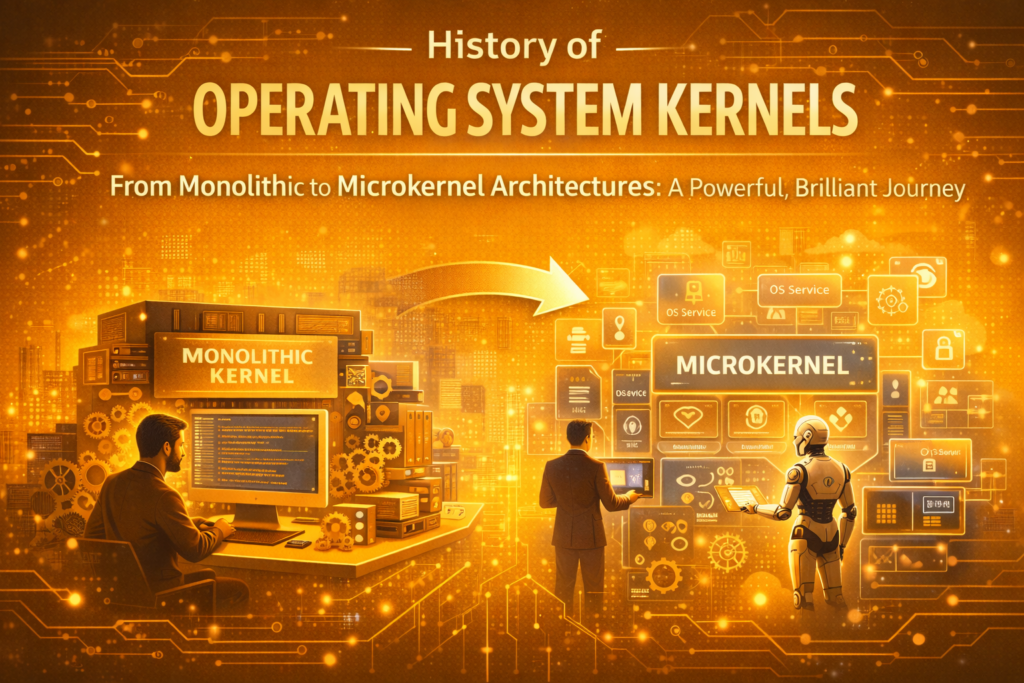
The kernel is the heart of every operating system. It manages hardware, runs programs, and protects resources. The history of operating system kernels is a powerful story of design trade offs, academic debates, and engineering brilliance. What began as simple monolithic programs that did everything has evolved into sophisticated microkernels that do as little as possible in privileged mode. The brilliant journey of the history of operating system kernels reveals fundamental questions about performance, reliability, and modularity. Understanding this evolution helps developers appreciate why modern operating systems like Linux, Windows, and macOS work the way they do.
Before Kernels: The Age of No Operating System (1940 – 1955)
Before the history of operating system kernels began, computers had no operating systems. Programmers wired plugboards or loaded paper tapes. The history of computers was in its earliest days. Each program had complete control of the machine. If a program crashed, the computer stopped. There was no protection between programs because only one program ran at a time. There was no Memory management because the program used all available memory. This worked for simple calculations but could not scale. As computers became more powerful, the need for a kernel became obvious.
The First Operating Systems and Monolithic Kernels (1955 – 1970)
The history of operating system kernels began with early batch processing systems. These systems ran one program at a time but provided common services for input/output. The kernel was a library of routines that programs could call. Everything ran in a single address space. This Monolithic design was simple and efficient. Function calls were fast because there was no mode switching. The entire kernel was one large program.
IBM’s OS/360, introduced in 1966, represented a milestone in the history of operating system kernels. It supported multiple simultaneous programs using CPU scheduling. The kernel decided which program ran next. It protected each program’s memory from others. It managed devices so programs did not need to know hardware details. OS/360 was huge and complex. It had thousands of programmers. But it proved that monolithic kernels could work at scale.
The history of programming languages influenced kernel development. Assembly language was common for early kernels. But higher level languages like C, invented in 1972, would transform kernel development. C offered low level access with high level structure. Almost every major kernel since has been written primarily in C.
The Unix Revolution (1969 – 1980)
The history of operating system kernels changed forever at Bell Labs. Ken Thompson, Dennis Ritchie, and others created Unix in 1969. Unix was a monolithic kernel, but it was smaller and cleaner than OS/360. The Unix and Linux kernel family began here. Unix introduced elegant abstractions. Everything was a file. Devices, terminals, and even network connections appeared as files in the filesystem. This simplicity made Unix powerful and portable.
The Unix kernel managed System calls as the interface between user programs and kernel services. A program opened a file by calling open(). It read data by calling read(). These system calls trapped into the kernel, which performed the requested operation on behalf of the user program. The User space vs. Kernel space separation was strict. User programs could not access hardware directly. They could not corrupt kernel memory. This Hardware abstraction layer made Unix more reliable than earlier systems.
The history of operating system kernels saw Unix spread through universities and research labs. The University of California, Berkeley created the Berkeley Software Distribution (BSD). BSD added virtual memory, TCP/IP networking, and other features. The history of computer networking and Unix grew together. Many early internet servers ran BSD Unix.
The Microkernel Vision (1980 – 1990)
Not everyone believed monolithic kernels were the future. Researchers at Carnegie Mellon University developed the Mach microkernel starting in 1985. The Mach project aimed to create a minimal kernel that provided only essential services. Inter Process Communication (IPC) , basic Memory management, and CPU scheduling. Everything else, including device drivers, file systems, and network stacks, would run as ordinary user space processes.
The microkernel approach promised several advantages. Kernel stability would improve because most components ran in user space. A crashing file system driver would not crash the entire kernel. Portability would improve because the microkernel abstracted hardware details. Most of the operating system would be the same across different hardware platforms. Security would improve because components were isolated from each other.
The history of operating system kernels saw Mach influence many systems. NeXTSTEP, the operating system for Steve Jobs’ NeXT computers, used a Mach microkernel. This lineage continues today. macOS, iOS, watchOS, and tvOS all use the XNU kernel, which combines a Mach microkernel with BSD components. Windows NT also borrowed ideas from microkernel research.
However, early microkernels suffered from performance problems. Inter Process Communication (IPC) was much slower than function calls. A monolithic kernel could call a file system function directly. A microkernel had to send messages between processes, involving multiple context switches. Performance was often 5 to 10 times slower. The history of operating system kernels entered a period of intense debate.
The Tanenbaum–Torvalds Debate (1992)
The Tanenbaum–Torvalds debate is legendary in the history of operating system kernels. In January 1992, Andrew Tanenbaum, creator of the MINIX operating system (a microkernel), posted a message on Usenet. He argued that microkernels were the future and monolithic kernels like Linux were obsolete. Tanenbaum wrote: “I still maintain the point that designing a monolithic kernel in 1991 is a fundamental mistake.”
Linus Torvalds, the creator of Linux, responded forcefully. He defended monolithic kernels as practical and performant. Torvalds argued that microkernels were theoretically elegant but practically slow. The debate raged for weeks. Tanenbaum predicted that Linux would be obsolete within a few years. Torvalds predicted that microkernels would never achieve competitive performance.
The history of operating system kernels proved both partly right. Microkernels did not replace monolithic kernels. Linux became one of the most successful software projects in history. But microkernel research improved. Modern microkernels like L4 are much faster than early Mach. They use techniques like direct process switching and minimal message copying. L4 can achieve performance close to monolithic kernels. The Tanenbaum–Torvalds debate remains a classic example of competing design philosophies in systems software.
Windows NT: A Hybrid Approach (1988 – 1993)
Microsoft took a pragmatic approach in the history of operating system kernels. Dave Cutler, who led development of Digital Equipment Corporation’s VMS operating system, joined Microsoft in 1988. He designed Windows NT architecture as a Hybrid kernels. NT combined ideas from monolithic kernels and microkernels. The NT kernel provided basic services like CPU scheduling and Inter Process Communication (IPC) . But many components traditionally in microkernel user space, like device drivers and file systems, ran in kernel space for performance.
Windows NT also introduced a Hardware abstraction layer (HAL) . The HAL isolated the rest of the kernel from hardware details. This made Windows NT portable across different CPU architectures. Early versions supported x86, MIPS, Alpha, and PowerPC. The HAL also simplified adding support for new hardware. The history of operating system kernels saw Windows NT become the foundation for all modern Windows versions. Windows 2000, XP, Vista, 7, 8, 10, and 11 all trace their lineage to NT.
Windows NT prioritized Kernel stability and security. Each process had its own Address space. A crashing application could not take down the system. The kernel enforced access controls. This made Windows NT suitable for servers and business environments. However, the hybrid design meant that device drivers still ran in kernel space. A buggy driver could crash the entire system. This trade off between performance and stability continues in modern kernels.
Linux and the Rise of Modular Monolithic Kernels (1991 – 2000)
Linus Torvalds released the first version of Linux in 1991. The history of operating system kernels gained a new player. Linux used a monolithic kernel but with a crucial innovation: loadable kernel modules. A Modularity approach allowed device drivers and file systems to be loaded and unloaded at runtime. This gave Linux many benefits of microkernels without the performance penalty. Unused drivers did not waste memory. New hardware could be supported without rebooting.
The Unix and Linux kernel family grew rapidly. Open source development meant thousands of programmers contributed. Linux added support for more hardware, more file systems, and more network protocols than any proprietary operating system. The kernel became more reliable through continuous testing and review. The history of open source software and Linux are deeply connected.
Linux also proved that monolithic kernels could be stable. The Linux kernel development process emphasized careful code review, rigorous testing, and backward compatibility. A bug that broke user space applications was unacceptable. The history of operating system kernels showed that good engineering practices mattered more than architectural purity.
Real Time Kernels and Embedded Systems (1990 – Present)
Not all kernels run on servers or desktops. The history of operating system kernels includes specialized Real time kernels (RTOS) for embedded systems. Real time kernels guarantee that operations complete within strict time constraints. A car’s airbag system must deploy within milliseconds of a crash. A pacemaker must sense and respond to heartbeats with precise timing. General purpose kernels like Linux cannot provide these guarantees because they optimize for average throughput, not worst case latency.
RTOS kernels like VxWorks, QNX, and FreeRTOS use different designs. QNX is a microkernel that runs almost everything in user space. This isolation improves reliability. If a camera driver crashes, the medical device keeps running. VxWorks is a monolithic kernel optimized for predictable performance. The history of operating system kernels for embedded systems has grown enormously. There are billions of embedded devices worldwide, each running some kind of kernel.
The history of the Internet of Things has created demand for lightweight kernels that run on tiny microcontrollers. RIOT, Zephyr, and Mbed OS provide POSIX like APIs on devices with kilobytes of memory. The history of operating system kernels continues to diversify.
Modern Microkernels: L4 and seL4 (1990 – Present)
While early microkernels were slow, later designs proved their critics wrong. The L4 microkernel, created by Jochen Liedtke in the 1990s, demonstrated that microkernels could be fast. L4 minimized the kernel to just address space management, thread scheduling, and Inter Process Communication (IPC) . Everything else moved to user space. L4’s IPC was an order of magnitude faster than Mach.
The history of operating system kernels reached a milestone with seL4. In 2009, researchers at NICTA (now part of CSIRO) formally proved that the seL4 kernel implementation correctly implemented its specification. This was the first time a general purpose kernel had been mathematically proven to be bug free in critical areas. seL4’s Fault tolerance and security guarantees make it suitable for military systems, autonomous vehicles, and critical infrastructure.
seL4 is a microkernel of about 10,000 lines of code. For comparison, the Linux kernel has over 30 million lines. The small size makes formal verification practical. The history of operating system kernels suggests that future safety critical systems will increasingly use formally verified microkernels.
The Exokernel and Unikernel Alternatives (1990 – Present)
Not all kernel research followed monolithic or microkernel paths. Resource allocation could be handled differently. The exokernel architecture, developed at MIT in the 1990s, took a radical approach. Exokernels exposed hardware resources directly to applications. There was no hardware abstraction. Applications could allocate memory, disk blocks, and network packets themselves. Library operating systems provided familiar interfaces like POSIX. This approach minimized kernel complexity and maximized application control.
The history of operating system kernels also includes Unikernels. A unikernel compiles the operating system and application together into a single address space. There is no separation between kernel and user space. Unikernels run only one application per virtual machine. This eliminates context switching overhead and reduces attack surface. Unikernels are popular in cloud environments where isolation comes from virtualization, not kernel boundaries.
The history of cloud computing has revived interest in alternative kernel designs. MirageOS, OSv, and IncludeOS are production unikernel projects. They boot in milliseconds and use minimal memory. The history of operating system kernels continues to evolve with new deployment environments.
The Influence on Modern Operating Systems
Modern operating systems reflect the entire history of operating system kernels. Linux remains a modular monolithic kernel. It runs most of the world’s servers, supercomputers, and Android devices. Windows uses a hybrid kernel derived from NT. It runs billions of PCs and Xbox consoles. macOS and iOS use XNU, which combines Mach microkernel and BSD components. They run on iPhones, Macs, and Apple Watches.
Each design has strengths. Linux performs well across many workloads. Windows supports a vast ecosystem of drivers and applications. Apple’s kernels provide a stable foundation for consumer devices. The history of operating system kernels shows that no single design is best for all use cases. Address space isolation, User space vs. Kernel space separation, and System calls are universal concepts. But the boundaries between kernel and user space vary.
The evolution of the first digital computer from specialized hardware to general purpose platform parallels kernel evolution. Early kernels were simple because computers were simple. Modern kernels are complex because they manage networks, graphics, storage, security, and power consumption. The history of operating system kernels is a story of managing complexity.
The Future of Kernels
What comes next in the history of operating system kernels ? Several trends are visible. First, formal verification will expand. Safety critical systems will use mathematically proven kernels like seL4. Second, kernel bypass will increase. Applications that need extreme performance will communicate directly with hardware using Data Plane Development Kit (DPDK) or similar technologies. Third, the history of operating system kernels will see more specialization. Different kernels for different domains: cloud, embedded, desktop, mobile.
The history of computer hardware shows that processors are getting more cores, not faster single threads. Kernels must scale to hundreds or thousands of cores. Lock contention becomes the bottleneck. New synchronization techniques like read copy update (RCU) and lock free data structures are essential. The evolution of gpus and other accelerators requires kernels to manage heterogeneous computing.
The history of cybersecurity will drive kernel security improvements. Kernel bugs are among the most severe vulnerabilities. A kernel compromise gives attackers full control of the system. Mitigations like kernel address space layout randomization (KASLR), supervisor mode access prevention (SMAP), and control flow integrity make kernel exploits harder. Future kernels may be written in memory safe languages like Rust instead of C.
Frequently Asked Questions (FAQs)
Q1: What is the difference between monolithic and microkernel?
A Monolithic design runs all operating system services (file systems, device drivers, network stacks) in kernel space. A microkernel runs only essential services (IPC, memory management, scheduling) in kernel space. Everything else runs in user space. Monolithic kernels are faster. Microkernels are more modular and potentially more reliable.
Q2: Why did the Tanenbaum–Torvalds debate matter?
The Tanenbaum–Torvalds debate represented a fundamental disagreement about operating system design. Tanenbaum argued microkernels were the future. Torvalds defended monolithic kernels. The debate helped clarify trade offs and spurred research into faster microkernels. It remains a classic example of competing philosophies in systems software.
Q3: What kernel does Windows use?
Windows NT architecture uses a hybrid kernel. It combines microkernel ideas (minimal core, hardware abstraction layer) with monolithic performance (device drivers run in kernel space). All modern Windows versions, from Windows 2000 to Windows 11, are based on the NT kernel.
Q4: What is a real time kernel?
Real time kernels (RTOS) guarantee that operations complete within strict time constraints. They are used in medical devices, automotive systems, industrial control, and military equipment. General purpose kernels like Linux optimize for average performance. RTOS kernels optimize for worst case latency.
Q5: Is Linux a monolithic or microkernel?
Linux uses a modular monolithic kernel. Most services run in kernel space for performance. However, loadable kernel modules provide runtime flexibility. Linux does not use a microkernel architecture, but it has adopted some microkernel ideas like modularity.
Q6: What is the smallest kernel?
seL4 is a microkernel of about 10,000 lines of code. It has been formally verified for correctness. Even smaller kernels exist for deeply embedded systems, but they lack features like memory protection. The history of operating system kernels shows a trade off between features and size.
Q7: What kernel does macOS use?
macOS uses XNU, which stands for “X is Not Unix.” XNU combines a Mach microkernel (for basic services) with BSD kernel components (for file systems, networking, and POSIX APIs). This hybrid approach gives macOS both the modularity of Mach and the compatibility of BSD.
Conclusion
The history of operating system kernels from monolithic to microkernel and hybrid designs is a powerful story of engineering trade offs. Early kernels did everything in one address space for simplicity and performance. Microkernels promised better reliability and modularity but struggled with performance. Hybrid kernels and modular monolithic kernels found practical compromises. The famous Tanenbaum–Torvalds debate captured the passion and intelligence of systems researchers. Today, Linux, Windows, and macOS represent different points in the design space. The history of operating system kernels continues to evolve with new requirements for security, real time performance, and heterogeneous hardware. The kernel remains the most critical software on any computer.