Introduction: The Hidden Sweet Spots of the Universe
Imagine a place in space where gravity and motion cancel out perfectly. A place where a spacecraft can sit almost forever without using much fuel. These places are real. They are called lagrange points. They are the hidden parking spots of the solar system. Every space agency wants to use them.
The story begins with a mathematical genius named Joseph-Louis Lagrange. While studying the famous three-body problem, he discovered five special equilibrium points. At these points, a small object like a satellite can remain stationary relative to two larger bodies like the Sun and Earth. This was a breathtaking breakthrough.
Today, lagrange points are essential for modern space exploration. The James Webb Space Telescope sits at one. Future lunar gateways will use another. In this article, we will explain what lagrange points are, where they are located, the mathematics behind them, and their incredible space applications. We will also connect this idea to lagrange multipliers, lagrangian mechanics, and the euler–lagrange equation.
What Exactly Are Lagrange Points? The Core Definition
Let us start simple. The three-body problem in celestial mechanics asks: how do three objects move under their mutual gravity? It is famously difficult. But Joseph-Louis Lagrange found a special set of solutions. He asked: are there positions where a small third body stays in a fixed pattern relative to two large bodies?
The answer is yes. These positions are lagrange points. At these points, the gravitational pull from the two large bodies exactly provides the centripetal force needed for the small object to rotate with them. So the object holds its position forever, like a silent sentinel.
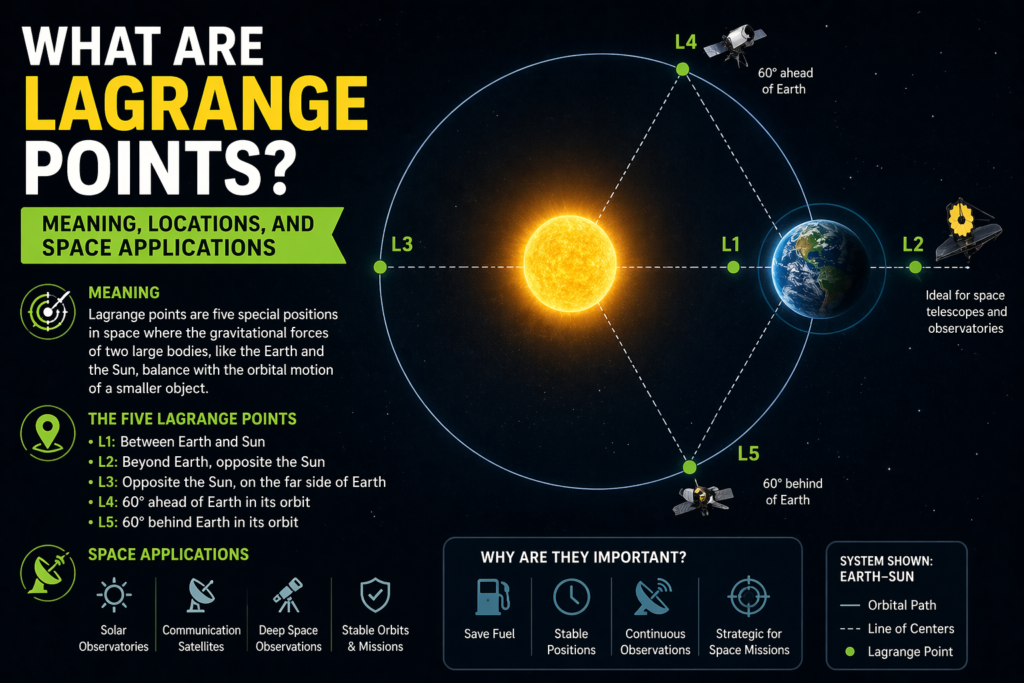
There are five lagrange points in any two body system. They are labeled L1, L2, L3, L4, and L5. L1, L2, and L3 are collinear. They lie along the line connecting the two large bodies. L4 and L5 are triangular. They form an equilateral triangle with the two large bodies. Understanding lagrange points is crucial for orbital mechanics and spacecraft positioning.
The Mathematical Foundation of Lagrange Points
Now let us do some mathematics. Do not be afraid. The beauty of lagrange points lies in simple equations.
Consider two large bodies with masses M1 and M2 orbiting their common center of mass (barycenter). A small third body of negligible mass moves in the same plane. In the rotating frame where M1 and M2 are fixed, there are five equilibrium solutions.
The effective potential includes gravitational potential and centrifugal potential:
U_eff = (G M1 / r1) + (G M2 / r2) + (1/2) ω² r²
Here ω is the angular velocity of the rotating frame. The lagrange points occur where the gradient of this effective potential is zero. That means the net force on the small body is zero.
For L1, L2, and L3, the equilibrium is along the line joining M1 and M2. The equation for L1 between M1 and M2 is:
G M1 / (d1)² = G M2 / (d2)² + ω² d1
Solving this requires numerical methods. For L4 and L5, the equilibrium occurs at the vertices of equilateral triangles. The mathematics shows that if M1/M2 > 24.96, L4 and L5 are stable. Otherwise they are not. This is why Jupiter has Trojan asteroids at its L4 and L5 points.
This entire analysis connects directly to lagrangian mechanics. The Lagrangian L = T − V yields the equations of motion. The euler–lagrange equation gives the conditions for equilibrium. So lagrange points are not isolated curiosities. They are natural consequences of fundamental physics.
The Five Lagrange Points Explained in Detail
Let us visit each lagrange point one by one.
L1: The Seesaw Point
L1 lies between the two large bodies. For the Earth Sun system, L1 is about 1.5 million kilometers from Earth toward the Sun. At L1, the gravitational pull of Earth and Sun combine to match the centripetal force needed to orbit at the same period as Earth. This point is great for solar observation. The Deep Space Climate Observatory (DSCOVR) sits at L1. It watches solar winds before they hit Earth.
L2: The Deep Space Gateway
L2 lies on the far side of the smaller body. For Earth Sun, L2 is also 1.5 million kilometers from Earth, opposite the Sun. At L2, Earth blocks sunlight partially. This is perfect for telescopes. The James Webb Space Telescope (JWST) orbits L2. It stays cold and stable. Future missions like the Roman Space Telescope will also use L2. These spacecraft positioning choices are no accident. L2 offers uninterrupted views of deep space.
L3: The Opposite Side
L3 lies on the opposite side of the Sun from Earth. It is roughly 300 million kilometers away. At L3, the combined gravity of Earth and Sun again balances. However, L3 is always hidden behind the Sun. No spacecraft currently uses L3. But science fiction loves it. Some stories place hidden planets at L3. In reality, it is an unstable libration point with little practical use.
L4 and L5: The Stable Triangular Points
L4 and L5 are 60 degrees ahead and behind the smaller body in its orbit. They form equilateral triangles with the two large bodies. These are the most exciting lagrange points because they are stable. If an object drifts slightly away from L4, it will orbit around L4 rather than leaving. This makes them natural traps for dust and asteroids.
In the Sun Jupiter system, the Trojan asteroids swarm around L4 and L5. In the Earth Moon system, L4 and L5 could hold future space stations. Some scientists even propose building human habitats there. The stability comes from the Coriolis force in the rotating frame. This is a key concept in celestial mechanics.
Stable vs Unstable Equilibrium at Lagrange Points
Not all lagrange points are equal. L4 and L5 are stable. That means if you push a satellite off these points, it will oscillate around them in complex patterns called Lissajous orbits or halo orbits. These orbits are not random. Mission designers carefully calculate them.
L1, L2, and L3 are unstable. A small push sends a spacecraft drifting away. However, unstable does not mean useless. With small periodic boosts from thrusters, spacecraft can maintain halo orbits around L1 and L2 for years. JWST does exactly that. The instability actually helps because spacecraft can escape easily when the mission ends.
The mathematics of stability involves linearizing the equations of motion around each lagrange point and examining eigenvalues. For L4 and L5, eigenvalues are purely imaginary when the mass ratio is large enough. That signals stable oscillations. For L1, L2, L3, there is always a positive real eigenvalue, indicating instability.
This analysis uses the same mathematical tools as lagrange multipliers and the calculus of variations. The connection is deep. Joseph-Louis Lagrange gave us both the points and the methods to analyze them.
Gravitational Potential and Effective Forces
To truly understand lagrange points, we must look at the gravitational potential. The total potential in the rotating frame is:
U = (G M1 / r1) + (G M2 / r2) + (1/2) ω² (x² + y²)
The lagrange points are the stationary points of this potential. Imagine a topographic map. L4 and L5 are like small hills but with a twist. Due to the rotating frame, they act like bowls trapping objects. L1, L2, L3 are saddle points. They are flat in one direction and curved in another.
The Roche lobe in binary star systems is closely related. Its inner lagrange point L1 connects two stars. Material can flow from one star to the other through L1. This is how many X ray binaries and cataclysmic variables work. So lagrange points are not just for spacecraft. They govern the evolution of entire star systems.
Space Applications: Why Lagrange Points Matter
Now we reach the most exciting part. lagrange points are not abstract mathematics. They are real estate in space. Here are the most powerful applications.
The James Webb Space Telescope at L2
JWST orbits the Sun Earth L2 point. Why? Because L2 offers a stable thermal environment. Earth and Sun are always in the same direction. The telescope’s sunshield blocks both. JWST can observe continuously without Earth or Moon getting in the way. The halo orbit around L2 requires only small adjustments every few weeks. This extends the mission life dramatically.
Solar Observatories at L1
The Solar and Heliospheric Observatory (SOHO) and DSCOVR sit at L1. From L1, they look directly at the Sun. They give us 30 to 60 minutes warning of solar storms. This protects power grids and satellites on Earth. Without lagrange points, such early warning would be impossible.
The Lunar Gateway at Earth Moon L1 or L2
NASA’s planned Lunar Gateway will orbit near the Earth Moon L1 or L2. This serves as a staging point for lunar landings and deep space missions. From there, spacecraft can easily reach the Moon’s surface or depart for Mars. The lagrange points create a deep space gateway.
Trojan Asteroids at Sun Jupiter L4 and L5
Thousands of Trojan asteroids share Jupiter’s orbit at L4 and L5. NASA’s Lucy mission is visiting them. These asteroids are leftovers from planet formation. They hold secrets of the early solar system. Lucy will fly by seven Trojans between 2025 and 2033. This shows how lagrange points act as time capsules.
The Interplanetary Superhighway
There is a network of low energy paths between lagrange points called the Interplanetary Superhighway. Using these paths, spacecraft can travel using very little fuel. This is orbital mechanics at its most elegant. The Genesis mission used such a path to return solar wind samples to Earth. Future missions will use it to reach the outer planets faster.
Lagrange Points in the Earth Moon System
Let us focus closer to home. The Earth Moon system has its own lagrange points. Earth Moon L1 is about 58,000 km from the Moon’s far side? Wait carefully. Actually Earth Moon L1 lies between Earth and Moon, about 85% of the distance from Earth to Moon. L2 is behind the Moon. L4 and L5 are 60 degrees ahead and behind the Moon in its orbit.
These points are being studied for communication relays. A satellite at Earth Moon L2 can see the far side of the Moon. China’s Queqiao relay satellite uses a halo orbit near Earth Moon L2. This allowed the Chang’e 4 mission to land on the far side. Without lagrange points, far side landing would have no communications.
The Remarkable Connection to Lagrangian Mechanics
The entire theory of lagrange points comes from lagrangian mechanics. In that framework, you write the Lagrangian L = T − V. The equations of motion come from the euler–lagrange equation. When you transform into a rotating frame, you get centrifugal and Coriolis terms. The equilibrium points are exactly the lagrange points.
This same formalism gives us lagrange multipliers for constrained problems. It gives us lagrange interpolation for numerical analysis. Joseph-Louis Lagrange was not just finding points in space. He was building a complete mathematical system. Every engineer who uses lagrange multipliers or lagrangian mechanics is walking in his footsteps.
Mathematical Work: Finding L1 in the Earth Sun System
Let us do a concrete calculation. For the Earth Sun system, M_sun = 1.989 × 10³⁰ kg, M_earth = 5.972 × 10²⁴ kg. The distance between them R = 1.496 × 10¹¹ m. L1 lies between them at distance d from Earth toward Sun.
The condition for equilibrium is:
G M_sun / (R − d)² = G M_earth / d² + ω² (R − d)
But ω² = G (M_sun + M_earth) / R³ for circular orbits.
For small d compared to R, we can solve approximately:
d ≈ R * (M_earth / (3 M_sun))^(1/3)
Plug numbers: (5.972e24 / (3 * 1.989e30))^(1/3) = (1.001e-6)^(1/3) ≈ 0.01
So d ≈ 0.01 * 1.496e11 = 1.5e9 meters = 1.5 million kilometers. This matches observations precisely. Mathematics works beautifully.
Frequently Asked Questions (FAQs)
1. Can any spacecraft stay exactly at a lagrange point?
No. L1, L2, L3 are unstable, so spacecraft perform halo orbits or Lissajous orbits around them. Even L4 and L5 have slight oscillations. Perfect stillness is mathematically impossible.
2. Do lagrange points exist in every two body system?
Yes. Any system with two massive bodies in circular orbits has five lagrange points. This includes Sun Jupiter, Earth Moon, and even binary star systems.
3. Why are L4 and L5 stable while L1 L2 L3 are not?
The Coriolis force stabilizes L4 and L5. At L1 L2 L3, the centrifugal and gravitational forces align to create a saddle point. At L4 L5, the rotating frame creates a potential valley despite the outward centrifugal force.
4. How do we send spacecraft to lagrange points?
We launch from Earth and perform trajectory correction maneuvers. The spacecraft follows a transfer orbit that inserts it into a halo orbit around the target lagrange point. This requires precise orbital mechanics calculations.
5. Can we see lagrange points with a telescope?
No. lagrange points are mathematical positions, not physical objects. But you can see objects that gather there, like Trojan asteroids at Jupiter’s L4 and L5. The points themselves are empty.
Conclusion
lagrange points are among the most practical and beautiful discoveries in celestial mechanics. They turn a chaotic three-body problem into a roadmap for space exploration. From the James Webb Space Telescope at L2 to the Trojan asteroids at Jupiter’s L4 and L5, these points shape our understanding of the solar system. The mathematics behind them connects to lagrange multipliers, lagrangian mechanics, the euler–lagrange equation, lagrange interpolation, and the calculus of variations.
Just like how ancient greek scientists changed modern science by asking fundamental questions about motion and equilibrium, Joseph-Louis Lagrange changed space travel forever. His five lagrange points are now interplanetary parking spots, deep space gateways, and windows into the early solar system. Whether you dream of becoming an astronaut or simply love stargazing, remember that hidden in the darkness are these perfect gravitational sweet spots. They are waiting for humanity’s next great leap.