Introduction: The Mathematics of Finding the Best Path
What is the fastest path for a roller coaster? What is the strongest shape for a dome? What is the shortest path between two points on a curved surface? These questions cannot be answered with ordinary calculus. Ordinary calculus finds the minimum of a function. But here, you are not looking for a single number. You are looking for an entire curve or shape. That requires a higher level of thinking. That requires the calculus of variations.
The calculus of variations is a powerful branch of mathematics. It deals with finding functions that make certain quantities stationary. Instead of optimizing a number, you optimize an integral. This field was developed by giants like Euler and Joseph-Louis Lagrange. The famous euler–lagrange equation is its central result.
In this article, we will explain the core principles of the calculus of variations. You will see classic problems like the brachistochrone and the catenary. We will derive the euler–lagrange equation with full mathematical work. We will also connect this field to lagrange multipliers, lagrange points, lagrangian mechanics, and lagrange interpolation. By the end, you will understand why the calculus of variations is essential for modern physics and engineering.
What Is the Calculus of Variations? The Core Idea
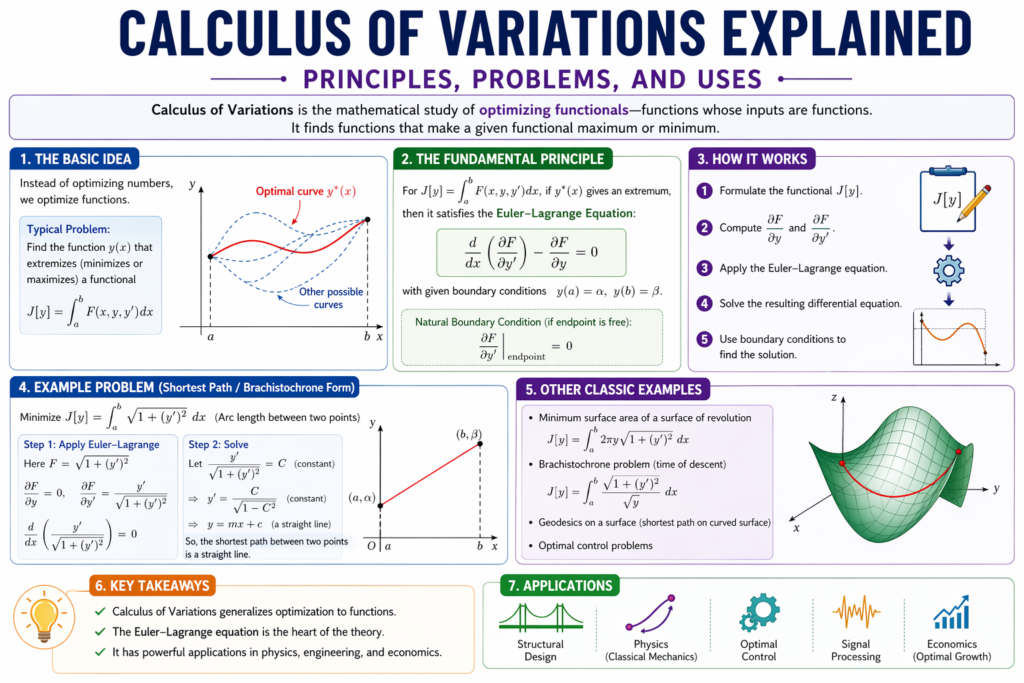
Let me start with a simple contrast. Ordinary calculus finds the minimum of a function f(x). You take the derivative, set it to zero, and solve for x. That gives you a number. The calculus of variations finds the function y(x) that minimizes or maximizes an integral I[y] = ∫ F(x, y, y’) dx.
In other words, ordinary calculus answers: “Which point gives the best value?” The calculus of variations answers: “Which path gives the best total outcome?” This is called functional analysis because you are optimizing a functional (a function of functions).
The calculus of variations is the foundation of lagrangian mechanics. In physics, nature follows the path that makes the action integral stationary. That is Hamilton’s principle. The same ideas govern optimal control and mathematical optimization. So learning the calculus of variations opens the door to understanding the deepest laws of the universe.
The History: From Bernoulli to Lagrange
The birth of the calculus of variations is a fascinating story. In 1696, Johann Bernoulli posed the brachistochrone problem: find the curve of fastest descent between two points. Newton solved it in one night. But a general method was needed.
Leonhard Euler developed the first systematic approach. Then Joseph-Louis Lagrange , still a teenager, wrote to Euler with a purely analytic method. Euler was so impressed that he renamed the field the calculus of variations. He ensured Lagrange received full credit.
The result of their collaboration is the euler–lagrange equation , the central equation of the calculus of variations. This equation appears everywhere from lagrange points in orbital mechanics to lagrange interpolation in numerical analysis. Joseph-Louis Lagrange later applied these ideas to mechanics, creating lagrangian mechanics. So the calculus of variations is the intellectual parent of half of modern physics.
The Fundamental Problem: Finding a Stationary Path
We begin with the simplest problem. Find the function y(x) that makes the integral I[y] = ∫ F(x, y, y’) dx stationary, with fixed endpoints y(a) = A and y(b) = B.
We consider a small variation: y(x) → y(x) + ε η(x), where η(a) = η(b) = 0. Then:
I[ε] = ∫ F(x, y + εη, y’ + εη’) dx
For stationarity, dI/dε = 0 at ε = 0. Compute:
dI/dε = ∫ [ (∂F/∂y) η + (∂F/∂y’) η’ ] dx
Integrate the second term by parts:
∫ (∂F/∂y’) η’ dx = [ (∂F/∂y’) η ] − ∫ d/dx(∂F/∂y’) η dx
The boundary term vanishes because η=0 at endpoints. So:
dI/dε = ∫ [ ∂F/∂y − d/dx (∂F/∂y’) ] η dx
For this to be zero for all η, we get the euler–lagrange equation :
d/dx (∂F/∂y’) − ∂F/∂y = 0
This is the foundational equation of the calculus of variations. Any extremal path must satisfy it. The derivation uses the calculus of variations fundamental lemma. This same equation appears in lagrangian mechanics with time as the independent variable.
Classic Problem 1: The Shortest Distance (Geodesic)
The simplest application of the calculus of variations is finding the shortest path between two points in a plane. The arc length is:
I = ∫ √(1 + (y’)²) dx
Here F = √(1 + (y’)²). Since F does not depend explicitly on y, ∂F/∂y = 0. The euler–lagrange equation reduces to:
d/dx (∂F/∂y’) = 0 → ∂F/∂y’ = constant
Compute ∂F/∂y’ = y’ / √(1 + (y’)²) = C
Solve: y’² = C²(1 + y’²) → y’² (1 − C²) = C² → y’ = C/√(1−C²) = constant = m
Thus y = mx + b, a straight line. The calculus of variations proves that the shortest distance is a straight line. This is also called a geodesic in flat space.
Classic Problem 2: The Brachistochrone Curve
The brachistochrone problem asks for the curve of fastest descent under gravity. A bead slides without friction from (0,0) to (x₁, y₁). The time is:
T = ∫ dt = ∫ √( (1 + (y’)²) / (2gy) ) dx
So F = √( (1 + y’²) / y ), ignoring constants. This F does not depend explicitly on x. The calculus of variations gives a first integral:
F − y’ (∂F/∂y’) = constant
Computing gives: 1 / √(y (1 + y’²)) = constant. After manipulation, this yields the parametric equations of a cycloid:
x = a(θ − sin θ), y = a(1 − cos θ)
The brachistochrone is a cycloid, not a straight line. This shocked 17th century mathematicians. The calculus of variations provided the first general method to solve such problems.
Classic Problem 3: The Catenary Curve
What shape does a hanging rope take? This is the catenary problem. The rope has uniform density. It hangs under gravity, minimizing its potential energy. The potential energy is proportional to the height of its center of mass:
U = ∫ y √(1 + y’²) dx, with fixed endpoints and fixed length.
This is a constrained problem. To solve it, we use lagrange multipliers . The augmented functional is:
∫ [ y √(1 + y’²) + λ √(1 + y’²) ] dx = ∫ (y + λ) √(1 + y’²) dx
The integrand does not depend explicitly on x. Using the first integral of the calculus of variations :
(y + λ) √(1 + y’²) − y’ * (y + λ) y’ / √(1 + y’²) = constant
This simplifies to (y + λ) / √(1 + y’²) = C. Solving gives y = a cosh(x/a) + constant. That is the catenary. This problem beautifully combines the calculus of variations with lagrange multipliers.
The Connection to Lagrangian Mechanics
The calculus of variations is the mathematical engine behind lagrangian mechanics. In mechanics, we define the action S = ∫ L dt, where L = T − V is the Lagrangian. Hamilton’s principle states that nature chooses the path that makes the action stationary.
Applying the calculus of variations to the action gives the euler–lagrange equation in the form:
d/dt (∂L/∂q̇) − ∂L/∂q = 0
This equation generates the entire dynamics of a physical system. From a simple pendulum to planetary orbits, everything follows from this single principle. lagrangian mechanics is essentially the calculus of variations applied to physics.
Even lagrange points in orbital mechanics come from the effective potential in the rotating frame. The equilibrium points are found by setting the first variation of the effective potential to zero. So the calculus of variations reaches into space exploration.
Mathematical Work: The Isoperimetric Problem
The isoperimetric problem asks: among all closed curves of a given length, which one encloses the maximum area? This is the oldest problem in the calculus of variations , dating back to ancient Greece.
We want to maximize A = ∫ y dx subject to the perimeter constraint L = ∫ √(1 + y’²) dx = constant. Using lagrange multipliers , we extremize:
∫ [ y + λ √(1 + y’²) ] dx
The integrand F = y + λ √(1 + y’²) does not depend explicitly on x. The first integral of the calculus of variations gives:
F − y’ (∂F/∂y’) = constant → y + λ √(1 + y’²) − y’ (λ y’ / √(1 + y’²)) = C
Simplify: y + λ / √(1 + y’²) = C → Solve for y’ and integrate. The solution is a circle. This proves that a circle encloses the maximum area for a given perimeter. The calculus of variations solved a 2000 year old puzzle.
Applications of the Calculus of Variations in Real Life
The calculus of variations is not just theoretical. It has powerful real world uses.
Minimal Surfaces
A soap film stretched across a wire frame takes the shape of minimal surface area. This is a calculus of variations problem in two dimensions. The Euler-Lagrange equation becomes a partial differential equation. The solutions include catenoids and helicoids. Architects use these shapes for tensile structures.
Optics and Fermat’s Principle
Fermat’s Principle of Least Time states that light travels the path of minimal time. This is a calculus of variations problem. It leads to Snell’s law of refraction and explains lenses and mirages. The entire field of geometric optics is built on this principle.
Economics and Optimal Control
Economists maximize utility over time. This is a calculus of variations problem with time as the independent variable. The mathematical optimization yields optimal consumption and investment strategies. The Hamilton-Jacobi Bellman equation extends these ideas to dynamic programming.
Image Processing
Denoising an image can be formulated as minimizing a functional that balances smoothness and fidelity to the data. The calculus of variations gives partial differential equations like the heat equation or total variation flow. These are used in medical imaging and computer vision.
Quantum Mechanics
The path integral formulation of quantum mechanics uses the calculus of variations . Particles take all possible paths, each weighted by exp(iS/ℏ). In the classical limit, the stationary path (where δS=0) dominates. This recovers classical mechanics and connects to lagrangian mechanics.
Weak vs Strong Variations
In the calculus of variations , we distinguish between weak and strong variations. A weak variation means both y and y’ change by small amounts. A strong variation allows sudden changes in y’ even if y changes little. The euler–lagrange equation gives necessary and sufficient conditions for weak extrema. For strong extrema, additional conditions like the Weierstrass condition are needed. This is advanced optimization theory .
Frequently Asked Questions (FAQs)
1. Is calculus of variations harder than ordinary calculus?
Yes, initially. It requires thinking about functions as variables. But once you master the euler–lagrange equation , it becomes systematic. Many problems reduce to solving differential equations.
2. What is the difference between calculus of variations and optimization?
Ordinary optimization finds numbers. The calculus of variations finds functions. It is also called functional analysis . Optimization with constraints often uses lagrange multipliers , which is a related but different technique.
3. Why is the calculus of variations important in physics?
Because Hamilton’s principle states that nature minimizes action. This principle unifies classical mechanics, electromagnetism, general relativity, and quantum field theory. The calculus of variations is the language of theoretical physics.
4. Can calculus of variations handle constraints?
Yes. Use lagrange multipliers inside the integral. The augmented functional includes a term λ times the constraint. The euler–lagrange equation then includes λ as an unknown function.
5. Who invented the calculus of variations?
Euler and Joseph-Louis Lagrange . Euler developed the geometric version. Lagrange gave the analytic method. Their collaboration produced the euler–lagrange equation . Later mathematicians like Legendre, Jacobi, and Weierstrass added rigor.
Conclusion
The calculus of variations is a breathtaking intellectual achievement. It transforms the question “Which path?” into a differential equation. From the brachistochrone to minimal surfaces, from lagrangian mechanics to lagrange points , this field governs the natural world. The euler–lagrange equation is its heart. lagrange multipliers help with constraints. lagrange interpolation connects discrete points.
The same Joseph-Louis Lagrange who gave us lagrange multipliers , lagrange points , lagrangian mechanics , the euler–lagrange equation , and lagrange interpolation also shaped the calculus of variations . Just like how ancient greek scientists changed modern science by asking fundamental questions about shape and motion, Lagrange changed science by giving us the mathematics of the best possible path.
Whether you are a physicist, engineer, economist, or mathematician, the calculus of variations will sharpen your thinking. Now go find the optimal path.