
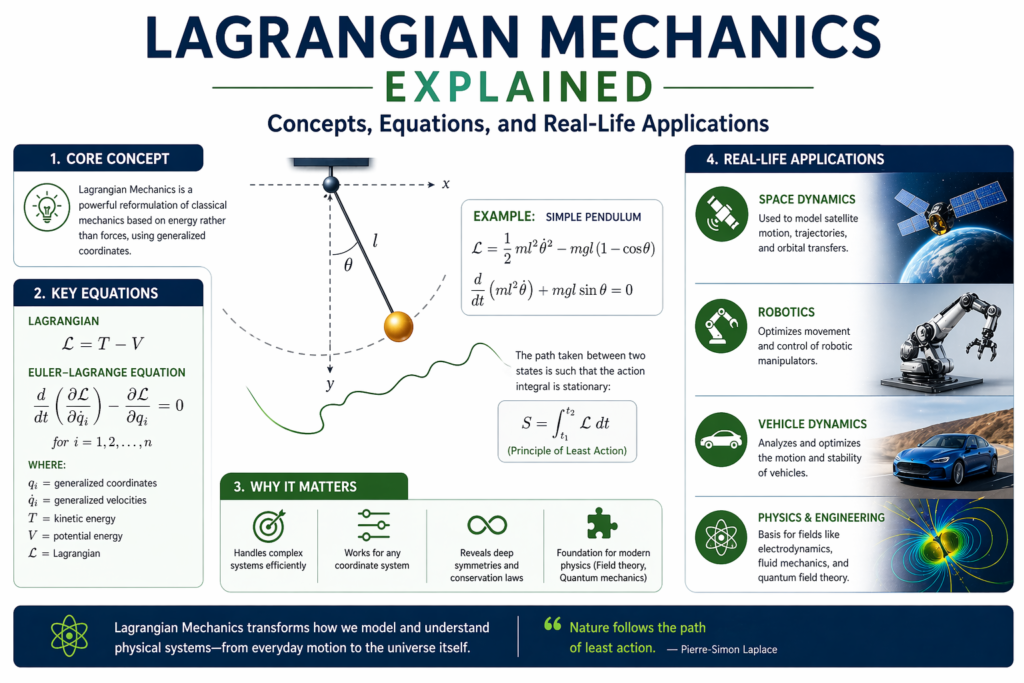
Introduction: A More Elegant Way to See Physics
Newton’s laws work. They got us to the Moon. But they can get messy. When you have many objects, pulleys, or curved paths, Newton’s forces become a tangled web. What if there was a cleaner way? There is. It is called lagrangian mechanics.
This beautiful framework was developed by Joseph-Louis Lagrange, the same genius who gave us lagrange points and lagrange multipliers. Instead of tracking every force, lagrangian mechanics uses only energy. You define kinetic energy and potential energy. Then you derive everything from a single function called the Lagrangian.
In this article, we will explain the core concepts of lagrangian mechanics, derive the famous euler–lagrange equation, and show real life applications. You will see why this approach dominates modern physics from quantum field theory to robotics. We will also connect it to lagrange interpolation, the calculus of variations, and more.
What Is Lagrangian Mechanics? The Core Idea
Let us start with a simple question. What if forces are not the best way to describe motion? lagrangian mechanics says: focus on energy instead. Energy is a scalar quantity. It has no direction. That makes it much easier to handle than vectors.
The method is astonishingly simple. You write the Lagrangian L = T − V, where T is kinetic energy and V is potential energy. Then you apply the euler–lagrange equation to get the equations of motion. No free body diagrams. No vector decompositions. Just one scalar function.
This is analytical mechanics at its finest. The entire physical system is captured in a single expression. lagrangian mechanics works for any number of degrees of freedom. It handles constraints naturally. It even reveals deep symmetries through Noether’s Theorem. For anyone studying classical mechanics, this is an essential tool.
The Principle of Least Action: Nature’s Economy
Behind lagrangian mechanics lies a profound idea called the principle of least action. Nature is economical. A particle moving from point A to point B does not take a random path. It takes the path that minimizes a quantity called action.
Action S is the integral of the Lagrangian over time:
S = ∫ L dt = ∫ (T − V) dt
Hamilton’s principle states that the true path of a system is the one where the action is stationary. That means small changes to the path do not change the action to first order. This is a variational principle. It belongs to the calculus of variations, a field that Joseph-Louis Lagrange helped create.
When you apply this principle, you automatically derive the euler–lagrange equation. So lagrangian mechanics is not just a trick. It is a consequence of a deep statement about how the universe works. Even quantum mechanics uses a version of this principle.
The Euler Lagrange Equation: The Engine of Lagrangian Mechanics
Now we arrive at the mathematical heart. For a system with generalized coordinates q (one for each degree of freedom), the euler–lagrange equation is:
d/dt (∂L/∂ q̇) − ∂L/∂q = 0
Here q̇ is the time derivative of q, meaning generalized velocity. This single equation replaces all of Newton’s second law. Let us see why it is so powerful.
First, L is a scalar quantity. You do not worry about directions. Second, constraints are built into your choice of generalized coordinates. Third, the equation automatically respects conservation laws when symmetries exist.
For example, if L does not depend on a coordinate q (that coordinate is cyclic), then ∂L/∂q̇ is constant. That is a conserved generalized momentum. This connects lagrangian mechanics directly to Noether’s Theorem, one of the most beautiful results in physics.
Step by Step Derivation with Mathematical Work
Let us derive the euler–lagrange equation from Hamilton’s principle. This mathematical work is essential for understanding.
We want the action S = ∫ L(q, q̇, t) dt to be stationary. Consider a small variation in the path: q(t) → q(t) + ε η(t), where η(t) is zero at the endpoints. The change in action is:
δS = ∫ [ (∂L/∂q) εη + (∂L/∂q̇) εη̇ ] dt
Integrate the second term by parts:
∫ (∂L/∂q̇) η̇ dt = [ (∂L/∂q̇) η ] − ∫ d/dt(∂L/∂q̇) η dt
The boundary term vanishes because η=0 at endpoints. So:
δS = ∫ [ ∂L/∂q − d/dt(∂L/∂q̇) ] εη dt
For δS=0 for all η, the bracket must be zero. That gives:
d/dt (∂L/∂q̇) − ∂L/∂q = 0
This is the euler–lagrange equation. It is the foundation of lagrangian mechanics. Every physics student must master this derivation. The same mathematics appears in lagrange multipliers for optimization and lagrange interpolation for numerical methods.
Lagrangian vs Newtonian Mechanics: A Friendly Comparison
Newtonian mechanics uses forces and vectors. You draw free body diagrams. You sum forces in x, y, and z directions. This works perfectly for simple problems like a falling ball.
But consider a double pendulum. Newton’s approach gives two coupled vector equations with tension forces that are hard to eliminate. lagrangian mechanics gives two second order differential equations directly. No tensions appear because constraints are handled by the generalized coordinates.
Another advantage: lagrangian mechanics works in non inertial frames without fictitious forces. You simply write T and V in that frame. The euler–lagrange equation automatically produces the correct centrifugal and Coriolis terms. This is much cleaner than Newton’s method.
For system dynamics with many parts, lagrangian mechanics is far superior. Robotics engineers use it exclusively. So do aerospace engineers designing lagrange points missions. The elegance cannot be overstated.
Real Life Applications of Lagrangian Mechanics
Let me give you powerful examples where lagrangian mechanics shines.
The Simple Pendulum
A mass m on a string of length L. Generalized coordinate is θ (angle from vertical). Kinetic energy T = (1/2) m (L θ̇)². Potential energy V = mgL (1 − cos θ). Lagrangian L = (1/2) m L² θ̇² − mgL (1 − cos θ).
Apply euler–lagrange equation:
d/dt (m L² θ̇) + mgL sin θ = 0 → m L² θ̈ + mgL sin θ = 0 → θ̈ + (g/L) sin θ = 0.
For small angles, sin θ ≈ θ, giving the harmonic oscillator equation. This derivation took two lines. Newton would require more work.
The Spring Mass System
A mass m on a spring with constant k. Generalized coordinate is x. T = (1/2) m ẋ², V = (1/2) k x². Lagrangian L = (1/2) m ẋ² − (1/2) k x².
The euler–lagrange equation gives:
d/dt (m ẋ) + k x = 0 → m ẍ + k x = 0. Simple.
The Atwood Machine
Two masses m1 and m2 connected by a string over a pulley. Generalized coordinate is y (position of m1). T = (1/2) m1 ẏ² + (1/2) m2 ẏ², V = − m1 g y − m2 g (constant − y). Lagrangian L = (1/2)(m1 + m2) ẏ² + (m1 − m2) g y + constant.
The euler–lagrange equation gives:
(m1 + m2) ÿ − (m1 − m2) g = 0 → ÿ = (m1 − m2)g / (m1 + m2).
This matches Newton’s result without ever dealing with tension. Beautiful.
Robotics and Control Theory
Modern robots have many moving parts. Engineers use lagrangian mechanics to derive equations of motion automatically. Software like Maple and Mathematica symbolically computes T and V, then applies the euler–lagrange equation. This is how your robot vacuum navigates. This is how space probes reach lagrange points.
Quantum Field Theory
Even in modern physics, lagrangian mechanics rules. The Standard Model of particle physics is written as a Lagrangian density. The euler–lagrange equation applied to fields gives the Dirac equation and Maxwell’s equations. So learning lagrangian mechanics is not just for classical problems. It is the gateway to advanced physics.
Generalized Coordinates and Degrees of Freedom
A key concept in lagrangian mechanics is generalized coordinates. These are any independent variables that completely describe the system’s configuration. For a particle in 3D, you might use x, y, z. For a pendulum, you use θ. For a double pendulum, you use θ1 and θ2.
The number of generalized coordinates equals the number of degrees of freedom. This number is 3N minus the number of holonomic constraints. lagrangian mechanics handles constraints by choosing coordinates that satisfy them automatically. You never solve for constraint forces unless you explicitly want them.
This is a massive simplification. In Newtonian mechanics, each constraint adds an unknown force. In lagrangian mechanics, constraints reduce the number of equations. That is progress.
Symmetry, Conservation Laws, and Noether’s Theorem
One of the deepest results in physics comes from lagrangian mechanics. Emmy Noether proved that every continuous symmetry of the Lagrangian corresponds to a conservation law.
If L does not depend explicitly on time, energy is conserved. If L does not depend on a coordinate q, generalized momentum p = ∂L/∂q̇ is conserved. For example, if L does not depend on x (translation symmetry), linear momentum is conserved. If L does not depend on θ (rotation symmetry), angular momentum is conserved.
This connection is invisible in Newtonian mechanics. lagrangian mechanics reveals the deep structure of physical laws. That is why every theoretical physicist loves it.
Handling Dissipative Forces and Non Holonomic Constraints
Pure lagrangian mechanics works for conservative systems where forces come from potentials. But what about friction? You can add dissipative forces using Rayleigh’s dissipation function. The modified euler–lagrange equation becomes:
d/dt (∂L/∂q̇) − ∂L/∂q + ∂F/∂q̇ = 0, where F is dissipation.
For non holonomic constraints (like rolling without slipping), you use lagrange multipliers to enforce them. This connects back to our earlier article on lagrange multipliers. So lagrangian mechanics and lagrange multipliers are best friends.
Mathematical Work: The Double Pendulum
Let me show the power of lagrangian mechanics with a double pendulum. Two masses m1 and m2, lengths L1 and L2, angles θ1 and θ2.
Kinetic energy T = (1/2) m1 (L1 θ̇1)² + (1/2) m2 [ (L1 θ̇1 cos θ1 + L2 θ̇2 cos θ2)² + (L1 θ̇1 sin θ1 + L2 θ̇2 sin θ2)² ]
Potential energy V = − m1 g L1 cos θ1 − m2 g (L1 cos θ1 + L2 cos θ2)
The Lagrangian L = T − V. Then two euler–lagrange equations (one for θ1, one for θ2) give two coupled nonlinear differential equations. Solving them numerically reveals chaotic motion. Without lagrangian mechanics, this derivation would be a nightmare.
Frequently Asked Questions (FAQs)
1. Is lagrangian mechanics harder than Newtonian mechanics?
Initially yes, because it requires calculus of variations. But for complex systems, lagrangian mechanics is much easier. It removes unknown constraint forces and works naturally with any coordinates.
2. Can lagrangian mechanics handle friction?
Yes, by adding a dissipation function. The standard euler–lagrange equation is modified with a damping term. This covers most real world dissipative forces.
3. Why do we use L = T − V instead of T + V?
The minus sign ensures that the principle of least action reproduces Newton’s laws. It was discovered experimentally. In relativistic mechanics, the sign flips for some fields.
4. Does lagrangian mechanics work in quantum physics?
Absolutely. Quantum field theory is built on Lagrangian densities. The path integral formulation of quantum mechanics is directly based on Hamilton’s principle. lagrangian mechanics is foundational for modern physics.
5. Who invented lagrangian mechanics?
Joseph-Louis Lagrange developed it in his 1788 book “Analytical Mechanics.” He famously wrote that there were no diagrams in the book because the methods were purely algebraic. It was a revolutionary departure from Newton.
Conclusion
lagrangian mechanics transforms how we see motion. Instead of chasing forces, we focus on energy. The Lagrangian L = T − V and the euler–lagrange equation replace Newton’s second law with a more powerful and elegant framework. From simple pendulums to spacecraft reaching lagrange points, this method dominates physics and engineering.
The same genius Joseph-Louis Lagrange gave us lagrange multipliers, lagrange points, lagrange interpolation, and the calculus of variations. All these tools are interconnected. Just like how ancient greek scientists changed modern science by asking fundamental questions about nature, Lagrange changed physics forever by asking: what if we stop pushing and start counting energy? That question opened the door to relativity, quantum mechanics, and beyond. Now go enjoy the elegance of lagrangian mechanics.
Salambetgame is seriously good I’ve spent hours playing there The selection of games is really impressive salambetgame