Introduction: The Most Important Equation You Never Learned
Every physicist and engineer eventually meets a wall. Newton’s laws work for simple problems. But what about finding the shape of a hanging rope? Or the fastest path for a roller coaster? These are not force problems. They are path problems. The solution lies in a single breathtaking equation: the euler–lagrange equation.
This equation is the heart of the calculus of variations. It answers a fundamental question: among all possible paths, which one makes a certain quantity smallest or largest? The euler–lagrange equation gives the answer directly.
The equation is named after two giants: Leonhard Euler and Joseph-Louis Lagrange. Euler discovered the first version. Lagrange perfected it and connected it to lagrangian mechanics. Together, they gave us a tool that reaches into physics, economics, biology, and even machine learning. In this article, we will derive the euler–lagrange equation step by step, explain its formula, and explore astonishing applications. We will also connect it to lagrange multipliers, lagrange points, and lagrange interpolation.
What Is the Euler–Lagrange Equation? The Core Idea
Let me start with a simple scenario. You have a function F that depends on x, y(x), and y'(x). You want to find the curve y(x) that makes the integral I = ∫ F(x, y, y’) dx stationary. The euler–lagrange equation is the necessary condition for this extremization.
In plain words: if a path minimizes something like time or energy, then that path must satisfy this equation. The euler–lagrange equation transforms a hard functional minimization problem into a manageable differential equation.
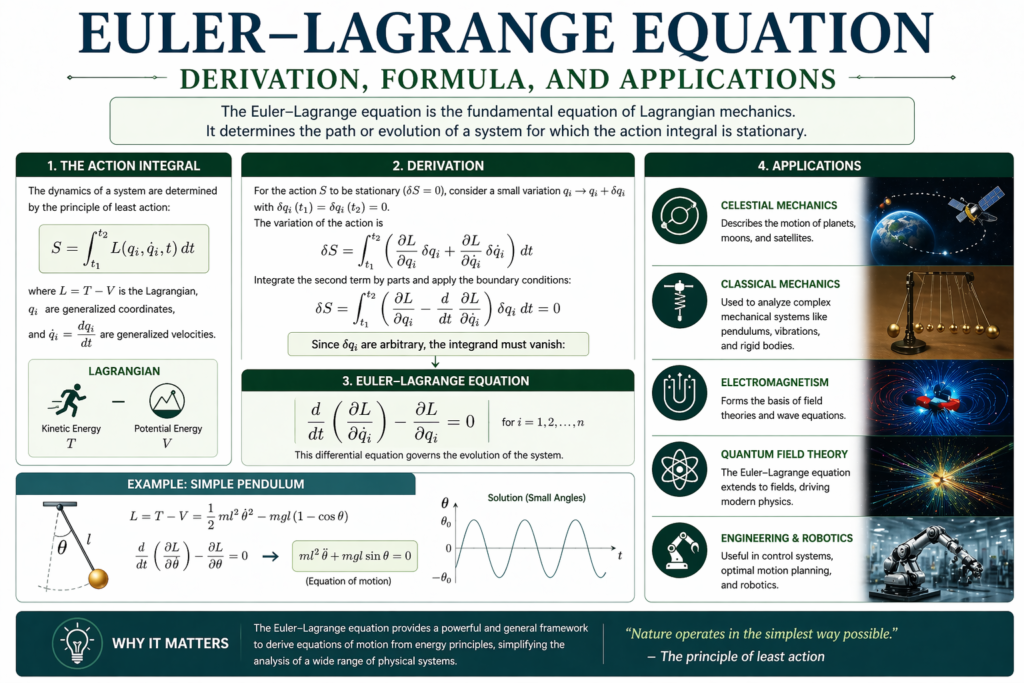
This is variational calculus at its finest. The euler–lagrange equation does not care about forces. It cares about the action integral S = ∫ L dt. In lagrangian mechanics, L = T − V, and the euler–lagrange equation gives the equations of motion. So this single equation unifies classical mechanics, optics, and even general relativity.
The History: Euler, Lagrange, and a Beautiful Collaboration
The story begins with the brachistochrone problem. In 1696, Johann Bernoulli challenged mathematicians: find the curve of fastest descent between two points. Newton solved it overnight. But the problem demanded a general method.
Leonhard Euler developed the first general approach. Then Joseph-Louis Lagrange, still a young man, wrote to Euler with a purely analytic method. Euler was thrilled. He recognized Lagrange’s method as superior. He named it the calculus of variations and ensured Lagrange received full credit.
The euler–lagrange equation was born from this beautiful collaboration. Euler provided geometric insight. Lagrange delivered algebraic elegance. Their combined work became the foundation of lagrangian mechanics and modern theoretical physics. Without this equation, we would not have lagrange points or lagrange multipliers.
Mathematical Derivation of the Euler–Lagrange Equation
Now we perform the full derivation. This mathematical work is essential. Please follow carefully.
We want to extremize the functional:
I[y] = ∫ F(x, y, y’) dx, from x = a to x = b
Here y’ = dy/dx. The endpoints are fixed: y(a) = y_a, y(b) = y_b.
Consider a small variation of the path: y(x) → y(x) + ε η(x), where η(a) = η(b) = 0. The parameter ε is small. The function η(x) is an arbitrary smooth variation that vanishes at endpoints.
The varied functional is:
I[ε] = ∫ F(x, y + εη, y’ + εη’) dx
We want the first derivative of I with respect to ε to be zero at ε = 0. This is the condition for stationarity.
Compute dI/dε:
dI/dε = ∫ [ (∂F/∂y) η + (∂F/∂y’) η’ ] dx
Now integrate the second term by parts:
∫ (∂F/∂y’) η’ dx = [ (∂F/∂y’) η ]_{a}^{b} − ∫ d/dx (∂F/∂y’) η dx
The boundary term vanishes because η(a) = η(b) = 0. Therefore:
dI/dε = ∫ [ ∂F/∂y − d/dx (∂F/∂y’) ] η dx
At ε = 0, we require dI/dε = 0 for every admissible η. The fundamental lemma of variational calculus states that the bracketed term must be zero. Hence:
∂F/∂y − d/dx (∂F/∂y’) = 0
Or more commonly written as:
d/dx (∂F/∂y’) − ∂F/∂y = 0
This is the euler–lagrange equation. It is the necessary condition for I to be stationary. Every student of calculus of variations must memorize this formula.
Understanding the Formula and Its Components
Let me break down the euler–lagrange equation piece by piece.
F is the integrand function. It depends on x (independent variable), y (dependent variable), and y’ (derivative of y with respect to x). The equation contains two terms.
First, ∂F/∂y is the partial derivative of F with respect to y, treating y’ as independent. Second, d/dx (∂F/∂y’) is the total derivative with respect to x of the partial derivative of F with respect to y’.
The euler–lagrange equation is a second order ordinary differential equation. Its solution y(x) is the extremal path. For many physical problems, this extremal path corresponds to the path of least time or stationary action.
Example 1: The Shortest Path Between Two Points
Let us apply the euler–lagrange equation to a classic problem. What is the shortest path between two points in a plane? The arc length is:
I = ∫ √(1 + (y’)²) dx
Here F(x, y, y’) = √(1 + (y’)²). Notice that F does not depend explicitly on y. So ∂F/∂y = 0.
The euler–lagrange equation simplifies to:
d/dx (∂F/∂y’) = 0 → ∂F/∂y’ = constant
Compute ∂F/∂y’ = y’ / √(1 + (y’)²) = constant = C
Solve for y’: y’ = C / √(1 − C²) = constant = m
Thus y = m x + b. The shortest path is a straight line. This matches intuition perfectly. The euler–lagrange equation proved it rigorously.
Example 2: The Brachistochrone Problem
The brachistochrone problem asks for the curve of fastest descent under gravity. This problem launched the calculus of variations. The time to travel from (0,0) to (x1, y1) is:
T = ∫ √( (1 + (y’)²) / (2 g y) ) dx
The integrand F = √( (1 + (y’)²) / y ) ignoring constants. This F does not depend explicitly on x. There is a first integral of the euler–lagrange equation:
F − y’ (∂F/∂y’) = constant
Applying this gives the equation of a cycloid. The fastest descent curve is a cycloid, not a straight line. This result shocked mathematicians of the 17th century. The euler–lagrange equation made the solution systematic.
The Euler–Lagrange Equation in Lagrangian Mechanics
In lagrangian mechanics, the euler–lagrange equation takes a slightly different form. For a system with generalized coordinates q, the Lagrangian L(q, q̇, t) replaces F. The independent variable is time t instead of x. The equation becomes:
d/dt (∂L/∂q̇) − ∂L/∂q = 0
This is the euler–lagrange equation for dynamics. It is the foundation of lagrangian mechanics. Every textbook on classical mechanics begins here.
For example, take a simple pendulum. L = (1/2) m L² θ̇² − mgL (1 − cos θ). Plugging into the euler–lagrange equation gives θ̈ + (g/L) sin θ = 0. No forces. No tension. Just pure elegance.
The same equation governs lagrange points in orbital mechanics. It controls the motion of spacecraft near L1 and L2. It even appears in lagrange interpolation when deriving error bounds.
First Integrals and Conservation Laws
The euler–lagrange equation often simplifies. If F does not depend explicitly on y (ignorable coordinate), then ∂F/∂y = 0, giving:
d/dx (∂F/∂y’) = 0 → ∂F/∂y’ = constant
This constant is a first integral. In dynamics, if L does not depend on a coordinate q, then ∂L/∂q̇ is conserved generalized momentum.
If F does not depend explicitly on x, there is another first integral:
F − y’ (∂F/∂y’) = constant
In lagrangian mechanics, when L does not depend explicitly on time, this quantity is the Hamiltonian (total energy). These conservation laws come directly from the euler–lagrange equation without additional work.
Applications Beyond Physics
The euler–lagrange equation reaches far beyond lagrangian mechanics. Here are powerful applications.
Economics and Utility Maximization
Economists maximize utility over time. The utility functional is an integral. The euler–lagrange equation gives optimal consumption paths. This is the basis of dynamic optimization and growth theory.
Image Processing and Computer Vision
Finding smooth curves in noisy images is a minimization problem. The euler–lagrange equation yields partial differential equations for edge detection. Active contour models (snakes) use this principle.
Machine Learning and Regularization
Many machine learning algorithms minimize a loss function plus a penalty term. The continuous version is a variational problem. The euler–lagrange equation gives the optimal function. This connects to neural network training and support vector machines.
Geodesics and General Relativity
A geodesic is the shortest path on a curved surface. The euler–lagrange equation applied to the metric yields the geodesic equation. In general relativity, light and matter follow geodesics. So the euler–lagrange equation is essential for understanding black holes and gravitational waves.
Solving the Euler–Lagrange Equation: A Practical Guide
To solve any functional minimization problem, follow these steps.
Step 1: Write the functional I = ∫ F dx.
Step 2: Identify F.
Step 3: Compute ∂F/∂y and ∂F/∂y’.
Step 4: Plug into the euler–lagrange equation: d/dx(∂F/∂y’) − ∂F/∂y = 0.
Step 5: Simplify. This gives a differential equation.
Step 6: Apply boundary conditions to find specific constants.
Step 7: Solve the differential equation (analytically or numerically).
For problems with constraints, you use lagrange multipliers inside the integral. The euler–lagrange equation then includes a Lagrange multiplier term. This is how we handle isoperimetric problems.
Mathematical Work: The Geodesic on a Sphere
Let us find the shortest path between two points on a sphere. For a sphere of radius R, the line element is ds² = R² (dθ² + sin²θ dφ²). The path length is:
I = ∫ R √( θ’² + sin²θ ) dφ, where θ’ = dθ/dφ.
Here F(θ, θ’, φ) = R √( θ’² + sin²θ ). F does not depend explicitly on φ, so we have a first integral:
F − θ’ (∂F/∂θ’) = constant
Compute ∂F/∂θ’ = R θ’ / √(θ’² + sin²θ). Then:
R √(θ’² + sin²θ) − θ’ * (R θ’ / √(θ’² + sin²θ)) = constant
Simplify: R sin²θ / √(θ’² + sin²θ) = constant → √(θ’² + sin²θ) = (R / constant) sin²θ
Solving gives great circles. The euler–lagrange equation proved that the shortest path on a sphere is an arc of a great circle. This is why airplanes follow curved routes.
Frequently Asked Questions (FAQs)
1. What is the difference between Euler–Lagrange and Lagrange equations?
They are the same equation. In lagrangian mechanics, it is written with time derivatives. In calculus of variations, it uses x derivatives. The euler–lagrange equation is the general form.
2. Is the Euler–Lagrange equation always solvable?
Not analytically. Many problems require numerical solutions. But the equation provides the necessary condition, which is the starting point for approximations.
3. Can the Euler–Lagrange equation handle multiple functions?
Yes. For functions y1(x), y2(x), …, you get one euler–lagrange equation per function. This is how we derive the equations for double pendulums and fields.
4. Why is the Euler–Lagrange equation so important in physics?
Because it derives from Hamilton’s principle. This principle underlies classical mechanics, quantum mechanics, and general relativity. The euler–lagrange equation is the universal translator of physics problems.
5. Who first discovered the Euler–Lagrange equation?
Leonhard Euler derived the first version in 1744. Joseph-Louis Lagrange generalized it in 1755. Their collaboration produced the modern form. It is one of the great partnerships in mathematics.
Conclusion
The euler–lagrange equation is a masterpiece of human thought. It takes a vague question, “which path minimizes something?” and turns it into a precise differential equation. From the brachistochrone to geodesics, from lagrangian mechanics to lagrange multipliers, this equation is everywhere.
The same Joseph-Louis Lagrange who gave us lagrange points, lagrange interpolation, and the calculus of variations also perfected this equation. His work, together with Euler’s, created the language of modern physics. Just like how ancient greek scientists changed modern science by asking why things move, Euler and Lagrange changed science by asking what path nature prefers. The answer is always the euler–lagrange equation. Now go apply it.