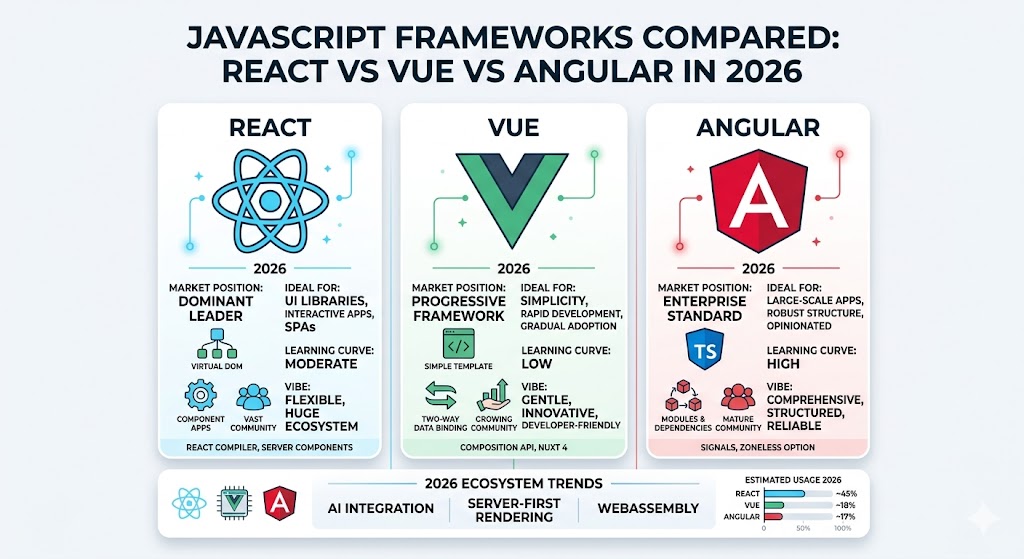
You have learned JavaScript. You understand variables, functions, and DOM manipulation. Now you face a bigger decision. Which framework should you learn? Three names dominate the conversation. React, Vue, and Angular. Each has passionate fans. Each powers thousands of websites. Each has different strengths. This excellent react vs vue vs angular comparison will help you decide. You will learn the history of each framework. You will understand their architectures, performance, learning curves, and ecosystems. By the end, you will know exactly which framework fits your goals for 2025 and beyond. The history of javascript shows that frameworks emerged because building complex user interfaces with plain JavaScript is tedious. Brendan Eich created the language. The community built the tools. React came from Facebook in 2013. Vue was created by Evan You in 2014. Angular was rewritten by Google in 2016 (Angular 2+). Each solved different problems. Let me start with the most important question. Should you even use a framework?
Why Use a JavaScript Framework
Before diving into react vs vue vs angular comparison , understand why frameworks exist. Building a single page application (SPA) without a framework means manually managing the DOM. You write code to create elements, update text, handle events, and re render when data changes. For a small site, that is fine. For a large application with hundreds of components, it becomes chaos. Frameworks provide structure. They offer component-based architecture where you build reusable UI pieces. They handle state management so data flows predictably. They optimize rendering through techniques like the Virtual DOM or incremental DOM. They provide client-side rendering for fast interactivity. They include developer tooling like CLI, debugging tools, and hot reloading. They have large ecosystems of third party libraries. Learning any framework makes you more employable. The future of javascript frameworks continues evolving. But React, Vue, and Angular remain the top three. This react vs vue vs angular comparison covers everything you need.
React The Library from Facebook (2013)
React was created by Jordan Walke at Facebook. It was released in 2013. React is technically a library vs framework distinction. It focuses only on the view layer. For routing and state management, you add other libraries. This flexibility is both a strength and a weakness. React introduced the Virtual DOM. Instead of touching the real DOM directly, React maintains a lightweight copy. When data changes, React compares the new Virtual DOM with the old one. It calculates the minimal changes needed. Then it updates the real DOM efficiently. This makes React fast. React uses JSX, a syntax extension that lets you write HTML inside JavaScript.
function Welcome({ name }) {
return <h1>Hello, {name}!</h1>;
}
JSX looks like HTML but compiles to JavaScript. Some developers love JSX. Others hate mixing HTML with JavaScript. React uses one way data binding. Data flows down from parent to child via props. Events flow up via callbacks. This makes debugging easier because data changes are predictable. The library ecosystem around React is massive. For routing, you use React Router. For state management, you use Redux, Zustand, or Context API. For forms, you use React Hook Form. For server communication, you use React Query or SWR. React introduced React Server Components in recent years. They allow components to run on the server, reducing client side JavaScript. The learning curve for React is moderate. You need to learn JSX, props, state, hooks (useState, useEffect, useContext), and component lifecycle. The job market for React is the largest of any front end framework. For react vs vue vs angular comparison , React wins on ecosystem size and job opportunities.
Vue The Progressive Framework (2014)
Vue was created by Evan You, a former Google engineer. He worked on Angular and wanted to extract the good parts into a lighter framework. Vue was released in 2014. It is called “progressive” because you can adopt it gradually. Add Vue to a single page without rebuilding your whole site. Or build a full SPA with Vue Router and Pinia (state management). Vue’s learning curve is the gentlest of the three. The syntax is intuitive. Vue uses single file components. A .vue file contains template, script, and style sections.
<template>
<div>
<h1>{{ message }}</h1>
<button @click="increment">Count: {{ count }}</button>
</div>
</template>
<script>
export default {
data() {
return {
message: "Hello Vue!",
count: 0
};
},
methods: {
increment() {
this.count++;
}
}
};
</script>
<style scoped>
h1 { color: blue; }
</style>
The scoped style means CSS only applies to this component. Vue supports two-way data binding with v-model. This is similar to Angular. Some developers find it convenient. Others prefer React’s one way flow. Vue also uses a Virtual DOM. Its performance is excellent. The component-based architecture in Vue is clean and intuitive. For state management, Vue offers Pinia (the modern replacement for Vuex). For routing, Vue Router is official and well integrated. The ecosystem is smaller than React but very high quality. Vue is extremely popular in Asia, especially China where it was created. For react vs vue vs angular comparison , Vue wins on learning curve and developer experience.
Angular The Enterprise Framework (2016)
Angular has a confusing history. AngularJS (version 1) was released by Google in 2010. It was completely rewritten for Angular 2 in 2016. That rewrite broke backward compatibility. The modern Angular is version 2 and above. Angular is a full framework, not a library. It includes everything. Routing, state management, HTTP client, forms, animations, and testing tools. You do not need to choose third party libraries. This is great for teams that want standardization. Angular uses TypeScript by default. TypeScript adds optional static types to JavaScript. This catches errors early and improves tooling. If you want TypeScript in frameworks , Angular is the natural choice.
import { Component } from "@angular/core";
@Component({
selector: "app-welcome",
template:Welcome, {{ name }}!,
styles: [h1 { color: green; }]
})
export class WelcomeComponent {
name = "Angular Developer";
}
Angular uses real DOM with incremental updates, not a Virtual DOM. It is still fast. Angular supports two-way data binding with [(ngModel)]. It uses dependency injection for service architecture. This makes testing easier. The learning curve for Angular is the steepest. You must learn TypeScript, RxJS (reactive programming), modules, components, services, directives, pipes, and dependency injection. The scalability of Angular is proven. Google uses it for thousands of internal applications. For react vs vue vs angular comparison , Angular wins on completeness and enterprise readiness.
Performance Comparison for 2025
Performance matters. All three frameworks are fast enough for most applications. But benchmarks reveal differences. Initial load time. React and Vue have smaller bundle sizes. Angular is larger because it includes everything. However, Angular’s new Ivy renderer improved significantly. Runtime performance. All three are excellent. React and Vue use Virtual DOM. Angular uses incremental DOM. In most real world scenarios, users cannot tell the difference. Memory usage. Vue tends to use less memory. React and Angular use more but within acceptable ranges. For framework performance 2026 , all three will continue improving. React Server Components reduce client side JavaScript. Vue’s Vapor mode (experimental) removes Virtual DOM. Angular’s signal based reactivity reduces change detection overhead. Your application architecture matters more than framework choice. Poorly written code in any framework is slow. Well written code in any framework is fast.
Learning Curve and Developer Experience
The react vs vue vs angular comparison learning curve differs dramatically. Vue is easiest. The documentation is excellent. The syntax is intuitive. You can learn Vue in a weekend and build real apps. React is moderate. JSX is strange for beginners. But once you understand it, React feels natural. Hooks require a mental shift from class components. The React documentation has improved dramatically. Angular is hardest. You must learn TypeScript before Angular. Then you need RxJS, which is comparable to learning a new language. Angular’s verbosity is overwhelming for beginners. But for large teams, that verbosity provides structure. Developer experience includes tooling. All three have excellent CLI tools. React uses Create React App or Vite. Vue has Vue CLI and Vite. Angular has Angular CLI. Vue’s Vite setup is the fastest. Hot reloading works well in all three. Debugging tools like React DevTools, Vue DevTools, and Angular DevTools are excellent.
Ecosystem and Job Market
Ecosystem size matters for finding libraries, solutions, and jobs. React has the largest ecosystem by far. Over 10 million weekly downloads. Thousands of job listings daily. React Native for mobile apps. Next.js for full stack React. The library ecosystem around React is unmatched. Vue has a smaller but high quality ecosystem. Nuxt for full stack Vue. Vuetify for UI components. Pinia for state management. The job market for Vue is strong, especially in Europe and Asia. Remote Vue jobs are common but fewer than React. Angular has a medium ecosystem. The job market is steady. Large enterprises and banks use Angular. Government projects use Angular. Angular jobs pay well but are less numerous. For front-end ecosystems , React is the clear winner. For job security, React offers the most opportunities. Vue and Angular are still excellent choices.
Which Framework Should You Choose for 2025
Your choice depends on your goals. Choose React if you want the most job opportunities. The largest ecosystem. The ability to build mobile apps with React Native. The flexibility to add only what you need. Choose Vue if you are a beginner or solo developer. You want the gentlest learning curve. You value excellent documentation. You are building smaller to medium applications. You want to build quickly and enjoyably. Choose Angular if you work in a large enterprise. You need a complete solution out of the box. Your team already uses TypeScript. You value consistency and testability. You are building a long term, large scale application.
For choosing a JS framework in 2025, consider your team. A solo developer or small startup might prefer Vue’s speed and simplicity. A mid sized company building a complex web app might prefer React’s ecosystem. A bank or insurance company with 100 developers might prefer Angular’s structure. There is no wrong answer. Learning one framework makes learning another easier. Many developers know multiple frameworks. For react vs vue vs angular comparison , each is a valuable skill.
Real World Companies Using Each Framework
Real world adoption validates framework choices. React is used by Facebook, Instagram, Netflix, Airbnb, Dropbox, and The New York Times. React Native powers Facebook, Instagram, and Discord mobile apps. Vue is used by Alibaba, Baidu, Xiaomi, GitLab, Adobe, and Nintendo. Vue is huge in China. Angular is used by Google (of course), Microsoft Office, PayPal, Upwork, and Forbes. Angular powers many internal Google tools. For client-side rendering at massive scale, all three work. The UI components ecosystem for each framework is mature. React has Material UI, Chakra UI, and Ant Design. Vue has Vuetify, Quasar, and Element Plus. Angular has Angular Material and PrimeNG.
Frequently Asked Questions (FAQs)
Q1: Which framework has better performance in react vs vue vs angular comparison?
All three perform well. Initial load: Vue and React are smaller. Runtime: Angular’s Ivy renderer is competitive.
Q2: Should I learn React or Vue or Angular in 2025?
For job opportunities, choose React. For easiest learning, choose Vue. For enterprise scale, choose Angular.
Q3: What is the Virtual DOM in React and Vue?
A lightweight copy of the real DOM. It allows fast updates by calculating minimal changes before updating the real DOM.
Q4: Does Angular use Virtual DOM?
No. Angular uses incremental DOM and change detection. It is still fast for most applications.
Q5: Can I use TypeScript in all three frameworks?
Yes. Angular requires TypeScript. React and Vue have excellent TypeScript support but do not require it.
Conclusion
You have completed this react vs vue vs angular comparison for 2025. React is the flexible library with the largest ecosystem and job market. Vue is the progressive framework with the gentlest learning curve. Angular is the complete enterprise framework with built in everything. The history of javascript frameworks shows rapid evolution. Brendan Eich created JavaScript. Facebook, Google, and independent creators built the frameworks. javascript ES6 features enabled modern frameworks. asynchronous javascript explained patterns power data fetching in all three. what is node.js provides the build tools. The future of javascript includes continued framework innovation. React Server Components, Vue Vapor mode, and Angular signals are just the beginning. The future of software engineering will always need UI frameworks. You now have the knowledge to choose. Pick one. Learn it deeply. Build projects. Join the community. The framework matters less than your ability to ship working software. Go build something amazing.