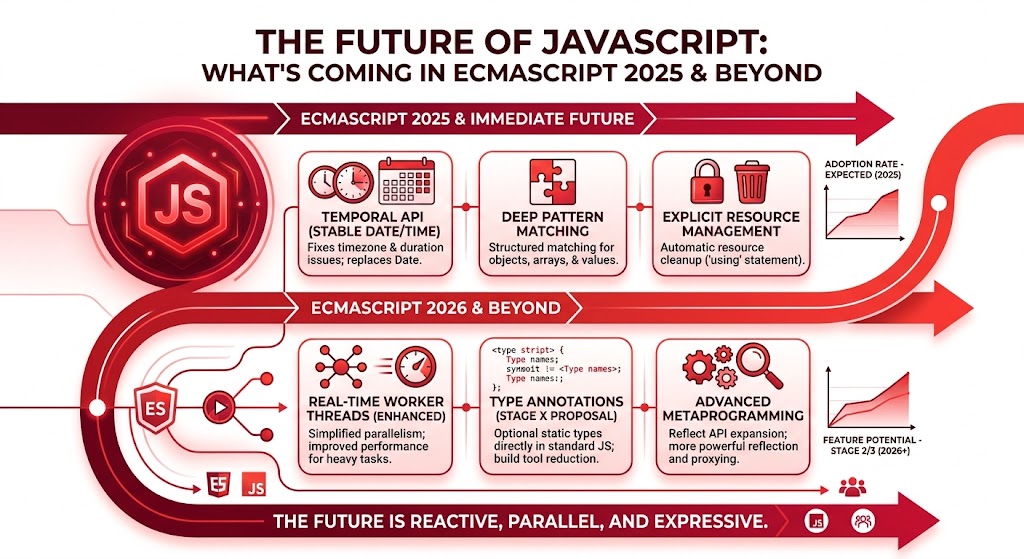
JavaScript never stops evolving. Every year, the TC39 committee adds new features. The language that started as a ten day prototype in 1995 is now a modern, powerful ecosystem. The future of javascript is brighter than ever. New proposals are moving through the stages. Some will arrive in ES2025. Others will take longer. But all will make JavaScript more expressive, safer, and faster. This exciting future of javascript guide covers everything coming to the language. You will learn about the Temporal API for dates and times. Records and Tuples for immutable data. The pipeline operator for readable function chains. Pattern matching for elegant conditionals. Decorators for meta programming. And much more. The history of javascript started with Brendan Eich . The javascript ES6 features of 2015 were revolutionary. Now the language evolution continues yearly. The TC39 roadmap shows the direction. Let me start with how new features become real.
How JavaScript Features Are Made The TC39 Process
Before exploring the future of javascript , understand how features get added. The TC39 committee governs ECMAScript (the official JavaScript specification). Any proposal goes through proposal stages . Stage 0 is a strawman idea. Anyone can submit. Stage 1 is a formal proposal. The committee assigns a champion. Stage 2 is a draft. The committee expects the feature to be developed. Stage 3 is a candidate. The feature is complete. Implementations needed. Stage 4 is finished. The feature is ready for the standard. Stage 4 proposals appear in the next release. This process ensures quality. Features can be rejected or changed. The web standards process is deliberate. Major browser engines like V8 (Chrome), SpiderMonkey (Firefox), and JavaScriptCore (Safari) implement Stage 3 and 4 features. The technical roadmap prioritizes features that improve developer experience and performance. For what is node.js , the same process applies because Node.js uses V8. The react vs vue vs angular comparison frameworks eagerly adopt new features. Let me explore the most exciting upcoming features.
Temporal API Fixing Date and Time (Stage 4)
Dates in JavaScript have been broken since 1995. The Date object is famously flawed. Months are zero indexed (January is 0). Years are complicated. Time zones are messy. Date parsing is inconsistent. The Temporal API fixes all of this. It is currently Stage 4 and will arrive in ES2025 or soon after. Temporal provides modern date and time handling.
// Current Date object problems
const date = new Date(2025, 0, 15); // January 15, 2025? Actually Jan 15
console.log(date.getMonth()); // 0 (January) - confusing
// Temporal API solution
const plainDate = new Temporal.PlainDate(2025, 1, 15); // Year, Month, Day
console.log(plainDate.month); // 1 (much better)
const zonedDateTime = Temporal.Now.zonedDateTimeISO();
const birthday = Temporal.PlainDate.from("2025-05-15");
const today = Temporal.Now.plainDateISO();
const daysUntil = birthday.since(today).days;
const time = Temporal.Now.plainTimeISO();
const zoned = Temporal.Now.zonedDateTimeISO("America/New_York");
const instant = Temporal.Instant.from("2025-05-15T12:00:00Z");
Temporal has many types. Temporal.PlainDate for dates without time. Temporal.PlainTime for times without date. Temporal.PlainDateTime for both without timezone. Temporal.ZonedDateTime for timezone aware. Temporal.Instant for UTC timestamps. The Temporal API will eliminate countless date bugs. Thousands of npm packages exist just to fix JavaScript dates. Temporal makes them obsolete. For javascript beginner guide readers, this is a huge quality of life improvement.
Records and Tuples Immutable Data (Stage 2)
Records and Tuples are new immutable data structures. Records are immutable objects. Tuples are immutable arrays. They use # prefix syntax. Unlike regular objects, Records are deeply immutable. They compare by value, not reference.
// Regular objects compare by reference
const obj1 = { a: 1, b: 2 };
const obj2 = { a: 1, b: 2 };
console.log(obj1 === obj2); // false (different objects)
// Records compare by value
const record1 = #{ a: 1, b: 2 };
const record2 = #{ a: 1, b: 2 };
console.log(record1 === record2); // true (same value)
// Tuples
const tuple1 = #[1, 2, 3];
const tuple2 = #[1, 2, 3];
console.log(tuple1 === tuple2); // true
// Records cannot have methods
// const invalid = #{ foo: () => {} }; // Error
// Records can be nested
const nested = #{
name: "Alice",
address: #{ city: "New York", zip: 10001 }
};
Records and Tuples are immutable . You cannot change them. You create new ones. This makes them perfect for state management. React, Redux, and Vue benefit enormously. They enable perfect equality checks without deep comparison. For future of javascript , Records and Tuples will change how we write front end code.
Pipeline Operator Readable Function Chaining (Stage 2)
The pipeline operator |> makes function chains readable. Instead of nested function calls, data flows left to right. This is similar to Unix pipes.
// Without pipeline (nested functions)
const result = toUpperCase(reverse(trim(" hello ")));
// With pipeline proposal
const result = " hello "
|> trim
|> reverse
|> toUpperCase;
// With async functions
async function fetchData(url) {
return await fetch(url)
|> await %
|> response => response.json()
|> await %;
}
The pipeline operator makes advanced syntax more readable. Each transformation is on its own line. You can add, remove, or reorder steps easily. For functional programming styles, this is transformative. The % token is the placeholder for the current value. The pipeline operator is Stage 2. It may change before final.
Pattern Matching Elegant Conditionals (Stage 1)
Pattern matching dramatically simplifies complex conditionals. Instead of nested if or switch, you match patterns.
// Current approach (verbose)
function getMessage(status) {
if (status === "loading") return "Loading...";
if (status === "success") return "Success!";
if (status === "error") return "Something went wrong";
return "Unknown status";
}
// Pattern matching proposal
function getMessage(status) {
return match (status) {
"loading": "Loading...",
"success": "Success!",
"error": "Something went wrong",
_: "Unknown status"
};
}
// Matching object shapes
match (response) {
{ status: "success", data }: handleSuccess(data),
{ status: "error", error }: handleError(error),
_: retry()
}
// Destructuring patterns
match (point) {
{ x: 0, y: 0 }: "origin",
{ x: 0, y }:x is zero, y is ${y},
{ x, y: 0 }:y is zero, x is ${x},
_:point (point.x,{point.y})“
}
Pattern matching makes code declarative. You describe what you want, not how to get it. For software trends , pattern matching is popular in Rust, Swift, and Python. JavaScript is catching up. This language specification addition will reduce bugs and improve readability.
Decorators Meta Programming (Stage 3)
Decorators let you annotate and modify classes and methods. They are already used in TypeScript. Native JavaScript decorators are Stage 3. They will likely arrive in ES2025 or 2026.
// Defining a decorator
function logged(originalMethod, context) {
return function(...args) {
console.log(Calling ${context.name} with, args);
const result = originalMethod.call(this, ...args);
console.log(Result:, result);
return result;
};
}
function readonly(target, context) {
context.addInitializer(function() {
Object.freeze(this);
});
}
// Using decorators
class Calculator {
@logged
@readonly
add(a, b) {
return a + b;
}
}
const calc = new Calculator();
calc.add(5, 3); // Logs the call and result
Decorators are meta programming . They let you write reusable behaviors. Logging, validation, timing, dependency injection, and memoization become clean annotations. Frameworks like Angular already use decorators. React may adopt them. For javascript design patterns , Decorator pattern becomes native syntax.
WebAssembly Integration and JavaScript
WebAssembly integration is not a language feature but an ecosystem shift. WebAssembly (Wasm) runs compiled code at near native speed. JavaScript and Wasm are becoming closer. Wasm modules will be importable like ES modules.
// Future JavaScript importing Wasm
import { expensiveCalculation } from "./calculation.wasm";
const result = expensiveCalculation(1000000);
Wasm allows other languages (Rust, C++, Go) to run in browsers. JavaScript orchestrates them. This web standards evolution means performance critical code can be written in other languages. JavaScript remains the glue. For next-gen JS engines , Wasm integration is a priority. The future of javascript includes JavaScript as the universal coordinator language.
New Syntax and Built in Improvements
Beyond major features, many smaller improvements are coming. Pattern matching was already covered. Additional proposals include:
// Await outside async (top level await already here)
// Better error handling with cause
try {
doSomething();
} catch (error) {
throw new Error("Something failed", { cause: error });
}
// Enhanced regex (unicode sets, history)
const regex = /[\p{Script=Greek}\p{Script=Cyrillic}]/u;
// Type Annotations (Stage 1)
let age: number = 25;
function greet(name: string): string {
returnHello ${name};
}
Type annotations are controversial. Some want TypeScript integrated. Others prefer separate tooling. The proposal is Stage 1. It may evolve. For javascript beginner guide , native types would be huge. For now, TypeScript remains the standard.
Performance Improvements and Next Gen Engines
The future of javascript is not just syntax. next-gen JS engines are getting faster. JIT (Just In Time) compilers are smarter. Inline caching improves property access. New optimizations for large arrays. WebAssembly integration offloads heavy work. The V8 engine (Chrome, Node.js) continuously improves. SpiderMonkey (Firefox) adds new optimizations. JavaScriptCore (Safari) focuses on energy efficiency. Your existing code will run faster without changes. advanced syntax features compile to efficient bytecode. The developer experience improves with better error messages and debugging.
Frequently Asked Questions (FAQs)
Q: When will ES2025 be released and what features are expected?
ES2025 will likely be released mid 2025. Temporal API (Stage 4), Decorators (Stage 3), and Record/Tuple (Stage 2) may be included.
Q: What is the Temporal API in future of javascript?
Temporal fixes JavaScript’s broken date handling. It provides modern date, time, timezone, and duration types.
Q: What are Records and Tuples in JavaScript?
Records are immutable objects (using # prefix). Tuples are immutable arrays. They compare by value, not reference.
Q: What is the pipeline operator in JavaScript?
The pipeline operator |> passes a value through a sequence of functions, making code more readable left to right.
Q: Will JavaScript ever get built in type annotations?
Proposals exist at Stage 1. It is possible but not guaranteed. TypeScript remains the solution for now.
Conclusion
The future of javascript is incredibly bright. The Temporal API will fix dates forever. Records and Tuples bring immutable data structures. The pipeline operator makes function chains readable. Pattern matching simplifies complex conditionals. Decorators enable meta programming. WebAssembly integration opens performance possibilities. The TC39 roadmap shows careful, deliberate progress. Each feature goes through proposal stages . The history of javascript from Brendan Eich to today is remarkable. javascript ES6 features modernized the language. Now the language evolution continues. asynchronous javascript explained patterns keep improving. javascript design patterns adopt new syntax. The future of software engineering depends on JavaScript remaining vibrant. It will. The committee, engine teams, and community ensure it. Stay curious. Keep learning. The best JavaScript is ahead of us.