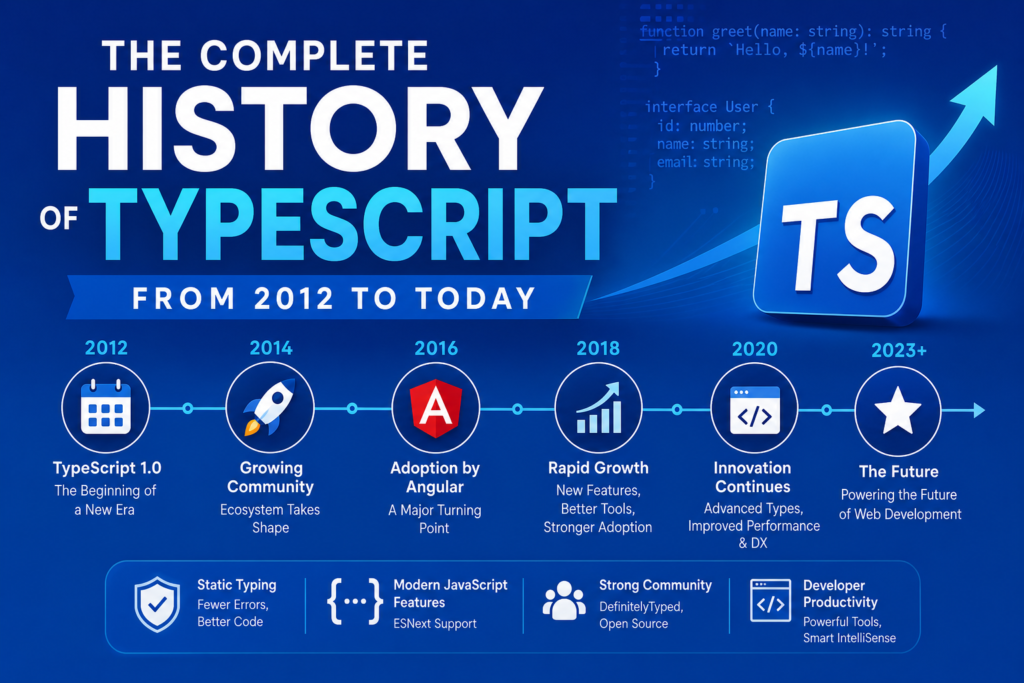
The journey of typescript history is one of the most powerful and transformative stories in modern programming. From its humble beginnings in 2012 to becoming a dominant force in web development, TypeScript has reshaped how developers write and maintain code. Understanding typescript history helps us see how innovation, community growth, and smart design choices can redefine an entire ecosystem.
Created by Anders Hejlsberg at Microsoft, TypeScript was introduced as a solution to the growing complexity of JavaScript applications. Today, it stands as a key part of modern software engineering and continues to evolve rapidly.
The Origins of TypeScript (2010 – 2012)
Before TypeScript was officially released, JavaScript was already dominating web development. However, as applications became larger, developers faced challenges related to maintainability and debugging. This is where the idea behind typescript history began.
Microsoft recognized the need for a language that could bring static analysis and better tooling to JavaScript. Inspired by the history of typed JavaScript and earlier experiments like CoffeeScript, TypeScript was designed to enhance JavaScript without replacing it.
During this period, Hejlsberg and his team focused on language specification, ensuring backward compatibility while introducing static typing. This careful balance became a defining feature of typescript history.
TypeScript 1.0 Release and Early Growth (2012 – 2014)
The official TypeScript 1.0 release marked a major milestone. It introduced optional static typing, classes, and modules, making it easier to build scalable applications.
Developers quickly started exploring what is typescript? and how it could improve their workflows. Early adopters appreciated the improved developer productivity and better error detection.
At this stage, the evolution of TypeScript was closely tied to Microsoft’s open source journey. Although initially not fully open source, it gradually embraced community contributions, setting the stage for rapid growth.
Community Expansion and Ecosystem Building (2014 – 2016)
As TypeScript gained popularity, its ecosystem began to expand. Tools like DefinitelyTyped allowed developers to use type definitions for existing JavaScript libraries, significantly boosting adoption.
The growth of the TS ecosystem was fueled by community contributions and improved developer tools. This period in typescript history also saw increased interest from major companies.
Developers began comparing typescript vs javascript, highlighting the benefits of static analysis and improved maintainability. This comparison played a crucial role in spreading awareness.
Angular and Enterprise Adoption (2016 – 2018)
One of the biggest turning points in typescript history came when Google adopted TypeScript for Angular. This decision brought massive visibility and credibility to the language.
The adoption by Google and Angular accelerated community growth and ecosystem maturity. Enterprises started using TypeScript for large scale applications, appreciating its strong typing and software architecture benefits.
This period also saw improvements in language interoperability and better support for modern web development trends. TypeScript became a standard choice for professional developers.
Rapid Evolution and Feature Expansion (2018 – 2020)
Between 2018 and 2020, TypeScript underwent rapid development milestones. New features like conditional types, advanced generics, and improved tooling were introduced.
Developers exploring advanced typescript concepts found powerful tools to handle complex scenarios. The language continued to evolve while maintaining backward compatibility.
The state of JS survey consistently showed increasing adoption of TypeScript, highlighting its growing importance in the industry. This phase solidified its position as a leading programming language.
Modern Era and TypeScript 5.0 Updates (2020 – Present)
The modern era of typescript history is defined by maturity and innovation. TypeScript 5.0 updates introduced performance improvements, better type inference, and enhanced developer experience.
The language now plays a crucial role in both frontend and backend development. Many developers rely on typescript with react and typescript with nodejs for building scalable applications.
This phase also reflects the ecosystem maturity of TypeScript. With strong community support and continuous updates, it remains at the forefront of web development trends.
Key Features That Shaped TypeScript
Several features have defined the success of TypeScript:
- Static typing for better error detection
- Strong tooling and IDE support
- Language interoperability with JavaScript
- Advanced features like generics and interfaces
- Continuous improvements through software versioning
These features highlight why typescript history is considered a landmark in programming language design.
TypeScript vs CoffeeScript and Other Alternatives
In the early days, TypeScript faced competition from languages like CoffeeScript. However, TypeScript’s approach to static typing and backward compatibility gave it a clear advantage.
The TypeScript vs CoffeeScript history shows how developer preferences shifted toward more robust and scalable solutions. This shift further strengthened the position of TypeScript in the ecosystem.
Impact on Modern Web Development
Today, TypeScript is a cornerstone of modern web development. It influences how developers write, test, and maintain code.
The typescript history journey demonstrates how a language can evolve to meet changing needs. It has improved developer productivity and reduced errors in large scale projects.
Its influence extends to frameworks, tools, and even standardization efforts within the JavaScript community.
Challenges and Criticism Over the Years
Despite its success, TypeScript has faced criticism. Some developers argue that it adds complexity and requires additional setup.
However, many of these concerns are outweighed by its benefits in large projects. The balance between flexibility and strictness continues to be a topic of discussion in typescript history.
The Future of TypeScript
Looking ahead, the future of typescript appears incredibly promising. Continuous improvements and strong community support ensure its relevance.
TypeScript is expected to play a key role in the future of software engineering, especially as applications become more complex. Its focus on developer productivity and scalability makes it a valuable tool for the next generation of developers.
FAQs About TypeScript History
What is TypeScript and why was it created?
TypeScript is a superset of JavaScript designed to add static typing and improve code quality. It was created to address challenges in large scale applications.
When was TypeScript first released?
TypeScript 1.0 was officially released in 2012, marking the beginning of its journey.
Why did TypeScript become so popular?
Its combination of static analysis, strong tooling, and backward compatibility made it highly appealing to developers.
How has TypeScript evolved over time?
It has grown through major TypeScript versions, adding advanced features and improving performance.
Is TypeScript the future of web development?
While no single tool defines the future, TypeScript is expected to remain a key player in modern development.
Conclusion
The story of typescript history is a remarkable example of innovation and adaptability. From its launch in 2012 to its current status as a dominant programming language, TypeScript has transformed the way developers build applications.
Its evolution reflects the changing needs of the industry and the importance of community driven development. As technology continues to advance, TypeScript will likely remain a powerful force shaping the future of programming.