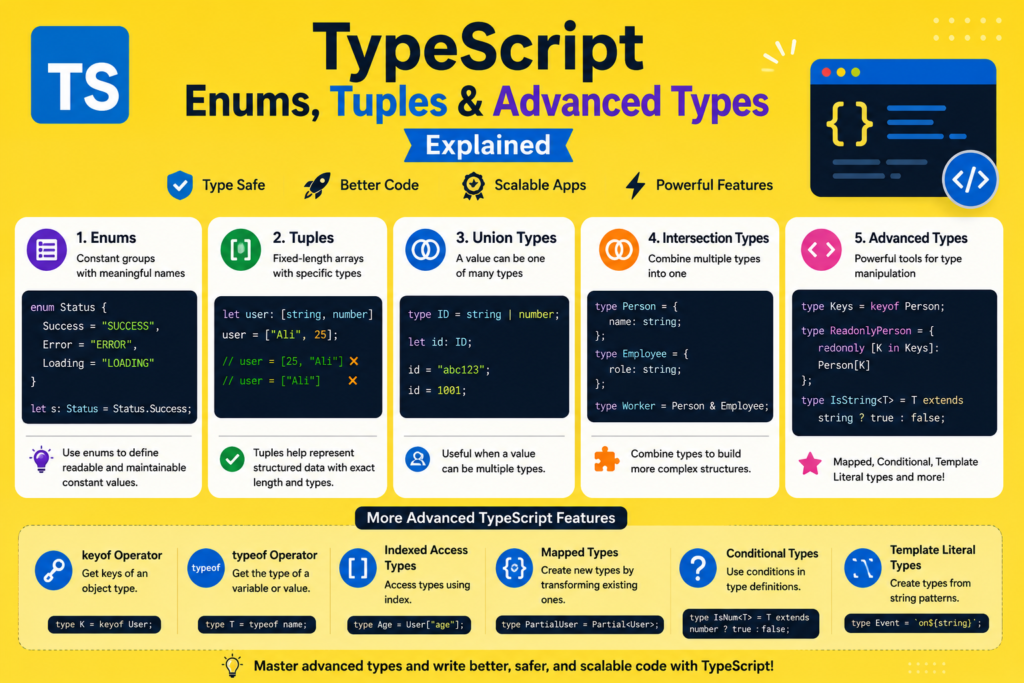
Learning advanced typescript concepts is one of the most important steps for developers who want to build scalable and maintainable applications. Once you understand the basics of variables, functions, and classes, the next stage is mastering advanced features like enums, tuples, union types, mapped types, and conditional types. These features make TypeScript one of the most powerful programming languages for modern software development.
Today, large scale applications rely heavily on type safety, reusable logic, and strong data modeling. This is where advanced typescript becomes extremely valuable. It helps developers create predictable systems, manage complex data structures, and improve developer productivity.
In this complete guide, you will learn everything about advanced typescript, including enums, tuples, discriminated unions, mapped types, and advanced type manipulation with practical code examples.
Evolution of Advanced Type Systems (1995 – 2026)
To understand advanced typescript, it is important to know how type systems evolved. JavaScript introduced flexibility in 1995, but its dynamic nature often caused runtime errors in large applications.
In 2012, Anders Hejlsberg introduced TypeScript. The typescript history demonstrates how TypeScript gradually evolved into one of the most sophisticated type systems in modern programming.
As software complexity increased, developers needed better tools for type manipulation, metadata handling, and scalable architecture. This demand led to features like enums, tuples, conditional types, and discriminated unions that define modern advanced typescript development.
What Is Advanced TypeScript?
At its core, advanced typescript refers to the advanced features of TypeScript’s type system that go beyond basic variables and functions.
If you are wondering what is typescript?, it is a strongly typed superset of JavaScript that adds compile time checking, type inference, and advanced tooling support.
Advanced TypeScript concepts allow developers to build safer APIs, reusable utilities, and scalable software architecture. These features are heavily used in enterprise applications and modern frameworks.
Understanding Enums in TypeScript
Enums are one of the most commonly used features in advanced typescript. Enums allow developers to define a group of named constants.
Numeric Enums
Example:
enum Direction {
  Up,
  Down,
  Left,
  Right,
}

console.log(Direction.Up);
Numeric enums automatically assign numbers to members.
String Enums
Example:
enum Status {
  Success = "SUCCESS",
  Error = "ERROR",
}

console.log(Status.Success);
String enums are easier to debug because they store readable values.
Enums improve code readability and help manage constant groups efficiently.
Tuple Types and Their Uses
Tuple types are another important feature in advanced typescript. Tuples allow developers to define fixed length arrays with specific types.
Example:
let user: [string, number];

user = ["Ali", 25];
This tuple ensures the first value is a string and the second is a number.
Tuple types are useful for data modeling, API responses, and structured data handling.
They are commonly used in React hooks and asynchronous programming.
Union Types Explained
Union types allow variables to hold multiple possible types.
Example:
let id: string | number;

id = "ABC123";
id = 100;
Union types improve flexibility while maintaining type safety.
They are heavily used in advanced typescript applications where variables can represent multiple states.
Intersection Types and Type Composition
Intersection types combine multiple types into one.
Example:
type Person = {
  name: string;
};

type Employee = {
  company: string;
};

type Worker = Person & Employee;
This creates a new type that contains properties from both structures.
Intersection types are useful for reusable components and complex data structures.
The keyof Operator
The keyof operator is a powerful feature in advanced typescript.
Example:
type User = {
  id: number;
  name: string;
};

type UserKeys = keyof User;
This generates a union of property names.
The keyof operator improves type manipulation and reusable utility creation.
The typeof Operator
The typeof operator extracts the type of a variable.
Example:
const username = "Ali";

type UserNameType = typeof username;
This feature improves consistency and prevents duplicate type definitions.
Indexed Access Types
Indexed access types allow developers to access property types directly.
Example:
type Product = {
  id: number;
  price: number;
};

type PriceType = Product["price"];
This improves reusability and consistency in large codebases.
Mapped Types in TypeScript
Mapped types transform existing types into new structures.
Example:
type User = {
  id: number;
  name: string;
};

type ReadOnlyUser = {
  readonly [K in keyof User]: User[K];
};
Mapped types are essential in advanced typescript because they automate repetitive type creation.
Conditional Types Explained
Conditional types allow logic branching within types.
Example:
type IsString<T> = T extends string ? true : false;

type Result = IsString<string>;
Conditional types make TypeScript extremely flexible and powerful.
They are commonly used in utility libraries and advanced frameworks.
Template Literal Types
Template literal types combine string manipulation with typing.
Example:
type Direction = "top" | "bottom";

type Position = `${Direction}-left`;
This feature improves metadata handling and type safety.
Discriminated Unions
Discriminated unions are advanced structures used for type narrowing.
Example:
type Circle = {
  kind: "circle";
  radius: number;
};

type Square = {
  kind: "square";
  size: number;
};

type Shape = Circle | Square;
These unions improve logic branching and make applications safer.
Utility Types in Advanced TypeScript
Utility types simplify type manipulation.
Popular utility types include:
- Partial
- Pick
- Omit
- Required
- Record
Example:
interface User {
  id: number;
  name: string;
}

type PartialUser = Partial<User>;
Utility types are heavily used in scalable applications.
Advanced TypeScript with React and Node.js
Modern frameworks heavily rely on advanced typescript concepts.
Developers using typescript with react frequently use tuples, unions, and generics in hooks and components.
Backend developers working with typescript with nodejs use advanced types for API handling, middleware typing, and scalable backend architecture.
These practical uses demonstrate the real power of TypeScript’s advanced type system.
TypeScript vs JavaScript Advanced Features
When comparing typescript vs javascript, advanced typing is one of the biggest differences.
JavaScript provides flexibility but lacks type safety and advanced tooling.
TypeScript’s advanced features improve scalability, maintainability, and software quality.
This makes advanced typescript essential for enterprise development.
Best Practices for Advanced TypeScript
When working with advanced typescript, developers should follow best practices:
- Keep types readable and maintainable
- Avoid overcomplicated type structures
- Use utility types effectively
- Prefer strong typing over
any - Organize reusable type definitions
These practices improve long term maintainability and developer productivity.
Future of Advanced TypeScript
The future of typescript looks extremely promising. New versions continue improving type inference, utility types, and compiler performance.
As applications become more complex, advanced typing systems will become even more important in the future of software engineering.
Developers who master advanced typescript today will be better prepared for future development challenges.
FAQs About Advanced TypeScript
What is advanced TypeScript?
It refers to advanced type system features like enums, tuples, unions, and mapped types.
Why are enums useful?
Enums help manage groups of constant values clearly and safely.
What are tuple types?
Tuple types are fixed length arrays with predefined data types.
What are conditional types?
Conditional types allow logic based type transformations.
Is advanced TypeScript difficult to learn?
It can seem complex initially, but practice and real projects make it easier.
Conclusion
Mastering advanced typescript is essential for building scalable and maintainable applications in modern development. Features like enums, tuples, union types, mapped types, and conditional types provide powerful tools for creating reliable software architecture.
By understanding advanced typescript, developers can improve code quality, reduce runtime errors, and create flexible systems capable of handling complex applications. As TypeScript continues evolving, these advanced features will remain critical in professional software engineering.
Start practicing with enums, tuples, and advanced types today to unlock the full power of TypeScript development.