Electromagnetic induction is one of the greatest scientific discoveries in human history. Almost every modern home, factory, city, and electrical system depends on this powerful principle. From charging a smartphone to running massive power plants, electromagnetic induction plays a central role in modern civilization.
Before this discovery, electricity was mysterious and difficult to generate efficiently. Everything changed when scientists discovered that moving a magnet near a wire could create electric current. This simple but revolutionary idea transformed science, engineering, transportation, and energy production forever.
Today, power generation systems around the world rely on electromagnetic induction. Electric generators, transformers, hydroelectric dams, wind turbines, and many household devices operate using this principle.
This article explores the history, science, experiments, equations, applications, and importance of electromagnetic induction in simple language while introducing the key concepts that shaped modern electromagnetism basics.
Early Discoveries Before Electromagnetic Induction (1800 – 1820)
Before the discovery of electromagnetic induction, scientists already knew that electricity and magnetism were connected somehow.
In 1820, Hans Christian Oersted discovered that electric current could create a magnetic field around a wire. Soon afterward, Andre Marie Ampere expanded this idea mathematically.
However, an important question remained unanswered:
Could magnetism create electricity?
This question fascinated many scientists, especially Michael Faraday.
Faraday believed nature worked through deep connections between forces. He imagined that magnetic field lines could somehow influence electrical conductors.
This idea eventually led to one of the most important discoveries in the history of science.
Michael Faraday’s Experiment (1831)
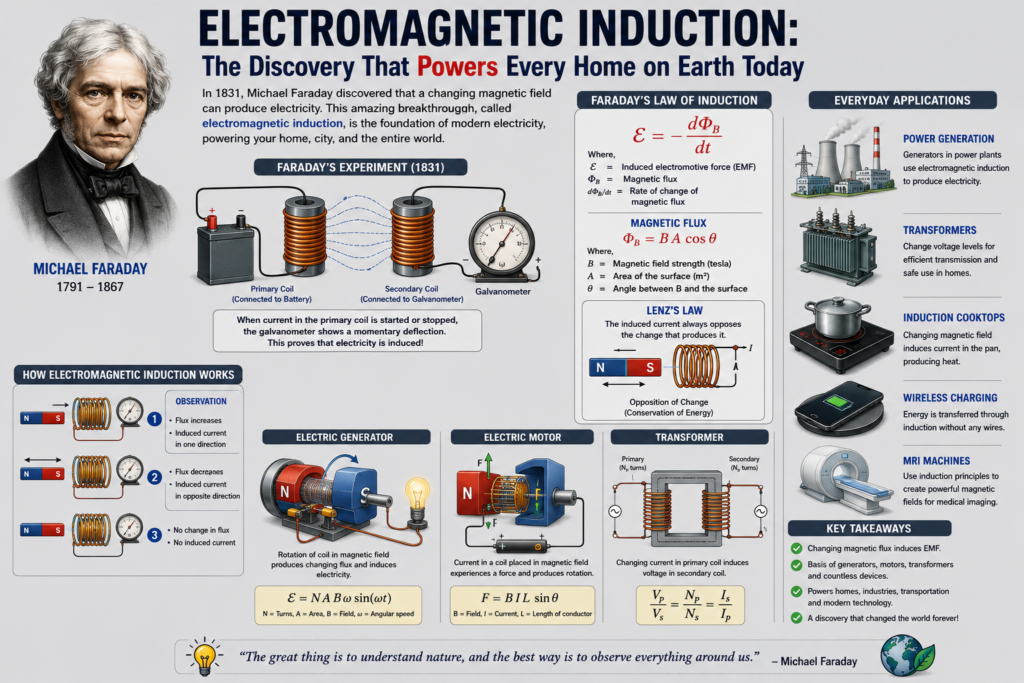
In 1831, Faraday performed the famous experiment that changed the world forever.
He wrapped two copper wire coils around an iron ring. One coil was connected to a battery, while the other coil was connected to a galvanometer.
A galvanometer is an instrument used to detect small induced current changes.
Faraday noticed something remarkable.
When current started or stopped flowing in the first coil, the galvanometer in the second coil moved briefly. This meant electricity appeared in the second wire even without direct battery contact.
Faraday later moved a stationary magnet in and out of a solenoid coil and observed the same effect.
This experiment proved that a time-varying magnetic field could generate electricity.
The discovery became known as electromagnetic induction.
What Is Electromagnetic Induction?
Electromagnetic induction is the process of producing electric current through changing magnetic fields.
In simple words:
- A moving magnet near a wire creates electricity
- A changing magnetic field produces an electromotive force (EMF)
- The wire must usually form a closed circuit for current to flow
The process depends on magnetic flux.
Magnetic flux is the amount of magnetic field passing through a surface.
The formula for magnetic flux is:
Where:
- = Magnetic flux
- = Magnetic field strength
- = Area of the surface
- = Angle between the field and surface
When magnetic flux changes over time, electricity is induced.
This principle became the foundation of modern power generation.
Faraday’s Law of Induction
Faraday later developed the mathematical explanation of electromagnetic induction.
This became known as faraday’s law of induction.
The equation is:
Where:
- = Induced electromotive force (EMF)
- Φ = Magnetic flux
- = Rate of change of magnetic flux
The negative sign represents Lenz’s law.
This equation explains that faster magnetic changes create stronger induced current.
If the magnetic field remains constant, no induction occurs.
This mathematical relationship became one of the most important equations in physics of electricity.
Lenz’s Law and Direction of Current
Lenz’s law explains the direction of induced current.
It states:
The induced current always opposes the change causing it.
For example:
- If a magnet moves toward a coil, the coil creates a magnetic field pushing it away
- If the magnet moves away, the coil creates a magnetic field trying to pull it back
This opposition conserves energy.
Without Lenz’s law, energy could be created infinitely, which violates physics.
Mathematically, Lenz’s law appears through the negative sign in Faraday’s equation:
This law is essential for understanding electromagnetic fields and energy conversion systems.
Electromagnetic Induction and Maxwell’s Equations
Faraday mainly understood induction through experiments and physical intuition.
Later, James Clerk Maxwell transformed Faraday’s ideas into advanced mathematics.
The faraday and maxwell connection completely changed modern physics.
One of Maxwell’s equations directly describes induction:
This equation states that changing magnetic fields create electric fields.
Maxwell’s equations unified electricity, magnetism, and light into one theory.
Modern electromagnetism basics are built on these discoveries.
Magnetic Flux and Flux Linkage
Another important concept in electromagnetic induction is flux linkage.
Flux linkage measures how much magnetic flux passes through multiple coil loops.
The formula is:
Where:
- = Flux linkage
- = Number of coil turns
- = Magnetic flux
More coil turns produce stronger induction effects.
This is why transformers and generators use many loops of copper wire.
Increasing:
- Magnetic strength
- Coil turns
- Speed of motion
all increase induced current.
Electromagnetic Induction in Electric Generators
One of the greatest applications of electromagnetic induction is electricity generation.
The electric generator discovery allowed humanity to create large amounts of usable electricity.
Generators work by rotating coils inside magnetic fields.
As the coil rotates, magnetic flux changes continuously, producing alternating current.
The induced voltage in a rotating generator is often written as:
Where:
- = Number of turns
- = Area of coil
- = Magnetic field strength
- = Angular velocity
This principle powers:
- Hydroelectric plants
- Wind turbines
- Coal power stations
- Nuclear plants
Without electromagnetic induction, modern electrical grids would not exist.
The Invention of Electric Motors
Electromagnetic induction also contributed to the invention of the electric motor.
Motors and generators are closely connected.
- Generators convert motion into electricity
- Motors convert electricity into motion
Motor force can be expressed as:
Where:
- = Magnetic force
- = Magnetic field
- = Current
- = Length of conductor
Electric motors now power countless devices worldwide.
Transformers and Power Transmission (1880 – 1900)
Transformers became another revolutionary application of electromagnetic induction.
A transformer changes voltage levels using induction between two coils.
The voltage relationship is:
Where:
- = Primary voltage
- = Secondary voltage
- = Primary turns
- = Secondary turns
Transformers allow electricity to travel long distances efficiently.
Without them, global power distribution would be impossible.
Every home receiving electricity depends indirectly on electromagnetic induction.
Everyday Applications of Electromagnetic Induction
Modern life uses electromagnetic induction everywhere.
Examples include:
- Phone chargers
- Electric toothbrushes
- Wireless charging systems
- Induction cooktops
- Transformers
- MRI machines
- Electric guitars
- Microphones
- Power stations
Even modern transportation systems rely heavily on induction technologies.
This discovery became one of humanity’s greatest engineering achievements.
Electromagnetic Induction in Modern Technology
Today, electromagnetic induction continues shaping advanced technologies.
Scientists use induction principles in:
- Renewable energy systems
- Maglev trains
- Wireless energy transfer
- Industrial machinery
- Electric vehicles
Engineers constantly improve energy conversion efficiency using Faraday’s principles.
Modern electrical conductor systems still follow the same laws discovered nearly two centuries ago.
This proves the timeless importance of Faraday’s work.
Field Theory and Scientific Thinking
Faraday introduced revolutionary ideas about invisible fields.
At the time, many scientists disliked the concept because fields could not be seen directly.
However, Faraday believed magnetic field lines physically represented real forces.
This became the basis of field theory and lines of force.
His ideas later inspired modern physics, including Einstein’s work on fields and spacetime.
Faraday’s scientific imagination was far ahead of his era.
Electromagnetic Induction and Scientific Legacy
The scientific legacy of electromagnetic induction is enormous.
It transformed:
- Industry
- Communication
- Medicine
- Transportation
- Computing
- Energy production
Modern civilization runs on electricity generated through induction.
Faraday’s discovery became one of the foundations of the scientific revolution during the Victorian era.
Even today, students learning electromagnetism basics begin with Faraday’s experiments.
Challenges Faced by Michael Faraday
Faraday’s success did not come easily.
He was poor, self educated, and lacked university training.
Yet through michael faraday self education, he became one of the greatest scientists in history.
His success showed that curiosity and persistence can overcome social barriers.
Faraday also remained humble throughout his life despite worldwide fame.
Relation Between Electrolysis and Induction
Faraday contributed to both induction and electrochemistry.
His electrochemical studies led to faraday’s electrochemical laws, which explained how electricity interacts with matter.
Together, these discoveries shaped modern electrical science.
Faraday’s work connected chemistry, magnetism, and electricity into one unified scientific framework.
Why Electromagnetic Induction Changed the World
Very few discoveries have transformed human civilization as deeply as electromagnetic induction.
Before Faraday’s work:
- Electricity was limited
- Power generation barely existed
- Industrial systems were primitive
After electromagnetic induction:
- Cities became electrified
- Factories expanded rapidly
- Communication systems improved
- Modern technology became possible
Today, nearly every electrical system depends on induction principles discovered in 1831.
FAQs About Electromagnetic Induction
What is electromagnetic induction?
Electromagnetic induction is the process of generating electricity using changing magnetic fields.
Who discovered electromagnetic induction?
Michael Faraday discovered electromagnetic induction in 1831 through experiments involving magnets and coils.
What is Faraday’s law of induction?
Faraday’s law explains that changing magnetic flux produces electromotive force in a conductor.
Why is electromagnetic induction important?
It powers electric generators, transformers, motors, and modern electrical systems worldwide.
What is magnetic flux?
Magnetic flux measures how much magnetic field passes through a surface.
Where is electromagnetic induction used today?
It is used in generators, transformers, wireless chargers, MRI machines, induction cookers, and power stations.
Conclusion
Electromagnetic induction remains one of the greatest discoveries in human history. It transformed the world from a society dependent on mechanical labor into a civilization powered by electricity.
From homes and hospitals to factories and transportation systems, electromagnetic induction makes modern life possible. Michael Faraday’s experiments revealed how changing magnetic fields could create electrical energy, opening the door to power generation, motors, transformers, and modern technology.
The discovery also inspired advanced theories developed through Maxwell’s equations and modern field physics. Today, scientists and engineers continue building upon Faraday’s revolutionary ideas.
The impact of electromagnetic induction on civilization is as profound as how ancient greek scientists changed modern science, proving that scientific curiosity can reshape the future of humanity forever.