Faraday’s law of induction is one of the most important equations in the history of science. This simple mathematical relationship changed human civilization forever by making large scale electricity generation possible. Every modern power station, transformer, electric generator, and electrical grid depends on this law.
Before Michael Faraday’s discovery, electricity was difficult to produce and poorly understood. Scientists knew electricity and magnetism were connected somehow, but nobody fully understood the relationship. Everything changed in 1831 when Faraday discovered that changing magnetic fields could create electric current.
This discovery became the foundation of modern electrical engineering and transformed industry, communication, transportation, and daily life.
Today, millions of homes receive electricity because of faraday’s law of induction. This article explains the history, equations, physics, applications, and scientific importance of this revolutionary discovery in simple language.
The Scientific World Before Faraday (1800 – 1830)
During the early 19th century, scientists were exploring electricity and magnetism separately.
In 1820, Hans Christian Oersted discovered that electric current produced magnetic effects around a wire. Andre Marie Ampere later developed mathematical descriptions of these interactions.
However, scientists still faced a major question:
Can magnetism produce electricity?
This question fascinated Michael Faraday deeply.
Faraday believed nature worked through invisible connections between forces. He imagined magnetic field lines acting through space and influencing matter.
Although he lacked advanced mathematical education, Faraday’s experimental genius allowed him to uncover one of the greatest principles in physics.
Michael Faraday’s Discovery (1831)
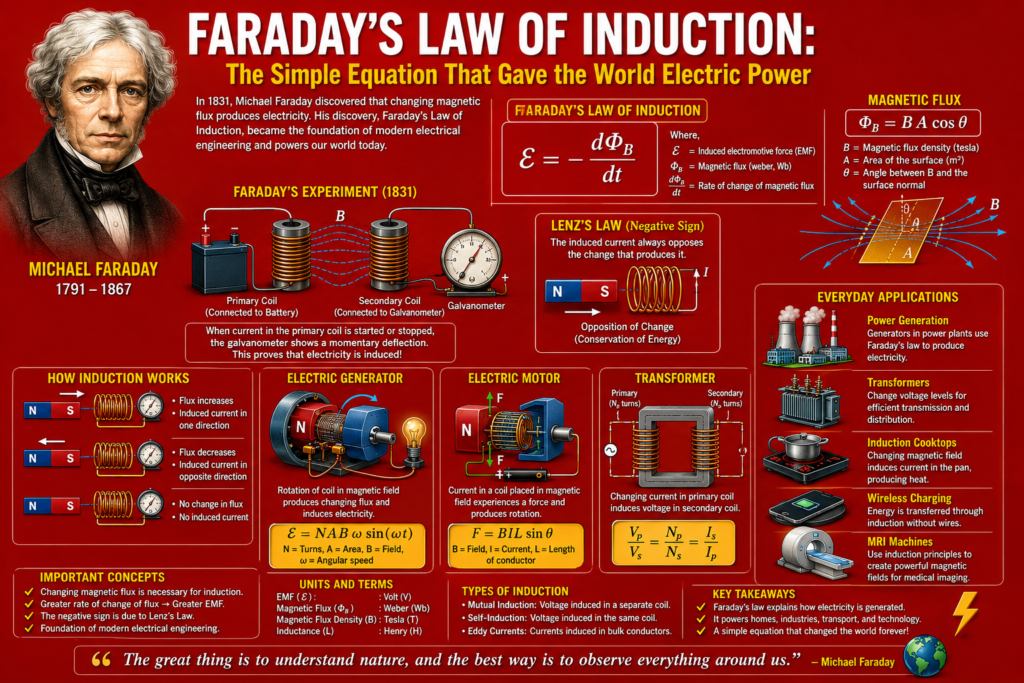
In 1831, Faraday performed a series of experiments involving copper wire coils, magnets, and galvanometers.
He discovered that moving a magnet through a wire coil generated electric current.
He also found that:
- A stronger magnet created greater induced current
- Faster movement increased electrical output
- More coil turns increased voltage
- Constant magnetic fields produced no current
These experiments became the basis of electromagnetic induction.
Faraday realized electricity appeared only when magnetic flux changed over time.
This insight became faraday’s law of induction.
What Is Faraday’s Law of Induction?
Faraday’s law states:
A changing magnetic flux through a circuit induces electromotive force.
The mathematical equation is:
Where:
- = Induced electromotive force (EMF)
- = Magnetic flux
- = Rate of change of magnetic flux over time
This equation explains how motion, magnetism, and electricity are connected.
The law became one of the most important physics formulas in modern science.
Understanding Magnetic Flux
To understand faraday’s law of induction, we must first understand magnetic flux.
Magnetic flux measures the amount of magnetic field passing through a surface.
The formula is:
Where:
- = Magnetic flux
- = Magnetic flux density
- = Area of the surface
- = Angle between field and surface
The Greek letter (Phi) represents magnetic flux.
If magnetic flux changes, electricity is induced.
Flux can change by:
- Moving the magnet
- Rotating the coil
- Changing field strength
- Changing coil area
This simple idea powers the modern world.
Why the Negative Sign Is Important
Many students wonder why Faraday’s equation includes a negative sign.
The equation is:
The negative sign represents Lenz’s law.
Lenz’s law states:
The induced current always opposes the change that creates it.
For example:
- If magnetic flux increases, the induced current creates an opposing magnetic field
- If magnetic flux decreases, the induced current tries to maintain it
This opposition protects conservation of energy.
Without the negative sign in Faraday’s Law, unlimited free energy would be possible, which violates physics.
The negative sign is one of the most important concepts in induction principles.
Calculus in Faraday’s Law
Faraday’s equation uses calculus in physics because induction depends on changing quantities.
The derivative:
represents how fast magnetic flux changes with time.
If flux changes rapidly:
- Large EMF is produced
If flux changes slowly:
- Small EMF appears
If flux remains constant:
Then:
No electricity is induced.
This mathematical relationship became essential in transformer theory and electrical engineering.
Maxwell Faraday Equation
James Clerk Maxwell later transformed Faraday’s experiments into advanced mathematics.
The faraday and maxwell connection created modern electromagnetism theory.
One of Maxwell’s equations is:
This Maxwell-Faraday equation explains that changing magnetic fields produce electric fields.
This equation uses vector calculus and became one of the foundations of modern physics.
It unified electricity, magnetism, and light into one scientific framework.
Faraday’s Law and Electric Generators
One of the greatest applications of faraday’s law of induction is electricity generation.
The electric generator discovery depends entirely on changing magnetic flux.
In generators:
- A coil rotates inside magnetic fields
- Magnetic flux changes continuously
- Alternating current is produced
The induced voltage in rotating systems can be written as:
Where:
- = Number of coil turns
- = Coil area
- = Magnetic field strength
- = Angular speed
This equation powers hydroelectric plants, nuclear stations, wind turbines, and industrial generators worldwide.
Every modern electrical grid relies on Faraday’s law.
Faraday’s Law and Transformers (1880 – 1900)
Transformers are another major application of faraday’s law of induction.
Transformers transfer energy between two coils through mutual induction.
The voltage relationship is:
Where:
- = Primary voltage
- = Secondary voltage
- = Primary coil turns
- = Secondary coil turns
Transformers allow electricity to travel long distances efficiently.
Without Faraday’s law:
- Power transmission would fail
- Cities could not receive large scale electricity
- Modern electrical infrastructure would collapse
Mutual Induction and Self Induction
Faraday’s law explains both mutual induction and self-induction.
Mutual Induction
Mutual induction occurs when changing current in one coil induces voltage in another coil.
The equation is:
Where:
- = Mutual inductance
- = Current in first coil
Self Induction
Self-induction occurs when changing current in the same circuit induces voltage within itself.
The equation is:
Where:
- = Inductance measured in Henry (unit)
- = Current
These principles are essential in electrical engineering and circuit design.
Eddy Currents and Faraday’s Law
Faraday’s law also explains eddy currents.
Eddy currents are circulating currents induced inside conductors exposed to changing magnetic fields.
These currents can:
- Produce heat
- Cause energy loss
- Create magnetic braking effects
Eddy currents are used in:
- Induction cooktops
- Magnetic brakes
- Metal detectors
- Industrial heating systems
Modern engineering carefully controls these effects using magnetic circuit design.
Faraday’s Law and Electric Motors
Faraday’s discoveries also influenced the invention of the electric motor.
Electric motors rely on magnetic forces and induction effects.
Motor force is expressed as:
Where:
- = Magnetic force
- = Magnetic field strength
- = Current
- = Length of conductor
Motors convert electrical energy into mechanical motion.
Today they power:
- Fans
- Cars
- Industrial machines
- Trains
- Household appliances
Faraday’s work made modern industry possible.
Field Theory and Lines of Force
Faraday introduced revolutionary ideas about invisible fields.
He imagined magnetic field lines spreading through space like real physical structures.
This became the basis of field theory and lines of force.
Although some scientists initially rejected the idea, Maxwell later proved Faraday was correct mathematically.
Modern physics, including relativity and quantum theory, heavily depends on field concepts.
Faraday’s scientific imagination transformed human understanding of nature.
Faraday’s Scientific Legacy
Faraday’s discoveries extended beyond induction.
He also worked on:
- Electrochemistry
- Magnetism
- Chemistry
- Optics
His studies eventually contributed to faraday’s electrochemical laws and other important scientific principles.
Despite worldwide fame, Faraday remained humble and deeply committed to science education.
His public lectures inspired generations of scientists.
Why Faraday’s Law Still Matters Today
Modern civilization depends heavily on faraday’s law of induction.
Without it:
- Power stations could not function
- Transformers would fail
- Electric grids would collapse
- Wireless charging would disappear
- Renewable energy systems would stop working
Today, induction principles power:
- Wind turbines
- Electric vehicles
- Wireless chargers
- MRI machines
- Renewable energy systems
Faraday’s equation continues shaping modern technology nearly two centuries after its discovery.
Faraday’s Law in Modern Technology (2000 – Present)
Modern engineers still rely on Faraday’s equation daily.
Applications include:
- Smart grids
- Solar energy systems
- High speed trains
- Robotics
- Wireless communication
- Artificial intelligence hardware
Scientists continue improving induction efficiency using advanced materials and electromagnetic research.
Faraday’s simple equation remains central to the future of technology.
FAQs About Faraday’s Law of Induction
What is Faraday’s law of induction?
Faraday’s law states that changing magnetic flux through a conductor induces electromotive force.
Who discovered Faraday’s law?
Michael Faraday discovered the law in 1831 through experiments involving magnets and coils.
Why is the negative sign important in Faraday’s law?
The negative sign represents Lenz’s law, showing that induced current opposes the change causing it.
What is magnetic flux?
Magnetic flux measures the amount of magnetic field passing through a surface.
Where is Faraday’s law used today?
It is used in generators, transformers, electric motors, wireless charging, and renewable energy systems.
What is the SI unit of inductance?
The SI unit of inductance is the Henry (H).
Conclusion
Faraday’s law of induction is one of the most powerful scientific discoveries ever made. With one elegant equation, Michael Faraday unlocked the secret behind electricity generation and transformed the modern world forever.
Today, every home, factory, city, and electrical system depends on the principles discovered by Faraday in 1831. His work created the foundation for generators, transformers, motors, and modern electrical engineering.
Faraday’s discoveries also inspired Maxwell’s equations, field theory, and advanced electromagnetic science. The influence of his ideas remains visible in nearly every modern technology around us.
The impact of Faraday’s law on civilization is as revolutionary as how ancient greek scientists changed modern science, proving once again that simple scientific ideas can completely reshape human history.