The question who invented bluetooth has fascinated millions of technology users around the world. Today, Bluetooth exists in smartphones, laptops, smartwatches, cars, gaming devices, speakers, and wireless earphones. It has become one of the most important wireless communication technologies in modern history.
Yet many people still do not know the incredible story behind its invention. The journey of Bluetooth began with brilliant Swedish engineers, revolutionary ideas, and a powerful vision for wireless communication. What started as a small Ericsson research project eventually transformed global telecommunications innovation forever.
This article explores who invented bluetooth, how the technology was created, why it received its unusual name, and how it became one of the greatest wireless breakthroughs of the digital age.
The Early Wireless Communication Problem (1980 – 1993)
Before Bluetooth existed, electronic devices relied heavily on cables and wires. Computers connected to printers with large cords. Mobile phones had very limited connectivity features. Sharing files between devices was slow and frustrating.
Technology companies wanted a solution that could enable short-range radio communication between electronic devices without using cables. Engineers around the world were researching radio frequency systems and ad-hoc networks to solve this challenge.
During this period, mobile phone connectivity became increasingly important. Consumers wanted smaller devices, better accessories, and easier communication methods. Wireless pioneers believed that a universal standard for data transfer standards could completely change the electronics industry.
At the center of this revolution was the Swedish telecommunications company Ericsson.
Who Invented Bluetooth? The Main Inventors (1994)
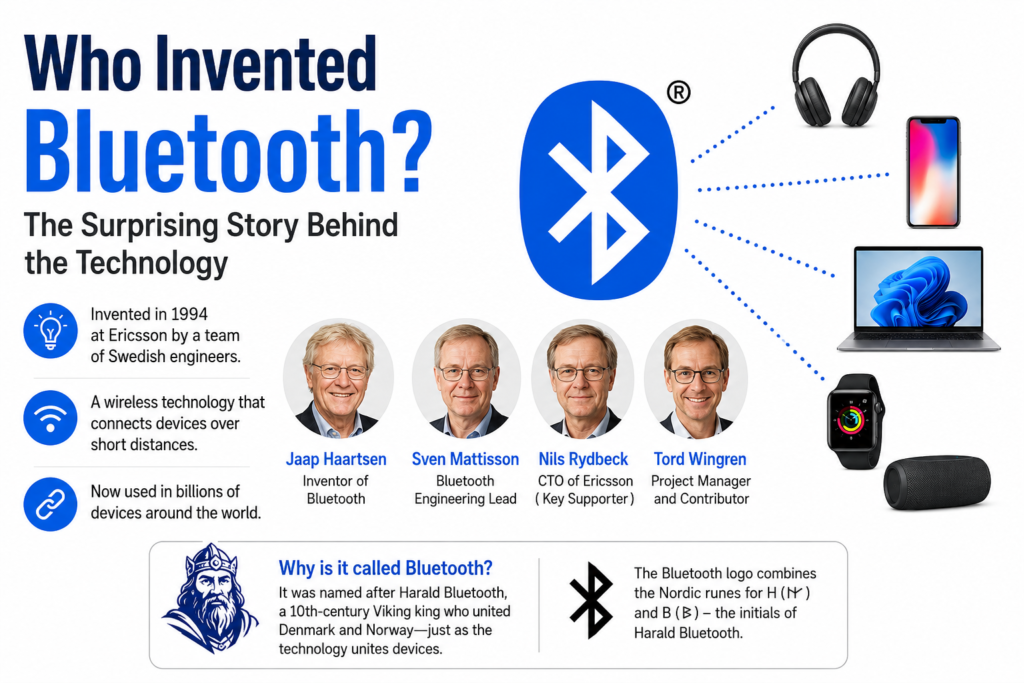
The true answer to who invented bluetooth begins with two brilliant engineers:
- Jaap Haartsen
- Sven Mattisson
These Swedish engineers worked at Ericsson in the early 1990s. Their mission was to develop a low-power wireless technology that could replace communication cables between electronic devices.
Jaap Haartsen is widely recognized as the primary inventor of Bluetooth technology. He worked on creating a system that used radio frequency communication to connect devices wirelessly over short distances.
Sven Mattisson played a major role in developing the hardware architecture and engineering concepts needed to make the technology practical.
Another important figure was Nils Rydbeck, Ericsson’s Chief Technology Officer. He strongly supported the project and helped push the innovation forward inside the company. Tord Wingren also contributed to the development process and strategic direction of the technology.
Together, this engineering team built one of the most influential wireless systems ever created.
The Ericsson Research Project That Changed Technology
In 1994, Ericsson officially started the Bluetooth project. The goal was simple but revolutionary:
Create a universal wireless communication system for mobile devices.
The engineers wanted devices from different manufacturers to communicate seamlessly without wires. This vision was extremely ambitious at the time because most companies used their own proprietary systems.
Bluetooth relied heavily on the invention of frequency hopping technology. Frequency hopping allowed signals to rapidly switch between radio channels, reducing interference and improving communication reliability.
The technology operated in the 2.4 GHz ISM radio band, which was available globally for industrial and scientific use. This made Bluetooth ideal for worldwide adoption.
The Ericsson engineering team realized that if they succeeded, the technology could become a global wireless standard.
Why Bluetooth Is Called Bluetooth (1996 – 1997)
One of the most fascinating parts of the Bluetooth story is its unusual name. Many people searching for why bluetooth is called bluetooth are surprised to learn that the technology was named after a Viking king.
The name came from Harald Bluetooth, a Danish king who ruled during the 10th century. King Harald united parts of Denmark and Norway, just as Bluetooth technology aimed to unite different electronic devices.
Jim Kardach from Intel suggested the name during a meeting with engineers from Ericsson and other technology companies. Initially, Bluetooth was only meant to be a temporary codename. However, the name became so popular that it remained permanent.
The Bluetooth logo also has historical meaning. It combines Nordic runes representing the initials of Harald Bluetooth.
This creative branding helped make Bluetooth memorable worldwide.
Formation of the Bluetooth Special Interest Group (SIG) (1998)
In 1998, several major technology companies joined forces to create the Bluetooth Special Interest Group (SIG).
The founding companies included:
- Ericsson
- Intel
- IBM
- Nokia
- Toshiba
The Bluetooth Special Interest Group (SIG) was responsible for developing and managing Bluetooth standards globally.
The organization ensured that devices from different manufacturers could work together smoothly. This was critical for global success because consumers needed reliable compatibility between products.
Without the Bluetooth Special Interest Group (SIG), Bluetooth may never have become a universal wireless standard.
Today, thousands of companies are members of the SIG, and billions of Bluetooth devices are produced every year.
How Bluetooth Works
People frequently ask about how bluetooth works because the technology seems almost magical.
Bluetooth uses low-power radio waves to send information between nearby devices. These devices create small wireless networks known as piconets.
The communication process follows several steps:
- Devices discover each other
- They establish a secure connection
- Data transfer begins
- Signals hop between frequencies to avoid interference
Bluetooth technology is designed for low energy consumption, making it ideal for mobile accessories like earbuds, keyboards, mice, and smartwatches.
Modern Bluetooth systems can support audio streaming, file sharing, gaming accessories, and even smart home devices.
The invention completely transformed wireless communication.
The First Bluetooth Devices (1999 – 2001)
The first commercial Bluetooth products appeared in 1999.
One of the earliest devices was a wireless headset developed by Ericsson. It demonstrated the incredible potential of cable-free communication.
Soon afterward, laptops, phones, and accessories started including Bluetooth support.
Consumers were amazed by the convenience. Suddenly, they could connect devices without dealing with messy cables.
This marked the beginning of a new era in mobile phone connectivity.
During this time, the technology still faced challenges such as slow speeds and compatibility issues. However, engineers continued improving the system rapidly.
Bluetooth Becomes a Global Technology (2002 – 2010)
Between 2002 and 2010, Bluetooth experienced explosive growth.
Major electronics companies began integrating Bluetooth into almost every portable device. The technology became essential for wireless audio, mobile accessories, gaming systems, and file transfers.
The introduction of improved Bluetooth versions increased speed, stability, and energy efficiency.
If you want to understand the evolution of the technology, reading about bluetooth versions can help explain how the system improved over time.
Bluetooth also became important in automotive systems, allowing drivers to connect phones to vehicles safely.
By the late 2000s, Bluetooth had become one of the most recognized wireless standards in the world.
Bluetooth Classic vs BLE (2010 – 2020)
One of the biggest technological improvements came with Bluetooth Low Energy, commonly called BLE.
People comparing bluetooth classic vs ble often discover that BLE uses significantly less power while maintaining effective communication capabilities.
Bluetooth Classic focused on continuous communication such as music streaming and calls. BLE focused on low-energy applications like fitness trackers, health devices, and smart sensors.
This innovation helped Bluetooth enter the Internet of Things industry.
Today, BLE powers countless wearable technologies and smart devices worldwide.
The Patent History and Technical Legacy
The patent history of Bluetooth reflects the incredible engineering achievements behind the technology.
Jaap Haartsen received major recognition for his wireless communication patents. Many experts consider him one of the greatest wireless pioneers in telecommunications innovation.
The engineering concepts developed during the Bluetooth project influenced future wireless technologies across the industry.
Bluetooth also inspired advancements in:
- Wireless networking
- Smart devices
- IoT systems
- Mobile computing
- Audio technology
The legacy technology created by Ericsson engineers continues shaping modern electronics today.
What Is Bluetooth and Why Is It Important?
Many beginners still ask what is bluetooth because the technology has become so common that people rarely think about how it works.
Bluetooth is a wireless communication technology that allows devices to exchange data over short distances using radio waves.
Its importance comes from several major advantages:
- No cables required
- Low power consumption
- Global compatibility
- Secure connections
- Affordable implementation
Without Bluetooth, modern wireless headphones, gaming controllers, smartwatches, and many mobile accessories would not exist in their current form.
Bluetooth helped create the connected digital lifestyle people enjoy today.
Bluetooth vs WiFi vs NFC
Consumers often compare bluetooth vs wifi vs nfc to understand the differences between wireless technologies.
Bluetooth is designed for short-range, low-power communication between nearby devices.
WiFi is optimized for high-speed internet and larger data transfers.
NFC is built for extremely short-range interactions like contactless payments.
Each technology serves a different purpose, but Bluetooth remains one of the most versatile solutions for everyday wireless communication.
The Future of Bluetooth Technology
The future of Bluetooth looks extremely promising.
Modern Bluetooth systems support faster data transfer, better audio quality, lower energy use, and stronger security features.
Emerging technologies such as augmented reality, virtual reality, smart homes, and wearable devices will continue relying heavily on Bluetooth innovation.
Experts believe Bluetooth will remain central to wireless ecosystems for decades.
The growth of artificial intelligence, automation, and the future of software engineering will likely create even more advanced Bluetooth applications.
Wireless communication continues evolving rapidly, but Bluetooth remains one of the strongest foundations of connected technology.
The Human Story Behind Bluetooth
The story of who invented bluetooth is not just about technology. It is also about creativity, teamwork, and long-term vision.
Jaap Haartsen, Sven Mattisson, Nils Rydbeck, Tord Wingren, and the Ericsson engineering team believed they could solve a global communication problem.
Their persistence transformed a research project into one of the most successful technologies in history.
Today, billions of devices use Bluetooth every single day.
Very few inventions have influenced modern life so deeply.
Frequently Asked Questions (FAQs)
Who officially invented Bluetooth?
Jaap Haartsen is widely recognized as the main inventor of Bluetooth technology, while Sven Mattisson also played a critical engineering role at Ericsson.
Why was Bluetooth invented?
Bluetooth was invented to replace cables and improve wireless communication between electronic devices using short-range radio technology.
Why is Bluetooth called Bluetooth?
Bluetooth was named after Harald Bluetooth, a Viking king who united Denmark and Norway. The technology symbolized uniting devices together.
Which company created Bluetooth?
Ericsson started the Bluetooth project in 1994 and developed the original technology with its Swedish engineers.
Is Bluetooth still improving today?
Yes. Modern Bluetooth systems continue improving in speed, audio quality, energy efficiency, and security.
What devices use Bluetooth?
Bluetooth is used in smartphones, headphones, speakers, cars, laptops, gaming systems, smartwatches, and many other smart devices.
Conclusion
The answer to who invented bluetooth reveals one of the most inspiring stories in modern engineering history. Jaap Haartsen, Sven Mattisson, and the Ericsson engineering team created a technology that revolutionized wireless communication forever.
What began as a small 1994 tech breakthrough became a global standard used by billions of people daily. Bluetooth transformed mobile phone connectivity, changed data transfer standards, and helped shape the modern wireless world.
From wireless headphones to smart homes, Bluetooth continues influencing how humans interact with technology. Its legacy proves that visionary engineering and innovative thinking can truly change civilization.