Understanding bluetooth vs wifi vs nfc is extremely important because these three wireless technologies power most modern digital communication systems. Smartphones, laptops, smart homes, payment systems, wireless audio devices, and connected gadgets all rely on one or more of these wireless standards.
Although Bluetooth, WiFi, and NFC all support wireless communication, they were designed for very different purposes. Each technology offers unique advantages involving speed, wireless range, power usage, connectivity methods, and security.
The comparison between bluetooth vs wifi vs nfc helps users choose the right wireless solution for streaming music, internet access, contactless payments, file transfers, gaming, smart devices, and IoT systems.
Some technologies are best for long-range internet connectivity, while others are optimized for low-power communication or ultra-fast close-range interactions.
This complete comparison guide explains bluetooth vs wifi vs nfc, including communication protocols, throughput, security, power usage comparison, wireless range, device compatibility, and the best use cases for each technology.
The Rise of Wireless Communication Technology (1990 – Today)
Before understanding bluetooth vs wifi vs nfc, it is important to understand why wireless communication became so important.
During the 1990s, technology companies wanted to eliminate cables and create easier communication systems for electronic devices.
Several wireless standards emerged to solve different problems:
- Bluetooth for personal wireless connectivity
- WiFi for internet networking
- NFC for contactless technology and ultra-short-range communication
These technologies transformed modern digital life.
Today, billions of devices worldwide rely on wireless communication systems daily.
If you want deeper historical background, exploring bluetooth history explains how wireless standards evolved over time.
What Is Bluetooth?
Bluetooth is a short-range wireless communication technology designed for personal device connectivity.
Bluetooth allows nearby devices to exchange information using low-power radio signals.
Common Bluetooth uses include:
- Wireless headphones
- Smartwatches
- Speakers
- Gaming controllers
- Wireless keyboards
- Fitness trackers
Bluetooth is optimized for:
- Low power usage
- Short-range communication
- Device pairing
- Peripheral support
If you are new to Bluetooth technology, learning what is bluetooth helps explain its wireless communication system in detail.
Bluetooth became one of the world’s most popular wireless standards because it is affordable, efficient, and easy to use.
What Is WiFi?
WiFi is a wireless networking technology designed mainly for internet connectivity and high-speed communication.
Unlike Bluetooth, WiFi focuses on:
- Large bandwidth
- Fast file transfer speed
- Internet access
- Home and office networking
WiFi operates across larger coverage areas and supports multiple devices simultaneously.
WiFi systems are commonly used for:
- Internet browsing
- Video streaming
- Cloud communication
- Online gaming
- Smart home networks
WiFi generally consumes more power than Bluetooth but provides much higher throughput and communication speed.
What Is NFC?
NFC stands for Near Field Communication.
NFC is an ultra-short-range wireless communication technology designed for fast close-contact interactions.
NFC usually works only within a few centimeters.
Common NFC uses include:
- Contactless payments
- Smartphone tap features
- Digital ticketing
- Smart card systems
- Device authentication
Near Field Communication (NFC) became extremely popular because it enables fast secure communication with almost instant connection establishment.
Unlike Bluetooth and WiFi, NFC focuses on very short-range convenience instead of long-distance communication.
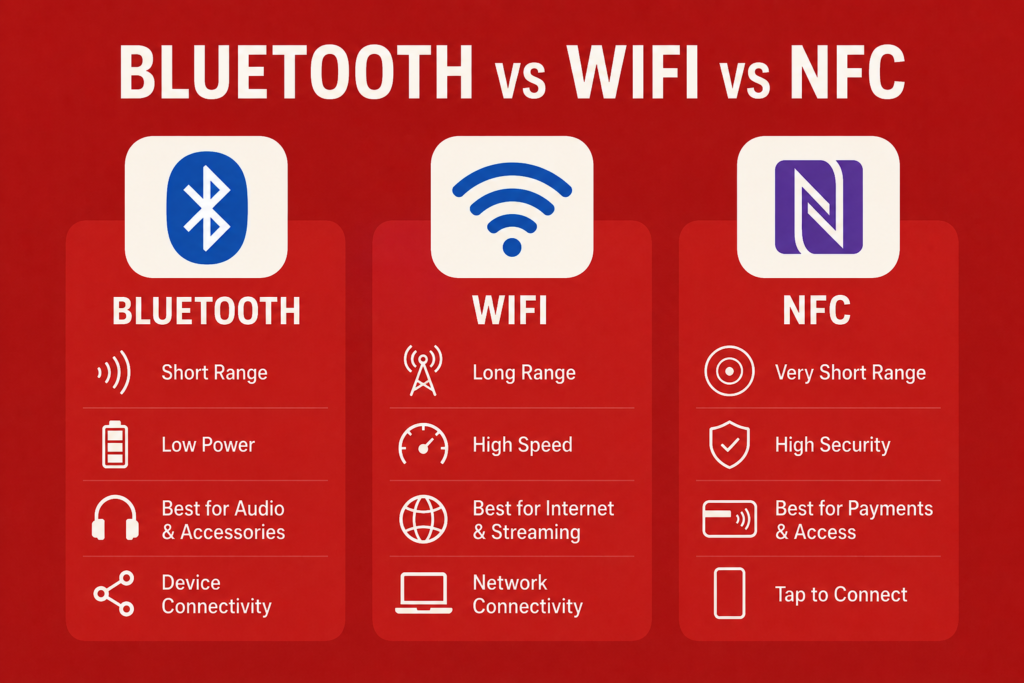
Bluetooth vs WiFi vs NFC Basic Comparison
The easiest way to understand bluetooth vs wifi vs nfc is by comparing their primary goals.
Bluetooth
- Short-range connectivity
- Low power communication
- Device accessories
- Wireless audio
WiFi
- Internet networking
- High-speed data transfer
- Large coverage area
- Multi-device communication
NFC
- Ultra-short-range communication
- Instant secure interaction
- Contactless payments
- Device authentication
Each technology solves different communication problems.
Wireless Range Comparison
Wireless range is one of the biggest differences in bluetooth vs wifi vs nfc.
Bluetooth Range
Bluetooth typically supports:
- Around 10 meters for consumer devices
- Up to 100 meters or more for advanced systems
If you want detailed distance information, exploring bluetooth range explains how Bluetooth communication distance works.
WiFi Range
WiFi generally supports:
- Around 30 to 100 meters indoors
- Much larger outdoor coverage with routers and extenders
NFC Range
NFC usually supports:
- Only a few centimeters
This extremely short range improves security for payment technology and authentication systems.
File Transfer Speed Comparison
Another major difference in bluetooth vs wifi vs nfc involves speed.
Bluetooth Speed
Bluetooth offers moderate speed optimized for:
- Audio streaming
- Peripheral devices
- Small file sharing
WiFi Speed
WiFi provides extremely high throughput suitable for:
- HD video streaming
- Cloud gaming
- Large file downloads
- Internet communication
NFC Speed
NFC focuses on tiny quick interactions instead of large file transfers.
NFC transfer rates are much slower than Bluetooth and WiFi.
WiFi clearly dominates high-speed communication tasks.
Power Usage Comparison
Power usage comparison is extremely important for portable electronics.
Bluetooth Power Usage
Bluetooth uses low power, especially modern Bluetooth Low Energy systems.
This makes Bluetooth ideal for:
- Smartwatches
- Earbuds
- Fitness trackers
- Battery-powered devices
WiFi Power Usage
WiFi generally consumes more energy because it handles:
- High-speed communication
- Internet networking
- Larger data transfers
NFC Power Usage
NFC uses extremely low power because communication occurs only briefly.
NFC systems are highly efficient for short transactions.
Bluetooth and NFC generally outperform WiFi for battery efficiency.
Bluetooth vs WiFi for Audio
When comparing bluetooth vs wifi vs nfc, Bluetooth dominates wireless audio.
Bluetooth powers:
- Wireless headphones
- Speakers
- Car audio systems
- Earbuds
Modern bluetooth audio codecs improved sound quality significantly over time.
WiFi can support audio streaming too, but Bluetooth remains more practical for portable wireless audio because of lower power usage and easier pairing.
NFC is not designed for audio streaming.
Bluetooth vs WiFi for Internet Connectivity
WiFi clearly dominates internet connectivity.
Bluetooth can share internet access in limited situations, but WiFi is specifically designed for high-speed networking.
WiFi supports:
- Routers
- Home networks
- Office systems
- Streaming services
- Online gaming
Bluetooth focuses mainly on personal wireless communication instead of internet networking.
This difference between home network vs personal network design is extremely important.
Bluetooth vs NFC for Payments
NFC dominates payment technology because it works instantly at extremely short distances.
NFC powers:
- Contactless credit cards
- Smartphone payments
- Transit systems
- Access cards
Bluetooth can support payment systems indirectly, but NFC is much faster and more secure for close-contact authentication.
NFC became essential in modern mobile wallets and digital payment systems.
Bluetooth Pairing vs NFC Tap
Bluetooth requires pairing before communication begins.
If you need setup help, learning how to pair bluetooth devices explains the process clearly.
NFC works differently.
NFC devices communicate instantly through physical proximity without traditional pairing systems.
This makes NFC extremely convenient for:
- Payments
- Device unlocking
- Authentication
- Quick device pairing triggers
Bluetooth takes longer to establish communication but supports larger wireless functionality afterward.
Bluetooth Classic vs BLE
Understanding bluetooth classic vs ble also helps compare wireless technologies properly.
Bluetooth Classic
- Audio streaming
- Continuous communication
- Wireless peripherals
BLE
- Low power communication
- Smart devices
- IoT systems
BLE became especially important for wearable devices and battery-powered technologies.
Modern Bluetooth systems support both communication methods efficiently.
Wireless Security Comparison
Security is a major concern in bluetooth vs wifi vs nfc.
Bluetooth Security
Modern bluetooth security systems include:
- Encryption
- Authentication
- Secure pairing
WiFi Security
WiFi uses:
- WPA2 and WPA3 encryption
- Password authentication
- Network firewalls
NFC Security
NFC security benefits from:
- Extremely short communication distance
- Quick interaction windows
- Physical proximity requirements
All three technologies continue improving wireless security standards.
Best Use Cases for Bluetooth
Bluetooth works best for:
- Wireless headphones
- Smartwatches
- Speakers
- Gaming controllers
- Smart home accessories
Bluetooth offers excellent convenience, battery efficiency, and wireless flexibility.
It became the standard for personal wireless communication.
Best Use Cases for WiFi
WiFi works best for:
- Internet access
- Video streaming
- Large file transfers
- Smart home networks
- Online gaming
WiFi provides much greater speed and bandwidth than Bluetooth or NFC.
It dominates home and office communication systems.
Best Use Cases for NFC
NFC works best for:
- Contactless payments
- Authentication systems
- Transit passes
- Secure device pairing
- Access cards
NFC focuses on quick, close-range interactions instead of large-scale communication.
Which Technology Should You Use?
The answer depends entirely on the task.
Choose Bluetooth For:
- Wireless audio
- Smart devices
- Portable accessories
- Battery-powered gadgets
Choose WiFi For:
- Internet access
- High-speed networking
- Streaming and gaming
- Large data transfers
Choose NFC For:
- Contactless payments
- Fast authentication
- Tap-based communication
Each technology excels in different situations.
The Future of Wireless Communication
The future of bluetooth and wireless networking looks incredibly exciting.
Future wireless systems will likely improve:
- Speed
- Security
- Power efficiency
- Smart automation
- Device synchronization
Artificial intelligence and smart ecosystems will increasingly combine Bluetooth, WiFi, and NFC technologies together.
This rapid evolution also connects closely with the future of software engineering, where intelligent wireless systems are becoming central to connected technology.
All three wireless standards will remain important for decades.
Why Wireless Technology Matters So Much
Wireless communication transformed modern life completely.
Without Bluetooth, WiFi, and NFC:
- Smartphones would lose many features
- Wireless audio would disappear
- Contactless payments would not exist
- Smart homes would be limited
- Portable computing would become less convenient
These wireless standards created the foundation of the modern connected world.
Each technology contributes uniquely to digital communication systems.
Frequently Asked Questions (FAQs)
Which is faster: Bluetooth, WiFi, or NFC?
WiFi is much faster than Bluetooth and NFC for data transfer and internet communication.
Which wireless technology uses the least power?
NFC generally uses the least power, followed by Bluetooth Low Energy systems.
Is Bluetooth better than WiFi?
Bluetooth is better for low-power personal device communication, while WiFi is better for internet networking and high-speed data transfer.
Why is NFC used for payments?
NFC works at extremely short distances, making contactless payments fast and secure.
Can Bluetooth and WiFi work together?
Yes. Many modern devices use Bluetooth and WiFi simultaneously for different communication tasks.
Which technology has the longest range?
WiFi generally provides longer wireless range than Bluetooth and NFC.
Conclusion
Understanding bluetooth vs wifi vs nfc helps users choose the right wireless technology for different tasks and devices.
Bluetooth excels in wireless audio, smart accessories, and low-power communication. WiFi dominates internet connectivity, high-speed networking, and large file transfers. NFC focuses on fast secure close-range communication for payments and authentication systems.
Each wireless standard was designed for specific communication goals, and together they power the modern connected world.
As wireless communication continues evolving, Bluetooth, WiFi, and NFC will remain essential technologies shaping future digital innovation and smart ecosystems worldwide.