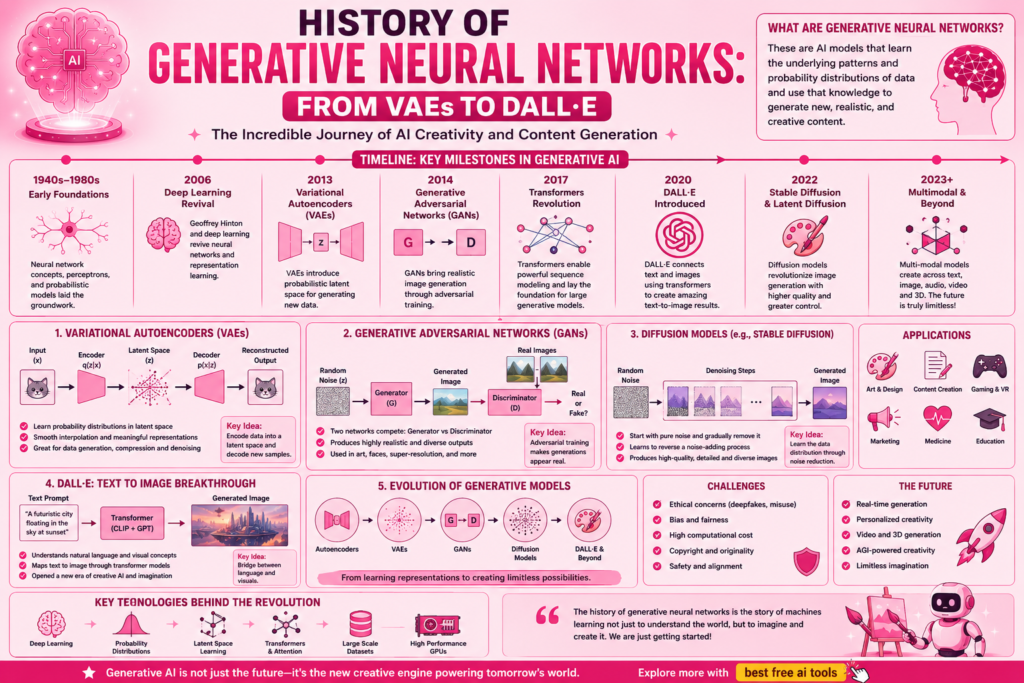
History of generative neural networks represents one of the most exciting transformations in artificial intelligence. For decades, neural networks mainly focused on classification tasks such as recognizing images, predicting numbers, or identifying speech. However, modern AI systems can now create art, generate realistic images, write stories, compose music, and even design entirely new worlds.
This revolution became possible because of generative neural networks.
The journey from Variational Autoencoders (VAE) to DALL·E completely changed the meaning of creativity in machines. Researchers developed systems capable of learning probability distributions, generating synthetic content, and producing realistic visual outputs from text prompts.
Today, the impact of history of generative neural networks can be seen across image generation history, stable diffusion models, creative AI systems, and multi-modal AI applications. What began as research experiments eventually evolved into some of the most powerful AI technologies ever created.
Early Neural Networks Before Generative AI (1940 – 1980)
To understand the history of generative neural networks, we first need to examine how neural systems evolved before machines could generate content creatively.
In 1943, Warren McCulloch and Walter Pitts introduced one of the earliest computational neuron models. Their work became the foundation of neural computation.
The famous mcculloch and pitts neural network model showed how artificial neurons could imitate biological signal processing.
During the following decades, researchers developed perceptrons, multilayer networks, and backpropagation algorithms. These systems improved pattern recognition and classification tasks.
However, early neural systems mainly focused on:
- Object recognition
- Speech classification
- Numerical prediction
- Statistical modeling
Machines still lacked the ability to create realistic content.
The dream of creative AI remained distant.
Geoffrey Hinton and the Deep Learning Revival (2006)
The modern history of generative neural networks became possible because of Geoffrey Hinton’s deep learning revival in 2006.
Hinton’s work on Deep Belief Networks and unsupervised pre-training restarted interest in deep neural architectures.
Researchers discussing history of deep learning often identify this breakthrough as the beginning of modern AI growth.
The deep learning revival improved:
- Feature learning
- Neural optimization
- GPU acceleration
- Representation learning
- High-dimensional modeling
This progress allowed researchers to train much deeper and more complex neural architectures.
Without these improvements, generative AI systems may never have become practical.
The Need for Generative Models
Traditional neural networks focused mainly on discriminative tasks.
For example:
- Identifying cats in images
- Predicting spoken words
- Detecting spam emails
Generative models attempted something much harder:
Learning how data itself is created.
Instead of only recognizing patterns, generative systems aimed to reproduce probability distributions and create entirely new outputs.
Researchers wanted systems capable of:
- Artistic synthesis
- Content creation
- Image generation
- Language generation
- Multi-modal AI
This challenge became one of the most important goals in modern artificial intelligence.
Variational Autoencoders Changed Everything (2013)
The first major milestone in the history of generative neural networks arrived with Variational Autoencoders, commonly called VAEs.
Introduced around 2013 by Diederik Kingma and Max Welling, VAEs became one of the earliest practical deep generative models.
VAEs combined neural networks with probabilistic modeling.
The architecture contained two major components:
- Encoder
- Decoder
The encoder compressed input data into latent space representations.
The decoder reconstructed outputs from those latent variables.
Unlike traditional autoencoders, VAEs learned probability distributions instead of fixed representations.
This allowed systems to generate entirely new samples.
The Mathematics Behind VAEs
VAEs used probabilistic latent variables.
The encoder learned:
Where:
- = input data
- = latent variables
The decoder reconstructed outputs using:
Training optimized the Evidence Lower Bound (ELBO):
This mathematical framework allowed smooth latent space traversal and realistic data generation.
VAEs became foundational for creative AI systems.
Why VAEs Were Important
The history of generative neural networks changed dramatically because VAEs introduced structured latent representations.
Researchers could now:
- Generate new images
- Interpolate between faces
- Create synthetic samples
- Learn compressed semantic structures
VAEs also improved:
- Noise reduction
- Dimensionality reduction
- Representation learning
- Image reconstruction
Although outputs were often blurry, VAEs demonstrated that machines could learn meaningful generative structures.
GANs Revolutionized Creative AI (2014)
The next giant leap in the history of generative neural networks happened in 2014 when Ian Goodfellow introduced GANs.
Researchers discussing history of gans often describe this breakthrough as one of the most important moments in modern AI.
GANs used adversarial training between two networks:
- Generator
- Discriminator
The generator created fake samples.
The discriminator attempted to identify whether outputs were real or synthetic.
This competition dramatically improved image realism.
GANs introduced:
- High-quality image synthesis
- Realistic face generation
- Artistic AI
- Deepfake technology
- Synthetic media creation
The rise of GANs transformed visual creativity forever.
GANs and Computer Vision Growth
GANs quickly became powerful tools in computer vision.
Researchers studying cnn computer vision history recognized GANs as major breakthroughs for image generation and enhancement.
GAN systems improved:
- Super-resolution imaging
- Face generation
- Style transfer
- Artistic rendering
- Medical imaging
The growth of creative AI accelerated rapidly after GANs appeared.
Soon, AI-generated artwork became globally popular.
The Rise of Transformer Architectures
The history of generative neural networks expanded further after transformer architectures appeared in 2017.
Transformers introduced attention mechanisms that improved sequential learning dramatically.
Researchers discussing transformer neural networks often identify transformers as the key technology behind modern generative language systems.
Transformers enabled:
- Large language models
- Contextual understanding
- Multi-modal AI
- Text-to-image systems
- Advanced sequence modeling
Unlike earlier RNN systems, transformers handled long-range dependencies far more effectively.
This became critical for generative AI growth.
DALL·E and the Text-to-Image Revolution
One of the biggest milestones in the history of generative neural networks arrived with DALL·E.
Developed by OpenAI, DALL·E combined transformer-based generation with image synthesis capabilities.
The system could generate images directly from text prompts.
For example:
- “A cat wearing astronaut armor”
- “A futuristic city underwater”
- “A painting of robots playing chess”
This breakthrough shocked the AI world because machines could now transform language into visual creativity.
DALL·E represented the true arrival of practical text-to-image AI.
How DALL·E Worked
DALL·E used transformer architectures trained on enormous image-text datasets.
The system learned relationships between:
- Words
- Visual structures
- Artistic styles
- Semantic concepts
This enabled pixel-to-pixel mapping between language and images.
The model effectively learned:
- Composition
- Object relationships
- Artistic styles
- Visual semantics
The success of DALL·E inspired a new era of creative AI systems.
Stable Diffusion and Latent Diffusion Models
The history of generative neural networks accelerated even further with stable diffusion and latent diffusion systems.
Diffusion models operate differently from GANs.
Instead of adversarial competition, diffusion models gradually remove noise from random samples.
The process works like this:
- Add noise to images
- Train the model to reverse the noise
- Generate realistic outputs step by step
This noise reduction process created remarkably high-quality image generation.
Stable diffusion systems became widely popular because they allowed open-source AI creativity.
Diffusion Models vs GANs
Researchers often compare diffusion systems and GANs.
GANs excel at:
- Fast generation
- Sharp visual outputs
- Adversarial realism
Diffusion models excel at:
- Stable training
- High diversity
- Detailed generation
- Better prompt alignment
Both architectures became essential chapters in the history of generative neural networks.
Generative AI and Multi-Modal Systems
Modern generative systems now combine multiple modalities simultaneously.
These include:
- Text
- Images
- Audio
- Video
- 3D environments
Researchers exploring history of ai often describe multi-modal AI as the next major technological leap.
Generative systems now power:
- AI art tools
- Video generation
- Voice synthesis
- Virtual assistants
- AI filmmaking
- Scientific simulation
The boundaries between creativity and computation continue shrinking rapidly.
Generative Neural Networks in Everyday Life
The impact of history of generative neural networks now reaches almost every digital industry.
These systems influence:
- Advertising
- Gaming
- Education
- Medicine
- Design
- Entertainment
Modern self driving cars and ai systems also use generative models for simulation and training environments.
Generative AI helps create synthetic driving scenarios for autonomous learning.
The technology continues expanding into nearly every field.
Ethical Challenges of Generative AI
Although generative AI created exciting possibilities, it also introduced major ethical concerns.
These include:
- Deepfakes
- Misinformation
- Copyright issues
- Synthetic propaganda
- AI-generated fraud
Researchers continue developing safeguards for responsible AI generation.
Balancing creativity with safety remains one of the biggest challenges in modern artificial intelligence.
The Influence of OpenAI and DeepMind
The competition between major AI labs accelerated generative AI progress dramatically.
Researchers discussing deepmind vs openai often compare their approaches to generative intelligence and large-scale AI systems.
OpenAI helped popularize:
- DALL·E
- GPT systems
- Multi-modal AI
DeepMind focused heavily on reasoning, scientific AI, and reinforcement learning systems.
Together, these organizations transformed modern AI research.
Generative AI and the Future
The future of history of generative neural networks remains incredibly exciting.
Researchers are now exploring:
- AI video generation
- Real-time simulation
- Personalized creative assistants
- Interactive storytelling
- Scientific discovery systems
Generative AI may eventually become one of humanity’s most important creative technologies.
Many of today’s best free ai tools already rely on generative neural architectures for writing, image generation, and artistic design.
The field continues evolving at astonishing speed.
FAQs About Generative Neural Networks
What are generative neural networks?
Generative neural networks are AI systems that learn data distributions and create new synthetic outputs such as images, text, audio, or video.
What is a Variational Autoencoder?
A Variational Autoencoder is a probabilistic generative model that learns latent representations for creating new data samples.
Who invented GANs?
Ian Goodfellow invented Generative Adversarial Networks in 2014.
What is DALL·E?
DALL·E is a text-to-image AI model developed by OpenAI that generates images from natural language prompts.
What are diffusion models?
Diffusion models generate images by gradually removing noise from random patterns during generation.
Why are generative neural networks important?
They transformed AI from recognition systems into creative systems capable of producing art, images, language, and simulations.
Conclusion
The story of history of generative neural networks represents one of the greatest revolutions in artificial intelligence. From early Variational Autoencoders to GANs, diffusion systems, and DALL·E, generative AI transformed machines into creative engines capable of producing astonishing content.
The rise of creative AI became deeply connected to history of deep learning, history of gans, transformer neural networks, cnn computer vision history, and history of ai research.
Today, generative neural systems power image synthesis, text-to-image creation, artistic AI, and multi-modal intelligence across the world.
As artificial intelligence evolves further, the impact of generative neural networks will continue shaping the future of creativity, communication, and digital innovation forever.