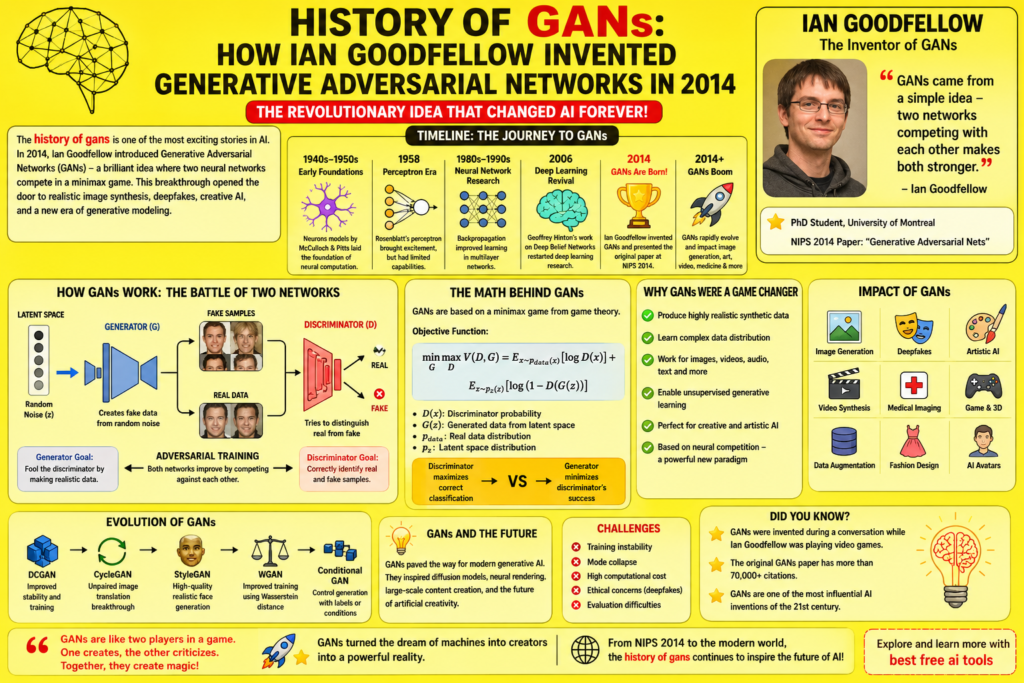
History of gans became one of the most fascinating chapters in artificial intelligence after Ian Goodfellow introduced Generative Adversarial Networks in 2014. This revolutionary invention completely changed how machines create images, videos, voices, and synthetic data. Before GANs appeared, neural networks mainly focused on classification and prediction tasks. Machines could recognize objects, but they struggled to generate realistic content.
The arrival of GANs transformed generative modeling forever. Ian Goodfellow’s breakthrough allowed two neural networks to compete against each other in a minimax game, producing astonishingly realistic outputs.
Today, GANs influence image synthesis, artistic AI, deepfakes history, gaming, medical imaging, and generative architecture research. The impact of history of gans can now be seen across modern AI systems worldwide.
Many experts consider GANs one of the greatest research breakthroughs in deep learning history because they turned neural competition into a powerful creative engine.
Early Neural Networks Before GANs (1940 – 2000)
To understand the history of gans, we first need to explore how neural networks evolved before generative AI became possible.
In 1943, Warren McCulloch and Walter Pitts created one of the earliest mathematical neuron models. Their work became the foundation for computational neural systems.
The famous mcculloch and pitts neural network model demonstrated how artificial neurons could imitate biological brain behavior.
Later, Frank Rosenblatt introduced the perceptron in 1958, which increased excitement around machine intelligence.
However, early neural systems focused mainly on recognition tasks instead of content generation.
During the following decades, researchers improved:
- Backpropagation
- Neural optimization
- Feature learning
- Computer vision
- Sequential learning
Still, neural networks lacked the ability to create realistic images or synthetic media.
The AI community needed more powerful generative systems.
Geoffrey Hinton and the Deep Learning Revival (2006)
The modern history of gans became possible largely because of Geoffrey Hinton’s deep learning revival in 2006.
Hinton’s Science 2006 paper introduced Deep Belief Networks and layer-wise pre-training.
Researchers discussing history of deep learning often describe this breakthrough as the moment modern AI truly restarted.
The deep learning revival improved:
- Neural network depth
- Feature extraction
- GPU acceleration
- Optimization stability
- Generative modeling research
This progress allowed researchers to train much deeper networks than before.
Without this revival, GANs may never have become practical.
The Problem with Early Generative Models
Before GANs, generative AI systems existed, but they produced weak and blurry outputs.
Researchers experimented with:
- Boltzmann Machines
- Autoencoders
- Probabilistic models
- Hidden Markov Models
These systems struggled to generate high-quality synthetic images.
The biggest challenges included:
- Poor image quality
- Weak data distribution learning
- Slow training
- Limited realism
- Difficulty modeling latent space
Researchers wanted neural systems capable of producing outputs nearly indistinguishable from real data.
That breakthrough finally arrived in 2014.
Ian Goodfellow’s Revolutionary Idea (2014)
The most important moment in the history of gans happened in 2014.
Ian Goodfellow, then a PhD student at the University of Montreal, invented Generative Adversarial Networks during a discussion with friends.
The idea was surprisingly elegant.
Instead of training one neural network, Goodfellow trained two competing networks:
- Generator
- Discriminator
The generator creates fake data.
The discriminator attempts to detect whether the data is real or fake.
This adversarial training process forces both networks to improve continuously.
The generator learns to create increasingly realistic outputs, while the discriminator becomes better at spotting fake samples.
This competition became the core innovation behind GANs.
The Generator vs Discriminator System
The heart of the history of gans lies in the battle between generator and discriminator networks.
Generator
The generator takes random input from latent space and creates synthetic outputs.
For example:
- Fake human faces
- Artificial artwork
- Synthetic voices
- Generated landscapes
Discriminator
The discriminator evaluates whether the generated output resembles real data.
Its goal is to classify:
- Real samples
- Fake samples
As training continues, both systems improve simultaneously.
This neural competition creates highly realistic synthetic data generation.
The Mathematics Behind GANs
GAN training relies on a minimax optimization game.
The mathematical objective function is:
Expanded form:
Where:
- = discriminator probability
- = generated data
- = real data distribution
- = latent space distribution
The discriminator maximizes classification accuracy.
The generator minimizes the discriminator’s success.
This adversarial loss system became one of the most innovative concepts in AI history.
Why GANs Changed Artificial Intelligence Forever
The history of gans became revolutionary because GANs solved problems earlier generative systems could not handle effectively.
GANs introduced:
- Realistic image synthesis
- High-quality synthetic data
- Creative AI generation
- Improved generative architecture
- Better latent space representation
The outputs became dramatically more realistic than earlier approaches.
GANs soon transformed:
- Computer vision
- Artistic AI
- Video generation
- AI avatars
- Medical imaging
- Face generation
Researchers studying generative neural networks often identify GANs as the biggest breakthrough in creative AI systems.
The NIPS 2014 Paper Shocked Researchers
Ian Goodfellow presented GANs at the NIPS 2014 conference.
The AI community quickly recognized the importance of the idea.
Researchers discussing ian goodfellow biography frequently mention GANs as one of the most brilliant AI inventions of the decade.
Even Geoffrey Hinton reportedly described GANs as one of the most interesting ideas in machine learning.
The simplicity and creativity of adversarial training impressed researchers worldwide.
Soon after, GAN research exploded globally.
GANs and the Rise of Deepfake Technology
One major chapter in the history of gans involves deepfakes history.
GANs became capable of generating realistic human faces, voices, and videos.
This created exciting possibilities but also serious ethical concerns.
GAN technology enabled:
- AI-generated actors
- Face swapping
- Synthetic speech
- Virtual influencers
- Fake political videos
The rise of deepfakes sparked global debates about misinformation and AI ethics.
Despite these concerns, GANs also created major positive applications in science and medicine.
GANs in Computer Vision and Art
GANs rapidly transformed computer vision research.
Researchers studying cnn computer vision history often connect GAN growth with modern image generation breakthroughs.
GANs improved:
- Super-resolution imaging
- Style transfer
- Artistic rendering
- Image restoration
- Data augmentation
Artists also began using GANs for creative projects.
AI-generated paintings and visual designs became increasingly popular.
GANs helped establish the idea that machines could become creative partners instead of simple analytical tools.
Variants of GANs
After 2014, researchers developed many GAN variations.
These included:
- DCGAN
- CycleGAN
- StyleGAN
- Conditional GANs
- Pix2Pix
- Wasserstein GANs
Each architecture improved training stability or output quality.
StyleGAN became especially famous for producing highly realistic human faces.
GAN research continues evolving today.
GANs and Modern Deep Learning
The history of gans became deeply connected to broader deep learning evolution.
Researchers exploring history of ai often view GANs as a major turning point where AI systems moved from recognition into true generation.
GANs also influenced:
- Reinforcement learning
- Diffusion models
- Multimodal AI
- Creative automation
- Synthetic simulations
The concept of adversarial learning inspired many future neural architectures.
GANs vs Transformers
Today, transformer systems dominate language AI, while GANs remain powerful in image synthesis.
Researchers discussing transformer neural networks often compare them with GAN-based image generators.
GANs excel at:
- Visual realism
- Image synthesis
- Artistic generation
Transformers excel at:
- Language modeling
- Sequential learning
- Attention mechanisms
Both systems remain highly influential in modern AI.
Ian Goodfellow’s Lasting Legacy
Ian Goodfellow became one of the most influential AI researchers because of GANs.
His invention demonstrated that creativity could emerge through neural competition.
The impact of GANs reached:
- Hollywood
- Gaming
- Medical research
- Fashion
- Advertising
- Robotics
Researchers discussing godfathers of deep learning often recognize Goodfellow as one of the most important next-generation pioneers after Hinton, LeCun, and Bengio.
His work permanently changed the direction of generative AI.
GANs in Today’s AI Tools
Modern AI platforms continue using GAN-inspired technologies.
Many of today’s best free ai tools use GAN principles for image generation, face enhancement, and visual editing.
GAN concepts also helped inspire newer generative systems including diffusion models.
The influence of adversarial training continues shaping the future of creative AI.
The Future of GANs
The future of GANs remains exciting despite competition from diffusion models.
Researchers continue improving:
- Training stability
- Synthetic realism
- Ethical safeguards
- Data efficiency
- Real-time generation
GANs may continue playing major roles in:
- Virtual reality
- Scientific simulation
- Robotics
- AI filmmaking
- Medical imaging
The legacy of history of gans will likely continue influencing artificial intelligence for decades.
FAQs About GANs
What are GANs in artificial intelligence?
GANs are Generative Adversarial Networks where two neural networks compete to generate realistic synthetic data.
Who invented GANs?
Ian Goodfellow invented GANs in 2014 while studying at the University of Montreal.
Why are GANs important?
GANs transformed generative AI by producing highly realistic images, videos, and synthetic content.
What is adversarial training?
Adversarial training involves two competing neural networks improving against each other during learning.
What are GANs used for today?
GANs are used in image generation, artistic AI, healthcare imaging, gaming, and deepfake systems.
Are GANs still important after diffusion models?
Yes. GANs remain highly valuable for image synthesis, visual realism, and fast generative applications.
Conclusion
The story of history of gans represents one of the most creative breakthroughs in artificial intelligence history. Ian Goodfellow’s invention of Generative Adversarial Networks in 2014 transformed neural systems from simple recognizers into powerful creators.
Through adversarial training, generator vs discriminator competition, and minimax optimization, GANs introduced a revolutionary new approach to synthetic data generation.
The rise of GANs became deeply connected to history of deep learning, generative neural networks, cnn computer vision history, transformer neural networks, and history of ai research.
Today, GANs continue influencing art, medicine, robotics, gaming, and generative media across the world.
As AI advances further, the impact of Ian Goodfellow’s revolutionary idea will remain one of the defining moments in modern artificial intelligence.