The story of deepmind vs openai is more than a corporate rivalry, it is the defining narrative of modern artificial intelligence. These two AI research labs, born on opposite sides of the Atlantic with different philosophies, founders, and funding sources, have together pushed neural networks from academic curiosity into world changing technology. From AlphaGo’s stunning victories to ChatGPT’s global takeover, the competition and occasional collaboration between these labs has shaped everything we now call modern AI. Understanding their journey is essential to understanding where intelligence itself is heading.
The Origins of DeepMind in London (2010 – 2014)
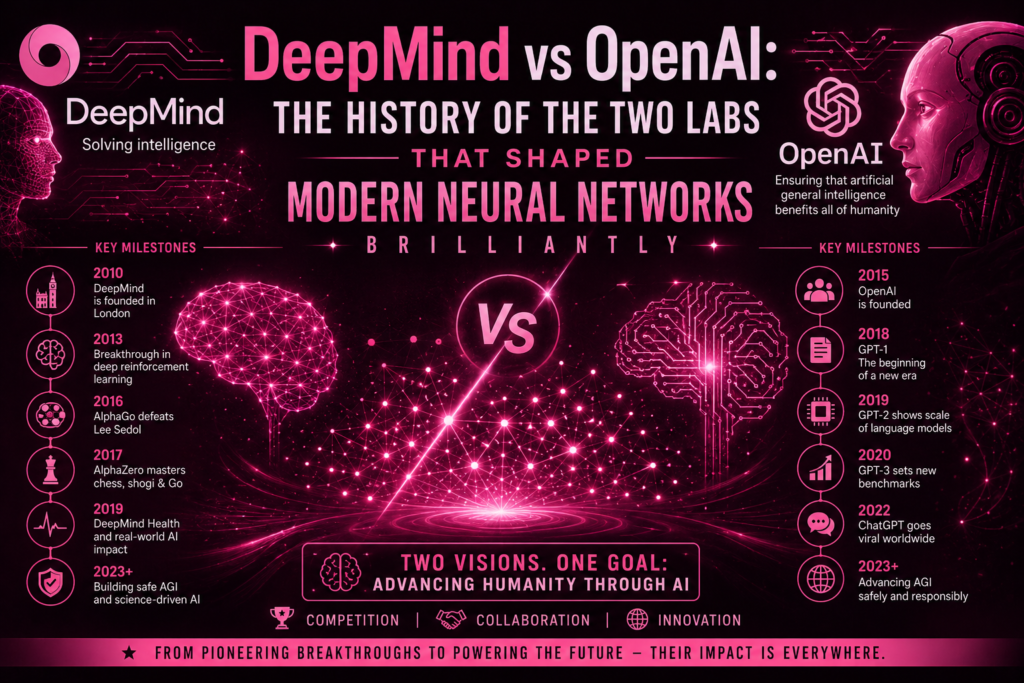
DeepMind was founded in 2010 in London by Demis Hassabis, Shane Legg, and Mustafa Suleyman. Hassabis, a former chess prodigy, video game designer, and neuroscientist, brought an unusual blend of skills to the table. From the very beginning, DeepMind’s mission was bold and almost philosophical: “Solve intelligence, and then use it to solve everything else.” This was not your typical Silicon Valley pitch.
The lab focused heavily on reinforcement learning, an approach inspired by how humans and animals learn through trial and reward. Early DeepMind researchers built systems that could play classic Atari games at superhuman levels, learning purely from pixels and scores. The work caught the eye of major investors and tech giants. In 2014, Google acquired DeepMind for a reported 500 million dollars, providing the lab with nearly unlimited compute resources while preserving its research independence. This Google acquisition would become a crucial advantage in the deepmind vs openai narrative that followed.
The Founding of OpenAI in Silicon Valley (2015 – 2018)
In December 2015, a different kind of lab emerged. OpenAI was founded in San Francisco by Sam Altman, Elon Musk, Greg Brockman, Ilya Sutskever, and several other AI luminaries. The founders pledged one billion dollars and announced an unusual mission: to ensure that artificial general intelligence benefits all of humanity. OpenAI was launched as a non profit, deliberately positioning itself against the closed nature of corporate research labs.
Elon Musk’s AI role was particularly notable in the early days. Worried about existential risks from AI, he wanted a counterweight to Google’s growing dominance through DeepMind. The contrast was immediate and stark. While DeepMind focused on reinforcement learning and game environments, OpenAI initially explored a broader research agenda, eventually placing big bets on large language models. The early deepmind vs openai dynamic was less a fight and more a philosophical divergence.
For deeper context on how we arrived at this moment, the broader history of ai shows that competition between labs has always driven breakthroughs.
AlphaGo and the Reinforcement Learning Revolution (2016 – 2017)
In March 2016, DeepMind shocked the world. Its AlphaGo system defeated Lee Sedol, one of the greatest Go players in history, four games to one. Go had long been considered too complex for computers due to its astronomical number of possible positions. The victory was a watershed moment, demonstrating that deep reinforcement learning combined with neural networks could conquer problems once thought uniquely human.
The history of alphago marked DeepMind’s clear lead in research prestige. Scientific publications poured out of the London lab, including papers on AlphaZero, which mastered chess, shogi, and Go from scratch, and later AlphaFold, which solved the 50 year old protein folding problem. Each breakthrough reinforced DeepMind’s reputation as the most prestigious AI research lab in the world. In the early rounds of deepmind vs openai, DeepMind appeared to be winning.
OpenAI’s Pivot to Large Language Models (2018 – 2020)
While DeepMind dominated headlines with reinforcement learning, OpenAI was quietly making a different bet. Researchers there became convinced that scaling up transformer based language models could unlock general intelligence. In 2018, they released GPT, followed by GPT-2 in 2019, which was so capable at generating text that OpenAI initially refused to release the full model, citing safety concerns.
This period also brought controversy. OpenAI transitioned from a pure non profit to a “capped profit” structure, allowing it to raise capital from venture capital firms and form a deep Microsoft partnership worth billions. Elon Musk left the board, citing potential conflicts with Tesla’s own AI work. Critics questioned whether OpenAI had abandoned its founding ideals, while supporters argued that competing with tech giants required serious funding.
The Reinforcement Learning vs LLMs debate became central to the deepmind vs openai rivalry. DeepMind believed agents that learned through interaction with environments were the path to AGI. OpenAI believed that simply scaling language models would produce emergent intelligence. Both bets would pay off, but in very different ways.
The ChatGPT Earthquake (2022 – 2023)
Then came November 2022. OpenAI released ChatGPT, a conversational interface to GPT-3.5, and the world changed overnight. Within five days, the chatbot had one million users. Within two months, it had one hundred million. No consumer product in history had grown so quickly. Suddenly, the average person could experience artificial intelligence directly, and OpenAI became a household name.
The release caught DeepMind, and parent company Google, completely off guard. Despite years of leading research, Google found itself in the awkward position of playing catch up to a smaller, faster moving rival. The deepmind vs openai rivalry intensified dramatically. Google merged DeepMind with its Google Brain team in 2023, creating Google DeepMind under Demis Hassabis’s leadership, in a clear attempt to consolidate resources and accelerate response.
If you want to try the products born from this rivalry, you can explore the best free ai tools that put both labs’ breakthroughs into everyday hands.
The Talent Wars and Compute Arms Race (2023 – 2024)
As both labs raced forward, the AI industry experienced unprecedented talent wars. Top researchers commanded salaries rivaling professional athletes, sometimes receiving multi million dollar offers to switch labs. Compute resources became the new oil, with both organizations spending billions on NVIDIA GPUs to train ever larger models. The gpu history in ai is intimately tied to this period, as hardware availability often determined which lab could push the frontier first.
OpenAI released GPT-4, which demonstrated remarkable reasoning capabilities. DeepMind countered with Gemini, a multimodal model that natively handled text, images, audio, and video. Each release escalated expectations. AI safety became a major public concern, with both labs publishing alignment research while critics questioned whether the pace of deployment was responsible.
The open source vs closed source debate added another layer. OpenAI, despite its name, had become increasingly closed, keeping model weights proprietary. Meta’s open releases and emerging Chinese labs put pressure on both DeepMind and OpenAI to balance secrecy with scientific transparency. Research ethics discussions intensified across academic and policy circles.
The Boardroom Drama That Shook Silicon Valley
In November 2023, OpenAI faced its most dramatic moment. The board abruptly fired Sam Altman, citing concerns about communication and trust. Within days, nearly the entire OpenAI staff threatened to resign and follow Altman to Microsoft. Under enormous pressure, the board reversed course, and Altman returned as CEO with a restructured board. The episode revealed deep tensions within OpenAI about its founding mission, safety priorities, and commercial direction.
DeepMind, by contrast, maintained relative stability under Hassabis, though it too faced internal debates about how aggressively to deploy products versus pursue long term research. The contrast between the two labs’ cultures became another fascinating dimension of the deepmind vs openai story. One was a fast moving startup chasing product market fit, the other a research powerhouse embedded within a global tech giant.
The Race Toward Artificial General Intelligence
Today, both labs openly pursue artificial general intelligence as their north star. DeepMind continues advancing scientific applications, with AlphaFold transforming biology, and newer projects targeting mathematics, materials science, and fusion energy. OpenAI focuses heavily on scaling language and reasoning models, with products like GPT-4o, Sora for video generation, and increasingly capable agents.
The contributions of the godfathers of deep learning, including Geoffrey Hinton, Yann LeCun, and Yoshua Bengio, laid the theoretical foundations that both labs now build upon. Meanwhile, advances in transformer neural networks have become the backbone of nearly every major model released by either organization. The architectures may differ, but the underlying mathematics traces back to decades of academic research.
Frequently Asked Questions (FAQs)
Q1: Who founded DeepMind and OpenAI?
DeepMind was founded in 2010 by Demis Hassabis, Shane Legg, and Mustafa Suleyman. OpenAI was founded in 2015 by Sam Altman, Elon Musk, Greg Brockman, Ilya Sutskever, and others.
Q2: Which lab is bigger or more advanced?
The deepmind vs openai comparison is complex. DeepMind has stronger scientific publications and game playing AI, while OpenAI dominates consumer products and large language models like ChatGPT.
Q3: Are DeepMind and OpenAI competitors or partners?
They are primarily competitors in the race to artificial general intelligence, though researchers from both labs collaborate through academic conferences and shared safety initiatives.
Q4: Why did Elon Musk leave OpenAI?
Musk left OpenAI’s board in 2018, citing potential conflicts with Tesla’s AI development. He has since launched his own competing lab and remains a vocal critic of OpenAI’s direction.
Q5: What is the future of the deepmind vs openai rivalry?
Both labs are racing toward AGI, with massive investments in compute, talent, and safety research. The rivalry will likely shape AI for decades to come, with breakthroughs benefiting humanity broadly.
Conclusion
The deepmind vs openai rivalry represents far more than a corporate competition. It is a clash of philosophies, founding stories, and visions for humanity’s future with intelligent machines. DeepMind brought scientific rigor and reinforcement learning breakthroughs from London, while OpenAI delivered consumer facing AI that changed how billions of people interact with technology. Their parallel journeys, with all the talent wars, boardroom dramas, and trillion dollar partnerships, have defined the modern era of neural networks. Whichever lab reaches AGI first, or whether the prize is shared, one thing is clear: the world we now live in was built in the creative tension between these two extraordinary organizations.