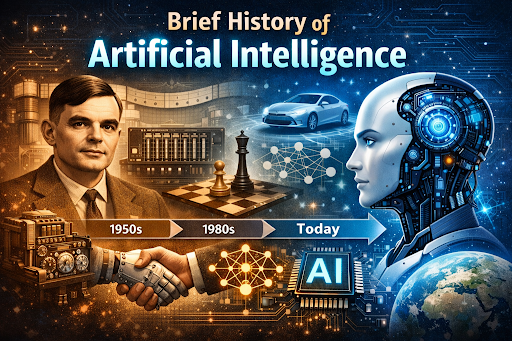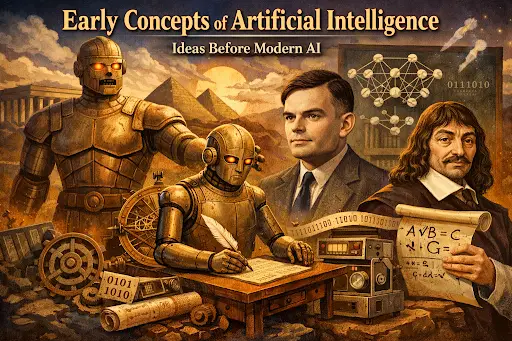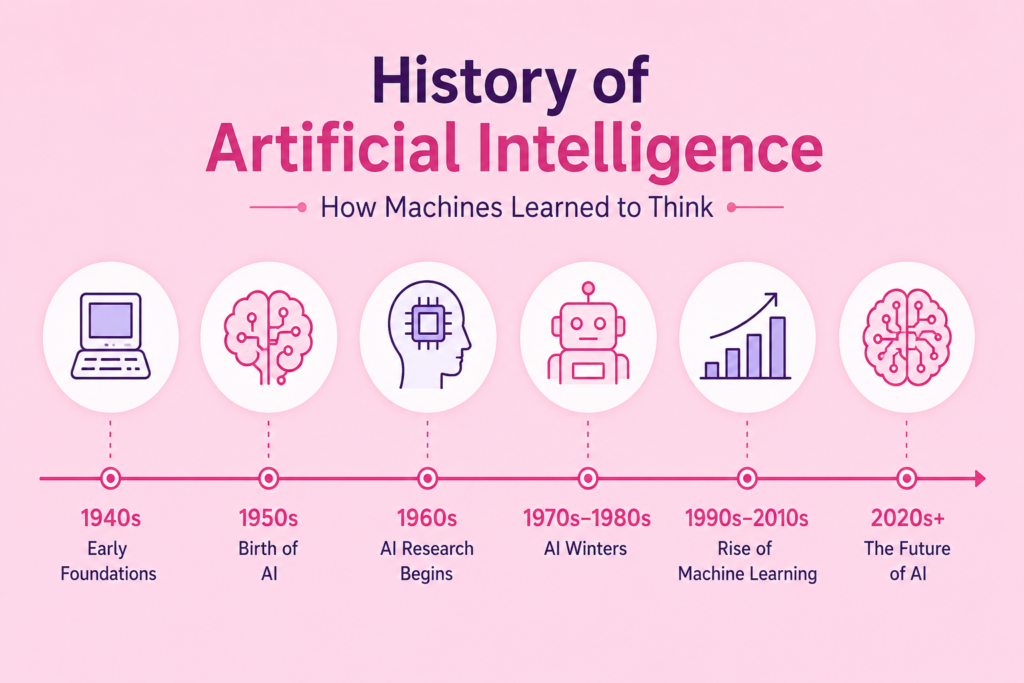
The history of artificial intelligence is one of the most fascinating journeys in modern science. What started as a dream of creating thinking machines eventually became a technological revolution that transformed healthcare, robotics, business, education, and communication.
Artificial intelligence, often called AI, refers to machines that can imitate human intelligence. These systems can solve problems, recognize patterns, process language, and even make decisions. Today, AI powers search engines, recommendation systems, autonomous vehicles, speech assistants, and predictive modeling platforms.
The history of artificial intelligence combines mathematics, cognitive science, cybernetics, digital computers, and computational logic. Researchers spent decades trying to understand how intelligence works and how machines could simulate it.
From early logic gates and heuristic search algorithms to deep learning architecture and transformer models, AI has evolved dramatically between 1943 and 2026.
In this article, we will explore the complete journey of AI evolution and discover how machines learned to think.
The Early Foundations of Artificial Intelligence (1930 – 1945)
The roots of the history of artificial intelligence began long before modern computers existed.
Scientists and mathematicians wondered if machines could perform reasoning like humans. Early ideas emerged from symbolic logic, mathematical modeling, and algorithmic thinking.
One of the most influential figures was Alan Turing. During the 1930s and 1940s, Turing developed theories about machine computation and intelligence simulation.
Turing introduced the concept of universal computation through the famous Turing Machine. This idea showed that machines could theoretically solve any computable problem using instructions.
Another important concept was Turing’s B-type unorganized machines, an early idea resembling neural architecture.
During World War II, digital computers rapidly advanced because governments needed faster calculations for cryptography and military planning. These early systems laid the groundwork for AI research.
The rise of information theory and hardware evolution also contributed to the future of machine intelligence.
The Birth of Neural AI (1943 – 1956)
One of the biggest milestones in the history of artificial intelligence came in 1943 when Warren McCulloch and Walter Pitts created the first artificial neuron model.
Their work introduced the idea that computers could imitate the brain through connected computational units.
This breakthrough became the foundation of neural network history and modern artificial neural networks.
The McCulloch-Pitts model used:
- Logic gates
- Binary computation
- Artificial neurons
- Simple activation systems
Their research helped launch connectionism, a theory suggesting intelligence emerges through networks of connected nodes.
This innovation later influenced machine learning, pattern recognition, and neural architecture design.
Researchers also began comparing machine intelligence with the human brain. This relationship became central to neural networks vs human brain discussions.
The Dartmouth Workshop and the Birth of AI (1956)
The official birth of artificial intelligence happened in 1956 during the Dartmouth Workshop in the United States.
Researchers including John McCarthy, Marvin Minsky, Claude Shannon, and Herbert Simon gathered to discuss intelligent machines.
John McCarthy officially coined the term “Artificial Intelligence.”
Scientists believed human-level AI might be achieved within a few decades.
The Dartmouth Workshop introduced several important concepts:
- Knowledge representation
- Heuristic search
- Problem solving
- Cognitive science
- Algorithmic complexity
This period became one of the most important events in the history of machine learning and AI evolution.
Symbolic AI and Expert Systems (1956 – 1970)
After the Dartmouth Workshop, researchers focused heavily on Symbolic AI.
Symbolic AI vs Connectionism became one of the biggest debates in artificial intelligence history.
Symbolic AI relied on:
- Logical rules
- Human-coded knowledge
- Decision trees
- Knowledge databases
Scientists believed intelligence could be achieved through symbolic reasoning rather than learning systems.
During this period, expert systems became popular.
Expert systems were designed to imitate human experts in fields like medicine and engineering.
Programs such as DENDRAL and MYCIN demonstrated that machines could assist in scientific analysis and medical diagnosis.
This period also advanced data processing and algorithmic thinking in computer science.
The Perceptron Revolution (1957 – 1969)
In 1957, Frank Rosenblatt introduced the Perceptron.
This invention became a major milestone in the history of perceptron and AI evolution.
The perceptron was one of the earliest machine learning systems capable of learning from data.
The basic perceptron equation:
The system used weighted inputs and activation functions to make predictions.
Scientists believed perceptrons could eventually lead to fully intelligent machines.
This breakthrough also fueled interest in who invented neural networks research.
The First AI Winter (1970 – 1980)
Despite early excitement, AI development faced serious limitations.
Computers lacked enough memory and processing power. Many systems failed to meet expectations.
In 1969, Marvin Minsky and Seymour Papert criticized perceptrons for their inability to solve complex problems.
This criticism contributed to the first ai winter.
Funding for AI projects declined sharply.
Many researchers abandoned neural network studies and shifted toward other computer science fields.
However, some scientists continued working on machine intelligence behind the scenes.
The Rise of Machine Learning (1980 – 1995)
The history of artificial intelligence changed dramatically during the 1980s.
Researchers discovered better learning algorithms and more efficient computational methods.
Backpropagation became one of the most important breakthroughs in AI.
The algorithm allowed neural networks to adjust weights using gradient calculations.
The weight update equation:
This breakthrough improved predictive modeling and multi-layer perceptron systems.
This era is deeply connected with history of backpropagation and multilayer perceptron history.
Researchers also explored:
- Evolutionary computing
- Neural optimization
- Pattern recognition
- Adaptive systems
Machine learning slowly became more powerful than rule-based expert systems.
Deep Learning Revolution (1995 – 2015)
The modern AI revolution truly exploded during the 2000s and early 2010s.
Better GPUs, massive datasets, and advanced algorithms transformed AI research.
Deep learning architecture emerged as the dominant AI approach.
Researchers developed systems with multiple hidden layers capable of extracting complex features automatically.
This period connects strongly to:
One of the most important breakthroughs came in 2012 when AlexNet won the ImageNet competition.
AlexNet demonstrated the power of convolutional neural networks in computer vision tasks.
This success changed the AI industry forever.
Scientists like Geoffrey Hinton, Yann LeCun, and Yoshua Bengio became known as the Godfathers of Deep Learning.
AI Defeats Human Champions (1997 – 2020)
Artificial intelligence achieved global attention when machines started defeating humans in difficult games.
In 1997, IBM Deep Blue defeated world chess champion Garry Kasparov.
Later, AI systems mastered poker, strategy games, and complex simulations.
One of the most important milestones came with AlphaGo.
Developed by DeepMind, AlphaGo defeated legendary Go player Lee Sedol in 2016.
This achievement became central to history of alphago and reinforcement learning history.
It proved machines could master highly strategic tasks once considered impossible for AI.
Transformer Models and Generative AI (2017 – 2026)
The introduction of transformer neural networks completely changed AI development.
In 2017, researchers at Google introduced the paper “Attention Is All You Need.”
Transformers improved language understanding through attention mechanisms instead of traditional sequential processing.
Modern generative AI systems now power:
- AI chatbots
- Text generation
- Image creation
- Speech synthesis
- Code generation
This era strongly relates to:
Companies like OpenAI, DeepMind, and Anthropic are leading modern AI innovation.
Today, even best free ai tools rely on transformer-based AI systems.
AI in Modern Industries
Artificial intelligence now influences nearly every industry.
Healthcare and Medicine
AI systems help doctors detect diseases, analyze scans, and develop treatments.
This field connects with ai in medicine history.
Machine intelligence supports:
- Cancer detection
- Medical imaging
- Drug discovery
- Personalized healthcare
Self Driving Cars
Autonomous vehicles use AI for object recognition, navigation, and traffic prediction.
This technology is closely related to self driving cars and ai research.
Business and Automation
Companies use AI for:
- Customer support
- Recommendation systems
- Fraud detection
- Market prediction
- Data analytics
AI has become essential for modern business operations.
The Future of Artificial Intelligence (2026 and Beyond)
The future of AI looks incredibly powerful.
Researchers are currently exploring:
- Spiking neural networks
- Artificial general intelligence
- Quantum AI
- Brain-inspired computing
- Advanced robotics
The competition between companies is accelerating innovation rapidly.
Many experts believe AI could eventually surpass human-level intelligence in certain fields.
However, ethical concerns also continue growing.
Questions about AI safety, employment, privacy, and machine consciousness remain major global topics.
The future of the history of artificial intelligence may completely reshape civilization itself.
Frequently Asked Questions (FAQs)
What is artificial intelligence?
Artificial intelligence is the simulation of human intelligence in machines that can learn, reason, and solve problems.
Who invented artificial intelligence?
John McCarthy officially coined the term “Artificial Intelligence” during the Dartmouth Workshop in 1956.
What was the first AI system?
Early AI systems included symbolic reasoning programs and the McCulloch-Pitts artificial neuron model from 1943.
Why is deep learning important?
Deep learning allows machines to recognize patterns and process massive amounts of data automatically using neural networks.
What industries use AI today?
AI is used in healthcare, finance, transportation, robotics, education, cybersecurity, and entertainment.
Conclusion
The history of artificial intelligence is a story of ambition, experimentation, failure, and extraordinary progress. From simple mathematical theories in the 1940s to advanced generative AI systems in 2026, machines have evolved from calculators into intelligent learning systems.
Researchers combined cognitive science, machine learning, neural architecture, and computational mathematics to create systems capable of reasoning, prediction, and creativity.
Today, artificial intelligence powers some of the most important technologies on Earth. As AI continues advancing, the boundary between human intelligence and machine intelligence may become even smaller in the coming decades.