History of reinforcement learning is one of the most fascinating stories in artificial intelligence because it transformed machines from passive prediction systems into active decision-makers. Instead of simply recognizing images or processing text, reinforcement learning taught AI how to learn through trial and error, reward optimization, and strategic behavior.
This branch of AI became famous after machines defeated human champions in games like chess, Go, and Atari. However, the roots of reinforcement learning stretch back decades into psychology, mathematics, neuroscience, and optimal control theory.
Today, the impact of history of reinforcement learning can be seen across robotics, autonomous systems, gaming AI, recommendation systems, and self-driving technology. Reinforcement learning became one of the key technologies powering modern AI breakthroughs.
The journey from simple reward-based systems to Deep Q-Networks and AlphaGo represents one of the greatest revolutions in computer science history.
Early Foundations of Reinforcement Learning (1940 – 1960)
To understand the history of reinforcement learning, we first need to explore the early foundations of behavioral learning and neural computation.
During the 1940s, researchers became interested in how biological organisms learn from rewards and punishments.
Psychologists studying behavioral psychology discovered that animals improve behavior through reinforcement.
At the same time, early AI researchers explored artificial neurons and computational learning systems.
The famous mcculloch and pitts neural network model introduced the idea that machine intelligence could imitate biological neural behavior.
These early systems laid the foundation for adaptive machine learning.
Researchers also became interested in dynamic programming and optimal decision-making problems.
Mathematicians such as Richard Bellman introduced Bellman equations, which later became central to reinforcement learning algorithms.
Markov Decision Processes and Decision Theory (1950 – 1970)
The modern history of reinforcement learning became strongly connected to Markov Decision Processes, commonly called MDPs.
MDPs mathematically describe agent-environment interaction.
An AI agent performs actions inside an environment and receives rewards based on its decisions.
The process contains:
- States
- Actions
- Rewards
- Policies
- Transitions
The Bellman equation became essential:
Where:
- = value of state
- = reward
- = discount factor
This framework allowed researchers to model long-term reward optimization mathematically.
The rise of MDPs became one of the most important moments in the history of reinforcement learning.
The Rise of Trial and Error Learning
The history of reinforcement learning expanded rapidly because researchers realized machines could improve through iterative learning instead of explicit programming.
Instead of hardcoding every action, AI agents could:
- Explore environments
- Test strategies
- Receive rewards
- Improve behavior
This process mirrored human learning surprisingly well.
Researchers began studying:
- Exploration vs exploitation
- Policy optimization
- Autonomous agents
- Sequential decision-making
- Game theory in AI
These ideas became foundational to modern reinforcement learning systems.
Early AI Struggles and the AI Winters (1970 – 1990)
Although reinforcement learning showed promise, AI research struggled during the AI winters.
Researchers discussing history of ai often describe this period as a time of reduced funding and skepticism toward neural learning systems.
Several limitations slowed progress:
- Weak computational power
- Limited memory
- Small datasets
- Slow algorithms
- Poor neural optimization
At the same time, neural networks themselves faced major criticism.
The famous vanishing gradient problem made training deep networks extremely difficult.
Reinforcement learning systems also struggled with delayed rewards and unstable learning behavior.
Despite these problems, researchers continued improving temporal difference learning methods.
Temporal Difference Learning and Q-Learning (1980 – 1995)
One of the greatest breakthroughs in the history of reinforcement learning arrived with temporal difference learning.
Richard Sutton and Andrew Barto helped popularize these methods, which combined ideas from dynamic programming and trial-and-error learning.
Temporal difference learning updated value estimates incrementally:
This allowed agents to learn continuously while interacting with environments.
Soon after, Christopher Watkins introduced Q-learning.
Q-learning became one of the most famous reinforcement learning algorithms ever created.
The Q-learning equation is:
This breakthrough allowed agents to learn optimal strategies without explicit environment models.
The rise of Q-learning transformed the history of reinforcement learning forever.
Reinforcement Learning and Neural Networks
During the 1990s, researchers began combining reinforcement learning with neural networks.
This idea became especially important after the deep learning revival led by Geoffrey Hinton.
Researchers discussing history of deep learning often connect reinforcement learning growth with improvements in neural optimization and GPU acceleration.
Neural networks allowed reinforcement learning agents to process:
- Images
- Complex game states
- Large environments
- Continuous control systems
This combination became one of the most powerful ideas in AI history.
Deep Q-Networks Changed Everything (2013 – 2015)
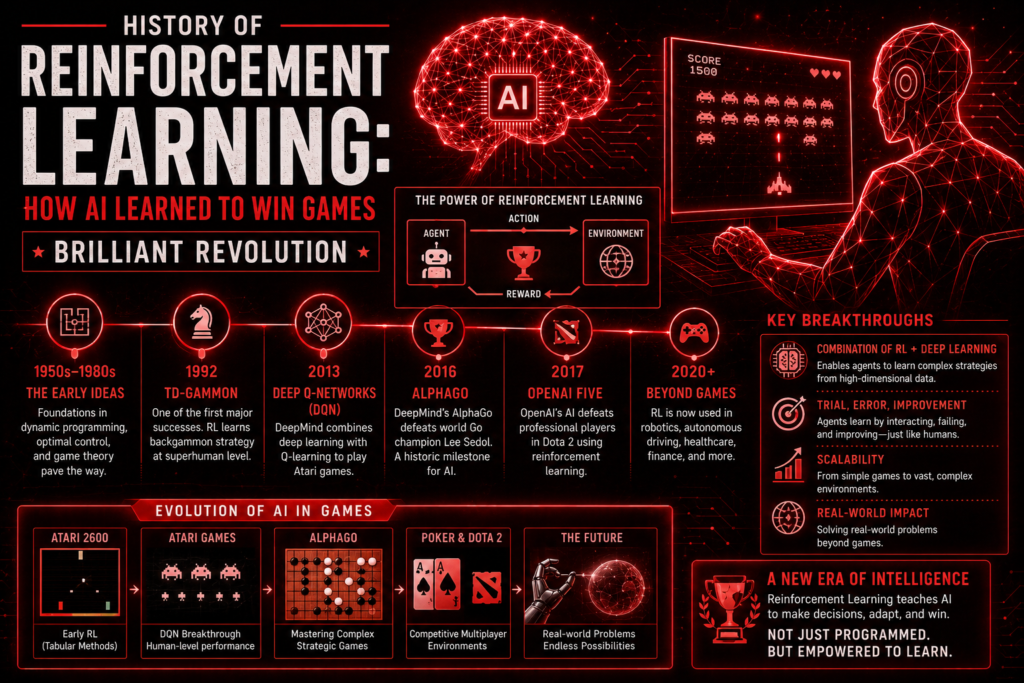
The biggest revolution in the history of reinforcement learning arrived when DeepMind introduced Deep Q-Networks, commonly called DQN.
DQN combined:
- Deep neural networks
- Q-learning
- Experience replay
- GPU acceleration
This system learned directly from raw Atari game pixels.
The AI agent played games repeatedly and improved through reward optimization.
Researchers discussing gpu history in ai often identify GPUs as essential for deep reinforcement learning success.
The DQN breakthrough shocked researchers because the AI learned strategies without handcrafted instructions.
This moment marked the beginning of modern deep reinforcement learning.
How DQN Worked
DQN approximated Q-values using neural networks.
The loss function became:
Where:
The system used:
- Experience replay memory
- Target networks
- Deep CNN architectures
This stabilized reinforcement learning training dramatically.
DQN became one of the defining breakthroughs in the history of reinforcement learning.
AlphaGo Shocked the World (2016)
The most famous moment in the history of reinforcement learning happened in 2016.
DeepMind’s AlphaGo defeated world champion Lee Sedol in the game of Go.
Go had long been considered too complex for AI because of its enormous search space.
AlphaGo combined:
- Deep neural networks
- Reinforcement learning
- Monte Carlo Tree Search
- Self-play training
The AI improved through iterative learning against itself.
Researchers discussing history of alphago often consider this event one of the greatest milestones in AI history.
The victory demonstrated that reinforcement learning could solve highly complex strategic problems.
Policy Gradients and Advanced Reinforcement Learning
The history of reinforcement learning continued evolving with policy gradient methods.
Instead of estimating value functions directly, policy gradients optimized action-selection policies.
The policy update equation became:
These methods improved:
- Continuous control
- Robotics
- Autonomous navigation
- Multi-agent learning
Advanced systems such as PPO and Actor-Critic architectures emerged from these ideas.
Reinforcement learning rapidly became one of the most powerful branches of AI research.
Reinforcement Learning Beyond Games
Although games made reinforcement learning famous, its applications expanded far beyond gaming.
Today, the influence of history of reinforcement learning can be seen across:
- Robotics
- Healthcare
- Recommendation systems
- Financial trading
- Industrial automation
- Autonomous driving
Modern self driving cars and ai systems often use reinforcement learning for navigation and decision-making simulations.
The technology continues spreading across industries worldwide.
Reinforcement Learning and Robotics
Reinforcement learning became especially important for robotics.
Robots can now learn tasks through repeated interaction instead of manual programming.
Examples include:
- Walking robots
- Warehouse automation
- Drone navigation
- Robotic arms
This agent-environment interaction approach allows adaptive robotic behavior.
The combination of reinforcement learning and robotics may eventually transform manufacturing completely.
Reinforcement Learning and Generative AI
Modern reinforcement learning also influences generative AI systems.
Researchers discussing generative neural networks often explore how reward-based optimization improves AI creativity and alignment.
Large language models increasingly use reinforcement learning from human feedback (RLHF).
This process helps AI systems:
- Follow instructions
- Improve responses
- Align with human preferences
The influence of reinforcement learning now extends into conversational AI and multi-modal systems.
OpenAI vs DeepMind in Reinforcement Learning
The competition between OpenAI and DeepMind accelerated reinforcement learning progress dramatically.
Researchers discussing deepmind vs openai often compare their approaches to RL systems.
DeepMind focused heavily on:
- AlphaGo
- AlphaZero
- Robotics
- Scientific AI
OpenAI explored:
- Game-playing agents
- RLHF
- Multi-agent systems
- Language model alignment
Together, these organizations transformed modern AI research.
Reinforcement Learning and the Future of AI
The future of history of reinforcement learning remains incredibly exciting.
Researchers are now exploring:
- Autonomous scientific discovery
- AI planning systems
- Multi-agent cooperation
- Real-world robotics
- General intelligence systems
Many of today’s best free ai tools already rely partly on reinforcement learning optimization behind the scenes.
The technology continues evolving rapidly.
Ethical Challenges of Reinforcement Learning
Despite its success, reinforcement learning introduces important ethical concerns.
These include:
- Unsafe autonomous behavior
- Reward hacking
- Unpredictable decision-making
- AI manipulation
- Bias reinforcement
Researchers continue developing safer reward optimization systems.
Balancing intelligence with safety remains a major challenge.
FAQs About Reinforcement Learning
What is reinforcement learning?
Reinforcement learning is an AI learning method where agents improve behavior through rewards and punishments.
What is Q-learning?
Q-learning is a reinforcement learning algorithm that learns the value of actions in different states.
What is the difference between supervised learning and reinforcement learning?
Supervised learning uses labeled examples, while reinforcement learning learns through interaction and rewards.
Why was AlphaGo important?
AlphaGo demonstrated that reinforcement learning combined with deep neural networks could master extremely complex games.
What are Markov Decision Processes?
MDPs are mathematical frameworks used to model sequential decision-making problems.
Is reinforcement learning used today?
Yes. Reinforcement learning is used in robotics, gaming, recommendation systems, autonomous driving, and modern AI alignment systems.
Conclusion
The story of history of reinforcement learning represents one of the greatest revolutions in artificial intelligence. From behavioral psychology and Markov Decision Processes to Deep Q-Networks and AlphaGo, reinforcement learning transformed AI into active decision-making systems.
The rise of reinforcement learning became deeply connected to history of deep learning, history of alphago, gpu history in ai, deepmind vs openai, and generative neural networks research.
Today, reinforcement learning powers robotics, autonomous systems, gaming AI, and modern generative models across the world.
As AI continues evolving, reinforcement learning will remain one of the most important technologies shaping the future of intelligent machines.