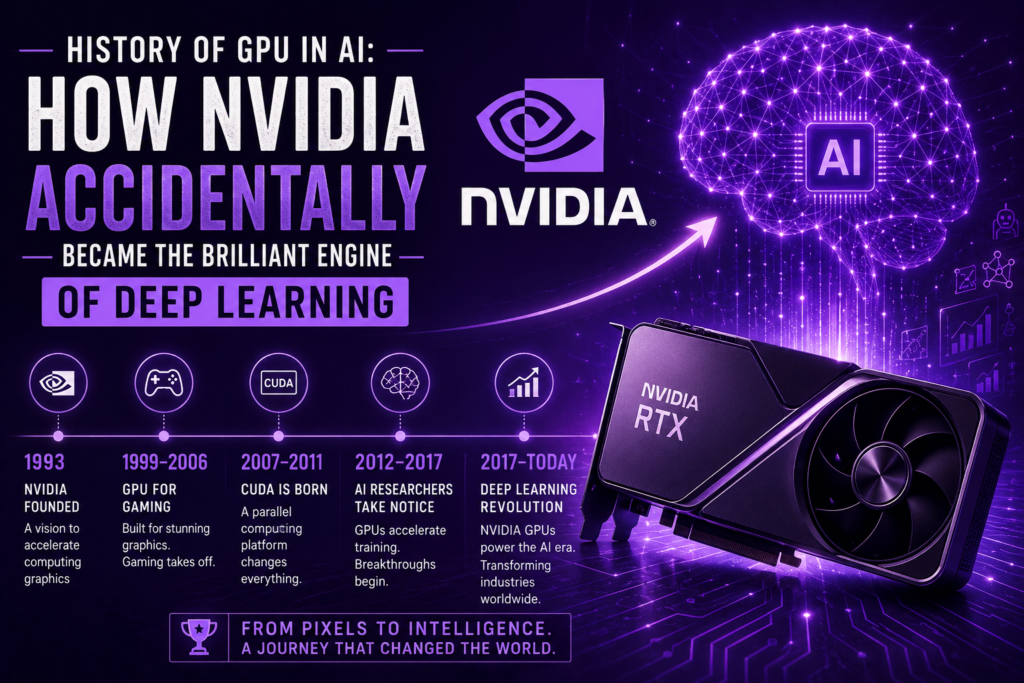
The history of gpu in ai is one of the most fascinating accidents in modern technology. What began as a humble effort to render smoother video game graphics eventually transformed into the backbone of artificial intelligence, deep learning, and generative models that now shape our daily lives. NVIDIA, a company founded to power gamers’ dreams, unintentionally engineered the very silicon that today fuels ChatGPT, autonomous vehicles, robotics, and scientific breakthroughs. This is the remarkable story of how parallel computing chips designed for pixels ended up powering intelligence itself.
The Early Days of Graphics Processing (1970 – 1990)
Long before anyone imagined neural networks training on graphics cards, the computing world relied heavily on CPUs to handle every task. CPUs were brilliant generalists, but they were serial processors, executing one instruction at a time. As video games and 3D visualization began demanding more realism in the 1980s, engineers realized that rendering millions of pixels simultaneously required a fundamentally different architecture, one capable of parallel computing on a massive scale.
Companies like Silicon Graphics pioneered specialized graphics hardware for workstations, while arcade machines used custom chips for sprite rendering. These early graphics cards laid the conceptual groundwork: split a heavy workload into thousands of smaller tasks and execute them simultaneously. This philosophy of hardware acceleration would later become the secret sauce behind the history of gpu in ai.
NVIDIA’s Founding and the Birth of the Modern GPU (1993 – 1999)
In 1993, three engineers, including a young Jensen Huang, founded NVIDIA in a Denny’s diner in San Jose. Their dream was simple: build the best graphics chips on the planet. After several rocky product launches, NVIDIA released the RIVA series and then, in 1999, the GeForce 256, which the company famously marketed as the world’s first true “GPU” or Graphics Processing Unit.
The GeForce 256 introduced hardware transform and lighting, offloading complex matrix multiplication and floating point operations from the CPU. Suddenly, gamers had smoother frame rates, and scientists noticed something interesting: these chips were extraordinarily good at the kind of linear algebra that also appears in physics simulations, weather modeling, and yes, neural networks.
GPGPU and the Spark That Started Everything (2000 – 2006)
By the early 2000s, researchers began experimenting with using graphics cards for non-graphics computation, a practice called GPGPU (General Purpose computing on GPUs). Early adopters cleverly disguised their math problems as compute shaders and pixel operations to trick the GPU into performing scientific calculations. It was hacky, painful, and brilliant.
Researchers studying the history of ai noticed that neural networks, which had fallen out of favor during the second AI winter, depended heavily on matrix multiplications, exactly what GPUs excelled at. The hardware was ready, but the software ecosystem was not. NVIDIA’s leadership, particularly Jensen Huang, made a bold bet: they would build a programming framework that made GPU computing accessible to everyone.
CUDA Changes the Game (2006 – 2010)
In 2006, NVIDIA released CUDA (Compute Unified Device Architecture), a parallel computing platform that allowed developers to use C-like programming to harness GPU power for any computation. NVIDIA CUDA was a turning point. For the first time, scientists, mathematicians, and machine learning researchers could write code that ran across thousands of GPU cores without needing to disguise calculations as graphics operations.
At first, the financial markets didn’t appreciate the investment. CUDA was expensive to develop, and the gaming customer base didn’t directly benefit. But Huang’s long term vision was clear: he believed parallel computing would eventually dominate every serious computational field. The history of gpu in ai would soon prove him spectacularly right.
If you’re exploring modern AI applications powered by these advances, you can also check out the best free ai tools that demonstrate just how accessible GPU powered intelligence has become for everyday users.
The AlexNet Moment That Shocked the World (2012)
Then came 2012, the year everything changed. Geoffrey Hinton’s students, Alex Krizhevsky and Ilya Sutskever, entered the ImageNet Large Scale Visual Recognition Challenge with a deep convolutional neural network called AlexNet. What made AlexNet revolutionary wasn’t just its architecture, it was the fact that it was trained on two NVIDIA GTX 580 GPUs.
AlexNet crushed the competition, reducing image classification error rates by an astonishing margin. The deep learning community immediately understood the implication: GPUs had unlocked deep neural networks. The story of AlexNet and GPUs became legendary, marking the official beginning of the modern AI era. Suddenly, every researcher wanted NVIDIA hardware, and the godfathers of deep learning, including Hinton, Yann LeCun, and Yoshua Bengio, became household names in tech circles.
This moment is essential to understanding the history of deep learning because it proved that compute power, not just clever algorithms, was the missing ingredient.
The Deep Learning Gold Rush (2013 – 2016)
Following AlexNet, deep learning research exploded. Google, Facebook, Microsoft, Baidu, and a wave of startups began snapping up GPUs by the thousands. NVIDIA’s data center business, once a tiny fraction of revenue, started growing exponentially. The company released the Tesla and later the Volta architectures, designed specifically for AI workloads rather than gaming.
Researchers built increasingly deep architectures like VGGNet, GoogLeNet, and ResNet, each pushing the boundaries of what neural networks could achieve. The history of resnet in 2015 demonstrated that networks could go 152 layers deep, something only practical thanks to GPU acceleration. Moore’s Law in AI was no longer about transistor density alone, it was about how quickly GPU based deep learning throughput could scale.
The contrast of GPU vs CPU performance became staggering. A single high end GPU could perform training that would take a CPU cluster weeks to complete in just hours. This advantage cemented NVIDIA’s dominance in AI infrastructure.
Tensor Cores and Purpose Built AI Hardware (2017 – 2020)
In 2017, NVIDIA introduced the Volta architecture with dedicated tensor cores, specialized silicon design built explicitly for the matrix operations at the heart of neural networks. This was no longer a happy accident, NVIDIA was now deliberately engineering chips for AI. Tensor cores could perform mixed precision calculations dramatically faster than traditional GPU cores, accelerating training speed by orders of magnitude.
During this period, transformer neural networks emerged, introduced in the famous “Attention Is All You Need” paper. These models would later power GPT, BERT, and the entire generative AI revolution. They were massively compute hungry, and once again, NVIDIA hardware for deep learning was perfectly positioned to meet the demand.
For anyone interested in the broader history of ai, this period represents the transition from research curiosity to commercial juggernaut.
The Generative AI Explosion and NVIDIA’s Trillion Dollar Moment (2020 – 2024)
When OpenAI released GPT-3 in 2020 and ChatGPT in late 2022, the world realized that large language models could converse, write, code, and reason. Every major tech company scrambled to train their own models, and every single one of them needed NVIDIA GPUs, specifically the A100 and later H100 chips. These data center accelerators became the most coveted hardware on Earth, with waiting lists stretching months.
NVIDIA’s market capitalization soared past one trillion, then two, then three trillion dollars, briefly making it the most valuable company in the world. Jensen Huang, once a quiet semiconductor executive, became one of the most influential figures in technology. The history of gpu in ai had reached its dramatic climax, the accidental engine of intelligence had become the most important industrial product of the 21st century.
Architectural Scaling and the Road Ahead
Today, NVIDIA’s Blackwell and upcoming architectures continue to push the boundaries of architectural scaling. Models with trillions of parameters now train across tens of thousands of interconnected GPUs. The transformer neural networks that power today’s AI systems would have been mathematically impossible to train without this hardware progression.
Competitors like AMD, Intel, Google’s TPUs, and a wave of AI chip startups are challenging NVIDIA, but the moat built by CUDA, software ecosystems, and developer loyalty remains formidable. The history of gpu in ai is still being written, with quantum computing, neuromorphic chips, and photonic processors waiting on the horizon.
Frequently Asked Questions (FAQs)
Q1: Why are GPUs better than CPUs for AI?
GPUs contain thousands of small cores designed for parallel computing, making them ideal for the matrix multiplication operations that dominate neural network training, while CPUs are optimized for sequential tasks.
Q2: When did NVIDIA realize GPUs could power AI?
NVIDIA began noticing scientific use of GPUs in the early 2000s, but the AlexNet breakthrough in 2012 confirmed that the history of gpu in ai would be transformative and commercially massive.
Q3: What is CUDA and why does it matter?
CUDA is NVIDIA’s parallel programming platform launched in 2006. It made GPUs accessible for general computation and created the software ecosystem that locked researchers into NVIDIA hardware.
Q4: Who is Jensen Huang?
Jensen Huang co-founded NVIDIA in 1993 and remains its CEO. His long term vision for parallel computing helped transform NVIDIA from a gaming graphics company into the foundation of modern AI.
Q5: Will NVIDIA always dominate AI hardware?
While competitors are rising, NVIDIA’s combination of hardware, the CUDA ecosystem, and developer mindshare gives it a significant lead. However, the history of gpu in ai shows that technology landscapes can shift rapidly.
Conclusion
The history of gpu in ai is a remarkable tale of accidental destiny. A company built to make video games look prettier ended up constructing the computational foundation for artificial intelligence, scientific discovery, and the next industrial revolution. From the GeForce 256 to tensor cores and Blackwell, NVIDIA’s journey reflects how visionary engineering, patient investment in CUDA, and a bit of serendipity can reshape the world. As AI continues advancing, one thing is certain: the GPU, once a humble graphics chip, has become the beating heart of intelligence itself.