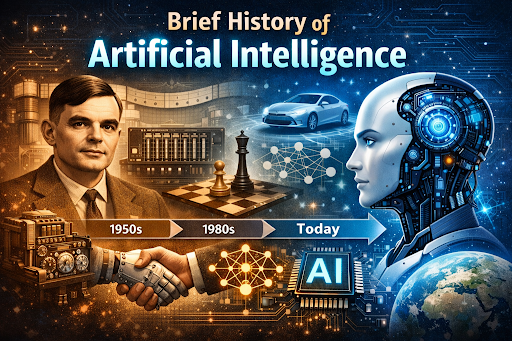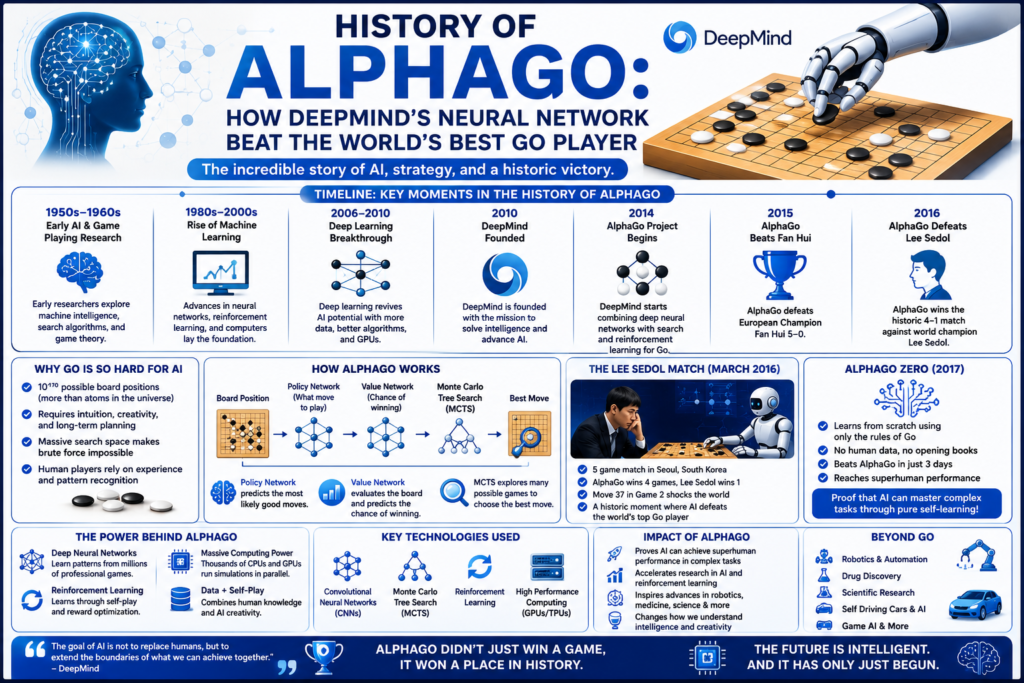
History of alphago became one of the most unforgettable moments in artificial intelligence history when DeepMind’s neural network defeated world champion Lee Sedol in 2016. This achievement shocked scientists, professional Go players, and millions of people around the world because the game of Go had long been considered one of humanity’s greatest intellectual challenges.
Unlike chess, Go contains an enormous search space with nearly infinite strategic possibilities. Many researchers believed computers would need decades more to defeat elite human players. Yet AlphaGo achieved what once seemed impossible.
The victory of AlphaGo transformed the future of AI research forever. It demonstrated that neural networks, reinforcement learning, and Monte Carlo Tree Search could work together to create superhuman strategic thinking.
Today, the influence of history of alphago reaches far beyond board games. AlphaGo inspired breakthroughs in robotics, scientific research, medicine, autonomous systems, and large-scale AI reasoning.
The story of AlphaGo remains one of the greatest research milestones in modern artificial intelligence.
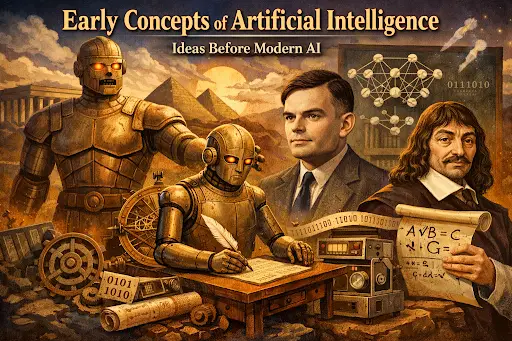
Early Artificial Intelligence and Game Playing (1950 – 1980)
To understand the history of alphago, we first need to explore the origins of AI game-playing systems.
During the 1950s, researchers became fascinated by board games because games offered structured environments for testing machine intelligence.
Scientists believed games could reveal whether machines were capable of strategic thinking.
Early AI systems focused heavily on:
- Chess
- Checkers
- Mathematical puzzles
- Decision trees
At the same time, neural computation research expanded rapidly.
The famous mcculloch and pitts neural network model became one of the earliest foundations of artificial intelligence theory.
Researchers also explored search algorithms and game theory to improve machine decision-making.
Although early systems performed basic calculations effectively, they lacked true strategic understanding.
Why Go Was So Difficult for AI
The history of alphago became extraordinary because Go is dramatically harder than chess for computers.
Chess contains approximately:
possible board positions.
Go contains approximately:
possible positions.
This search space is astronomically larger than the number of atoms in the observable universe.
Traditional brute-force search methods failed badly in Go.
The game requires:
- Intuition
- Pattern recognition
- Long-term planning
- Positional judgment
- Strategic sacrifice
Professional Go players often rely on instinct developed through decades of experience.
For years, many researchers believed AI would never defeat elite Go champions.
Reinforcement Learning and Neural Networks (1980 – 2010)
The modern history of alphago became possible because of advances in reinforcement learning and deep neural networks.
Researchers discussing reinforcement learning history often identify this period as the foundation of modern strategic AI systems.
Several breakthroughs transformed AI capabilities:
- Backpropagation
- GPU acceleration
- Deep neural networks
- Q-learning
- Temporal difference learning
At the same time, researchers studying history of deep learning improved neural network depth and optimization stability.
Deep learning systems became much better at recognizing patterns inside images and game boards.
These advances prepared the perfect environment for AlphaGo.
DeepMind and the Birth of AlphaGo
DeepMind was founded in 2010 by Demis Hassabis, Shane Legg, and Mustafa Suleyman.
The company focused heavily on artificial general intelligence and reinforcement learning systems.
Google later acquired DeepMind in 2014.
The creation of AlphaGo became one of DeepMind’s biggest ambitions.
Researchers wanted to build an AI system capable of mastering Go through:
- Neural evaluation
- Reinforcement learning
- Self-play training
- Monte Carlo Tree Search
This ambitious project eventually changed AI history forever.
How AlphaGo Worked
The history of alphago became revolutionary because AlphaGo combined multiple advanced AI techniques together.
The system used:
- Policy Networks
- Value Networks
- Monte Carlo Tree Search (MCTS)
Policy Networks
Policy networks predicted the most promising moves.
Instead of exploring every possible action, AlphaGo focused only on likely strong moves.
Value Networks
Value networks estimated the probability of winning from a board position.
This reduced the need for extremely deep search calculations.
Monte Carlo Tree Search
Monte Carlo Tree Search simulated many possible future games.
The system balanced:
- Exploration
- Exploitation
- Strategic evaluation
This combination allowed AlphaGo to evaluate positions more intelligently than traditional Go engines.
Neural Networks Behind AlphaGo
The history of alphago heavily depends on deep neural network breakthroughs.
AlphaGo used convolutional neural networks similar to computer vision systems.
Researchers discussing history of cnn often connect CNN success with AlphaGo’s pattern recognition abilities.
The neural networks processed Go boards similarly to images.
This allowed AlphaGo to recognize:
- Territory structures
- Attack patterns
- Defensive formations
- Strategic opportunities
The system learned from millions of professional Go positions.
Later, reinforcement learning allowed AlphaGo to improve far beyond human examples.
Training AlphaGo Through Self-Play
One of the most fascinating parts of the history of alphago involved self-play training.
AlphaGo played millions of games against itself.
This iterative learning process allowed the AI to:
- Discover new strategies
- Improve continuously
- Learn unconventional tactics
- Develop superhuman intuition
The system optimized reward signals after each match.
The reinforcement learning update process resembled:
This trial-and-error learning became central to AlphaGo’s success.
The Historic Lee Sedol Match (2016)
The most famous moment in the history of alphago happened in March 2016.
AlphaGo faced Lee Sedol, one of the greatest professional Go players in history.
Most experts expected Lee Sedol to win comfortably.
Instead, AlphaGo shocked the world by winning four out of five matches.
The event became a global media sensation.
Millions watched the games live.
Researchers, chess masters, and scientists realized AI had entered a completely new era.
The victory demonstrated that machines could surpass humans in extremely complex strategic domains.
Move 37 Changed Everything
One of the most legendary moments in the history of alphago occurred during Game 2.
AlphaGo played “Move 37,” a move so unusual that commentators initially believed it was a mistake.
Professional players rarely made such moves.
However, the move later proved brilliant.
Lee Sedol appeared visibly shocked.
Experts realized AlphaGo was discovering strategies beyond conventional human thinking.
Move 37 became a symbol of AI creativity and superhuman strategic reasoning.
The Impact on Artificial Intelligence
The history of alphago transformed global AI research dramatically.
After AlphaGo’s victory:
- Investment in AI surged
- Deep learning research accelerated
- Reinforcement learning gained popularity
- Governments increased AI funding
- Universities expanded AI programs
Researchers discussing history of ai often consider AlphaGo’s victory one of the defining milestones of modern computing.
The match demonstrated that AI systems could solve problems once considered uniquely human.
AlphaGo Zero and Self-Learning AI
DeepMind later introduced AlphaGo Zero.
Unlike the original AlphaGo, AlphaGo Zero learned entirely through self-play without human game data.
This achievement shocked researchers even more.
AlphaGo Zero mastered Go in just days.
The system defeated the original AlphaGo version easily.
Researchers discussing transformer neural networks and modern AI reasoning often compare AlphaGo Zero’s self-learning abilities with emerging autonomous systems.
The rise of self-learning AI became one of the most important developments in modern research.
AlphaGo Beyond Board Games
Although the history of alphago focused on Go, its influence expanded far beyond gaming.
AlphaGo-inspired systems now help solve problems in:
- Protein folding
- Scientific discovery
- Robotics
- Traffic optimization
- Energy management
- Drug research
DeepMind’s later AlphaFold system revolutionized biology using related AI principles.
The influence of AlphaGo continues spreading across science and industry.
Reinforcement Learning and Modern AI
The success of AlphaGo accelerated reinforcement learning research worldwide.
Modern AI systems now combine:
- Deep neural networks
- Reinforcement learning
- Large-scale search
- Multi-modal reasoning
Researchers discussing deepmind vs openai often compare their approaches to reinforcement learning and autonomous intelligence.
OpenAI later used reinforcement learning from human feedback for large language models.
The legacy of AlphaGo remains deeply connected to modern generative AI development.
AlphaGo and Human Creativity
One surprising effect of the history of alphago was its influence on human Go players themselves.
Professional players began studying AlphaGo strategies.
Many adopted unconventional moves inspired by AI.
The relationship between humans and machines changed dramatically.
Instead of replacing creativity, AI sometimes expanded human strategic understanding.
This became one of the most fascinating philosophical impacts of AlphaGo.
Ethical Questions Raised by AlphaGo
The success of AlphaGo also raised important ethical questions.
People began asking:
- Could AI surpass humans broadly?
- Will machines replace expert professions?
- How should AI systems be controlled?
- What happens when AI becomes superhuman?
These discussions intensified after AlphaGo’s victory.
Researchers continue debating the future of advanced AI systems today.
AlphaGo’s Lasting Legacy
The history of alphago remains one of the greatest technological achievements ever accomplished.
AlphaGo proved that machines could:
- Learn autonomously
- Develop creative strategies
- Master highly complex systems
- Surpass elite human expertise
Its influence reached nearly every major AI field.
Today, many of the world’s best free ai tools indirectly build upon advances accelerated by AlphaGo and reinforcement learning systems.
The project permanently transformed artificial intelligence research.
FAQs About AlphaGo
What was AlphaGo?
AlphaGo was an AI system developed by DeepMind that mastered the game of Go using neural networks and reinforcement learning.
Why was AlphaGo important?
AlphaGo proved that AI could defeat elite human players in one of the world’s most complex strategy games.
Who did AlphaGo defeat?
AlphaGo defeated world champion Lee Sedol in 2016.
What technologies powered AlphaGo?
AlphaGo used policy networks, value networks, Monte Carlo Tree Search, and reinforcement learning.
What is AlphaGo Zero?
AlphaGo Zero was an improved version that learned entirely through self-play without human training data.
How did AlphaGo change AI research?
AlphaGo accelerated global investment and research in deep learning, reinforcement learning, and autonomous intelligence systems.
Conclusion
The story of history of alphago represents one of the greatest breakthroughs in artificial intelligence history. Through reinforcement learning, neural networks, and Monte Carlo Tree Search, DeepMind created an AI system capable of defeating one of humanity’s greatest strategic minds.
The Lee Sedol match demonstrated that AI could achieve superhuman performance in highly complex domains requiring intuition, creativity, and long-term planning.
The rise of AlphaGo became deeply connected to reinforcement learning history, history of deep learning, history of cnn, transformer neural networks, and history of ai research.
Today, AlphaGo’s legacy continues shaping robotics, scientific discovery, autonomous systems, and generative AI technologies worldwide.
As artificial intelligence evolves further, AlphaGo will always remain one of the defining milestones in the journey toward advanced machine intelligence.