history of self-driving cars and neural networks represents one of the most exciting journeys in modern artificial intelligence. What once seemed like science fiction is now becoming reality as autonomous vehicles learn to navigate roads, detect obstacles, understand traffic, and drive with minimal human assistance.
The road to autonomous driving has taken decades of research involving robotics, computer vision, neural networks, sensor fusion, and reinforcement learning. Early experiments struggled with limited computing power and weak perception systems, but modern AI now powers some of the most advanced automated transport systems ever created.
From ALVINN in 1989 to Tesla Autopilot and modern end-to-end driving models, the evolution of autonomous vehicle history has completely transformed transportation technology.
Today, the impact of history of self-driving cars and neural networks reaches far beyond cars. These technologies influence robotics, logistics, traffic analysis, safety systems, and smart city infrastructure worldwide.
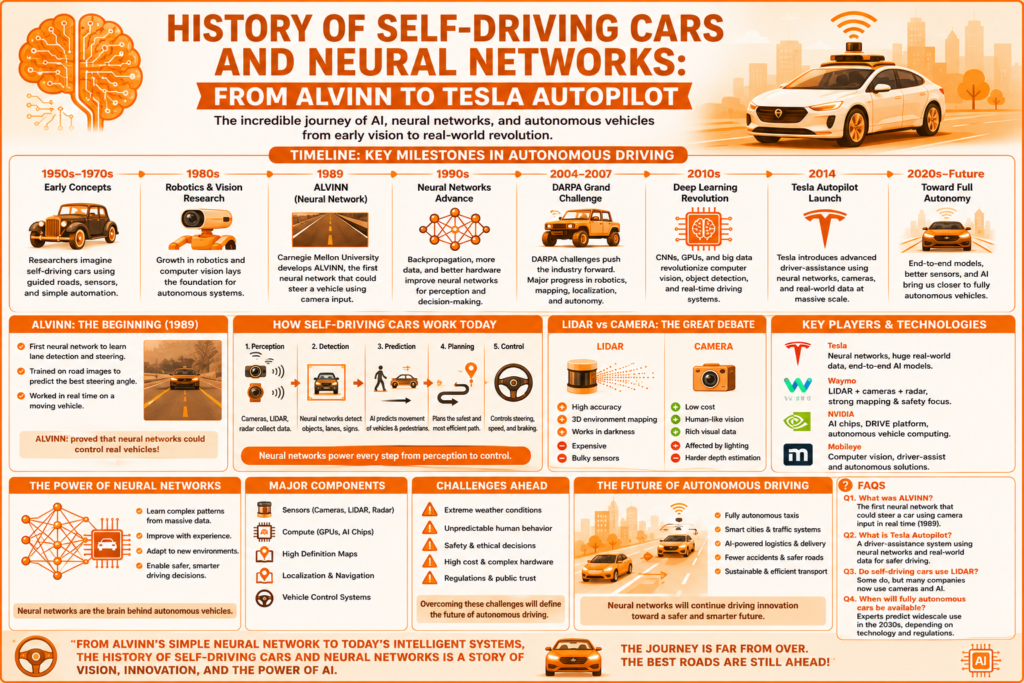
Early Dreams of Autonomous Vehicles (1950 – 1980)
The roots of the history of self-driving cars and neural networks began long before modern AI existed.
During the 1950s and 1960s, researchers imagined highways filled with automated vehicles controlled by electronics and sensors. Early concepts focused on guided roads using magnetic wires and radio systems rather than intelligent onboard computers.
At the same time, artificial intelligence research was rapidly expanding.
The famous mcculloch and pitts neural network model inspired scientists to explore machine perception and decision-making systems.
Researchers believed machines could eventually imitate human driving behavior through artificial neural control systems.
However, computing hardware remained extremely limited during this era.
Autonomous driving required technologies that did not yet exist:
- Real-time navigation
- Image recognition
- Sensor fusion
- Fast processors
- Neural pattern recognition
The dream of self-driving cars remained mostly theoretical.
Robotics and Computer Vision Growth (1980 – 1990)
The modern history of self-driving cars and neural networks accelerated during the 1980s as robotics and computer vision research improved dramatically.
Researchers began experimenting with cameras, sensors, and machine learning systems for autonomous navigation.
One of the biggest breakthroughs arrived in 1989 with ALVINN.
ALVINN stood for:
Autonomous Land Vehicle In a Neural Network.
Developed at Carnegie Mellon University, ALVINN used neural networks to process camera images and steer a vehicle automatically.
This project became one of the earliest successful demonstrations of neural driving systems.
ALVINN and Neural Driving Systems (1989)
The launch of ALVINN became a defining milestone in the history of self-driving cars and neural networks.
ALVINN used a neural network trained on road images to predict steering directions.
The system processed:
- Road lanes
- Visual patterns
- Driving environments
- Steering corrections
Instead of relying entirely on handcrafted rules, ALVINN learned driving behavior through training examples.
This represented one of the earliest forms of end-to-end driving models.
Researchers discussing history of ai often identify ALVINN as one of the first major demonstrations of neural perception in transportation.
Although primitive by modern standards, ALVINN proved that neural networks could control vehicles directly.
The Rise of Neural Networks and Deep Learning
The history of self-driving cars and neural networks became closely connected to the broader deep learning revolution.
During the 1990s and early 2000s, neural networks improved steadily because of advances in:
- GPU acceleration
- Backpropagation
- Larger datasets
- Better optimization methods
Researchers discussing history of deep learning often describe this era as the rebirth of neural AI.
The rise of convolutional neural networks became especially important for autonomous driving.
CNN systems improved:
- Lane detection
- Traffic sign recognition
- Obstacle detection
- Pedestrian tracking
The influence of history of cnn research became critical for modern vehicle perception systems.
DARPA Grand Challenge Changed Everything (2004 – 2007)
One of the greatest turning points in the history of self-driving cars and neural networks came through the DARPA Grand Challenge.
The United States Defense Advanced Research Projects Agency organized competitions encouraging teams to build autonomous vehicles capable of navigating desert environments.
The first competition in 2004 ended disastrously.
None of the vehicles completed the course successfully.
However, rapid progress followed.
By 2005, several vehicles completed long autonomous routes successfully.
The DARPA Grand Challenge accelerated innovation in:
- Sensor fusion
- Robotics
- Vehicle safety
- Computer vision in cars
- Autonomous navigation
Many future leaders of self-driving research emerged from these competitions.
Sensor Fusion and Autonomous Perception
The history of self-driving cars and neural networks became deeply tied to sensor fusion technology.
Autonomous vehicles require multiple sensor systems working together simultaneously.
These include:
- Cameras
- LIDAR
- Radar
- GPS
- Ultrasonic sensors
Sensor fusion combines these inputs into unified environmental understanding.
For example:
- Cameras recognize lanes and traffic signs
- Radar measures object speed
- LIDAR maps surroundings in 3D
The AI system merges all data for real-time navigation decisions.
This became one of the most important challenges in autonomous driving.
LIDAR vs Camera Debate
One major controversy in the history of self-driving cars and neural networks involves LIDAR vs Camera approaches.
LIDAR Systems
Advantages:
- Accurate depth mapping
- Strong 3D perception
- Reliable object distance measurement
Disadvantages:
- Expensive hardware
- Large sensor units
- Complex integration
Camera-Based Systems
Advantages:
- Lower cost
- Human-like perception
- Rich visual information
Disadvantages:
- Sensitive to lighting conditions
- Harder depth estimation
Tesla became famous for emphasizing camera-based neural perception systems rather than relying heavily on LIDAR.
This debate continues today.
Tesla Autopilot and Neural Driving (2014 – Present)
The rise of Tesla Autopilot became one of the biggest chapters in the history of self-driving cars and neural networks.
Tesla introduced advanced driver-assistance systems using:
- Neural networks
- Real-time computer vision
- Massive driving datasets
- Edge computing systems
Tesla vehicles continuously collect driving information from millions of real-world miles.
This enormous dataset allows neural systems to improve rapidly.
Tesla Autopilot performs tasks including:
- Lane keeping
- Traffic-aware cruise control
- Automatic parking
- Highway navigation
The company also pioneered large-scale end-to-end driving models.
End-to-End Driving Models
The history of self-driving cars and neural networks evolved further through end-to-end learning systems.
Traditional driving systems used separate modules for:
- Detection
- Mapping
- Planning
- Control
End-to-end systems attempt to map raw sensor inputs directly into driving actions.
For example:
Where:
- = camera input
- = steering output
This approach allows neural networks to learn driving behavior directly from data.
Researchers discussing transformer neural networks increasingly explore transformer-based driving systems for autonomous navigation.
Reinforcement Learning and Autonomous Driving
The history of self-driving cars and neural networks also intersects heavily with reinforcement learning.
Autonomous vehicles can improve through:
- Simulation training
- Reward optimization
- Scenario testing
- Trial-and-error learning
Researchers discussing reinforcement learning history often connect RL systems with autonomous navigation improvements.
Self-driving AI agents learn:
- Collision avoidance
- Efficient route planning
- Traffic behavior
- Driving policies
This combination of reinforcement learning and neural perception remains a major research focus today.
Computer Vision in Modern Vehicles
Modern autonomous vehicles rely heavily on advanced computer vision systems.
These systems perform:
- Pedestrian recognition
- Object tracking
- Traffic analysis
- Road segmentation
- Weather adaptation
Researchers studying cnn computer vision history frequently highlight autonomous driving as one of the most important real-world applications of CNNs.
Deep learning transformed vehicle perception from simple rule-based detection into highly adaptive intelligent systems.
Self-Driving Cars Beyond Tesla
Although Tesla receives enormous attention, many companies contributed to the history of self-driving cars and neural networks.
Major autonomous vehicle companies include:
- Waymo
- Cruise
- NVIDIA
- Baidu Apollo
- Mobileye
Each company explores different combinations of:
- Sensors
- Neural architectures
- Mapping systems
- Reinforcement learning
- Edge computing
The global race for autonomous transportation continues accelerating rapidly.
Challenges Facing Autonomous Vehicles
Despite major progress, the history of self-driving cars and neural networks still includes serious challenges.
These include:
- Bad weather conditions
- Unpredictable pedestrians
- Ethical driving decisions
- Sensor failures
- Edge-case scenarios
- Regulatory uncertainty
Autonomous systems must achieve extremely high reliability before widespread adoption.
Safety remains the highest priority.
Autonomous Vehicles and Society
The rise of autonomous vehicles may transform society dramatically.
Possible benefits include:
- Reduced traffic accidents
- Improved mobility
- Lower transportation costs
- Efficient logistics
- Reduced human driving errors
However, concerns also exist regarding:
- Job displacement
- Privacy
- Cybersecurity
- Ethical AI behavior
The future impact of self-driving systems remains one of the most important technological debates today.
Neural Networks and the Future of Transportation
The future of history of self-driving cars and neural networks looks incredibly promising.
Researchers are now exploring:
- Fully autonomous taxis
- AI traffic systems
- Smart city integration
- Vehicle-to-vehicle communication
- Transformer-based driving models
Modern best free ai tools increasingly use technologies related to computer vision, edge AI, and neural automation originally accelerated through autonomous driving research.
The influence of self-driving AI now extends across robotics and intelligent infrastructure worldwide.
The Lasting Legacy of Autonomous Driving AI
The history of self-driving cars and neural networks represents one of humanity’s most ambitious engineering projects.
From ALVINN’s primitive neural steering system to Tesla Autopilot’s advanced perception networks, autonomous driving transformed transportation forever.
The combination of:
- Neural networks
- Computer vision
- Sensor fusion
- Reinforcement learning
- Robotics
created intelligent systems capable of navigating real-world environments with increasing accuracy.
The journey continues evolving rapidly.
FAQs About Self-Driving Cars and Neural Networks
What was ALVINN?
ALVINN was one of the earliest neural network driving systems developed in 1989 at Carnegie Mellon University.
How do self-driving cars use neural networks?
Neural networks help autonomous vehicles process images, detect objects, recognize lanes, and make driving decisions.
What is Tesla Autopilot?
Tesla Autopilot is an advanced driver-assistance system using neural networks and computer vision for semi-autonomous driving.
Why is computer vision important for self-driving cars?
Computer vision allows vehicles to understand roads, traffic signs, pedestrians, and surrounding environments.
What is sensor fusion?
Sensor fusion combines data from cameras, radar, LIDAR, and other sensors into one unified driving system.
Are fully autonomous cars possible?
Researchers believe fully autonomous driving is achievable, but significant safety and regulatory challenges still remain.
Conclusion
The story of history of self-driving cars and neural networks represents one of the most important technological revolutions in transportation history. From ALVINN in 1989 to Tesla Autopilot and modern autonomous systems, neural networks transformed vehicles into intelligent decision-making machines.
The rise of self-driving AI became deeply connected to history of deep learning, history of cnn, reinforcement learning history, transformer neural networks, and history of ai research.
Today, autonomous vehicles continue influencing robotics, logistics, smart infrastructure, and intelligent transportation systems worldwide.
As artificial intelligence advances further, self-driving technology may eventually redefine mobility, safety, and transportation for future generations.