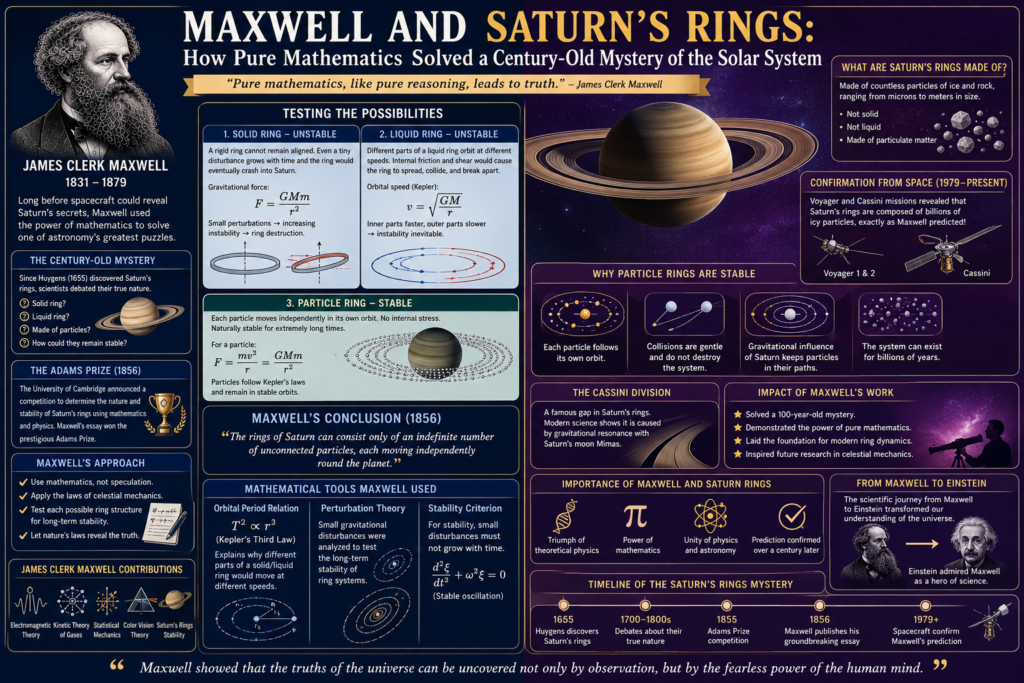
The story of maxwell and saturn rings is one of the most remarkable examples of mathematics solving a mystery long before technology could provide direct evidence. Today, we know Saturn’s rings are made of countless small particles orbiting the giant planet. However, in the nineteenth century, nobody knew their true nature.
Scientists debated whether Saturn’s rings were solid, liquid, or composed of many small objects. The mystery puzzled astronomers for more than a century.
Then James Clerk Maxwell entered the debate.
Using pure mathematics, physical reasoning, and celestial mechanics, Maxwell solved the problem decades before spacecraft and telescopes could confirm the answer. His work on Saturn’s rings became one of the greatest achievements in theoretical astronomy and earned him the prestigious Adams Prize.
The story of maxwell and saturn rings demonstrates how mathematics can reveal truths about the universe long before direct observation becomes possible.
The Mystery of Saturn’s Rings (1655 – 1850)
The fascination with maxwell and saturn rings began long before Maxwell was born.
In 1655, Dutch astronomer Christiaan Huygens proposed that Saturn was surrounded by a thin ring.
Later observations confirmed the existence of the rings, but their composition remained unknown.
Astronomers wondered:
- Were the rings solid?
- Were they liquid?
- Were they made of particles?
- How could they remain stable?
These questions became one of astronomy’s greatest puzzles.
Early Theories About Saturn’s Rings
Before Maxwell’s investigation, scientists proposed several possibilities.
Theory 1: Solid Ring
Many astronomers believed Saturn possessed a solid ring orbiting around the planet.
The idea seemed reasonable because the rings appeared smooth through telescopes.
However, serious stability problems existed.
Theory 2: Liquid Ring
Others suggested the rings consisted of liquid material.
This explanation also faced difficulties because liquids tend to redistribute themselves under gravity.
Theory 3: Particulate Matter
A minority proposed that the rings might consist of countless small particles.
The challenge was proving which explanation was correct.
This became the central problem of maxwell and saturn rings.
The Adams Prize Competition (1855 – 1856)
In 1855, the University of Cambridge announced a competition.
The subject involved the stability of Saturn’s rings.
Participants were asked to determine the true nature of the rings using mathematics and physics.
This became known as the Adams Prize 1856 competition.
The problem attracted talented mathematicians throughout Britain.
Among them was a young James Clerk Maxwell.
Maxwell Accepts the Challenge
At the time, James Clerk Maxwell was still early in his scientific career.
Although he had already demonstrated remarkable talent, he was not yet famous.
The Saturn ring problem offered an opportunity to apply mathematics to a major astronomical mystery.
Maxwell approached the challenge systematically.
Rather than relying on speculation, he examined the physical stability of each possible ring structure.
This rigorous approach would make maxwell and saturn rings a landmark achievement.
Analyzing the Solid Ring Hypothesis
Maxwell first investigated whether Saturn’s rings could be solid.
Imagine a rigid ring orbiting Saturn.
For stability, the center of the ring must remain perfectly aligned with the planet.
Even a tiny displacement creates problems.
Using gravitational stability analysis, Maxwell demonstrated that any slight disturbance would grow over time.
The ring would eventually crash into Saturn.
The mathematics showed that a perfectly solid ring was unstable.
The Mathematics of Gravitational Stability
Maxwell applied Newton’s law of gravitation:
F = G(Mm/r²)
Where:
- F = Gravitational force
- G = Gravitational constant
- M = Saturn’s mass
- m = Ring mass
- r = Distance
Small perturbations caused imbalances in force.
These imbalances produced increasing instability.
The analysis convinced Maxwell that a solid ring could not survive for long periods.
This was the first major breakthrough in maxwell and saturn rings.
Testing the Liquid Ring Model
Maxwell next examined the liquid ring hypothesis.
At first glance, liquid seemed more flexible than a rigid structure.
However, orbital mechanics created new difficulties.
Different portions of the ring orbit at different velocities.
According to Kepler’s laws:
v = √(GM/r)
Inner regions move faster.
Outer regions move slower.
A continuous liquid ring would experience internal stresses and distortions.
Maxwell’s calculations showed that a liquid ring would also become unstable.
Orbital Mechanics and Ring Stability
The study of maxwell and saturn rings depended heavily on orbital mechanics.
Objects closer to Saturn complete orbits more quickly than objects farther away.
This principle is fundamental to celestial mechanics.
For a stable system:
T² ∝ r³
Where:
- T = Orbital period
- r = Orbital radius
A solid or liquid structure cannot easily accommodate these velocity differences.
Instability becomes inevitable.
Maxwell’s mathematical modeling revealed this clearly.
The Revolutionary Particle Theory
After eliminating solid and liquid models, Maxwell turned to a third possibility.
The rings might consist of countless independent particles.
Each particle would orbit Saturn individually.
This idea transformed the entire problem.
Instead of one giant object, the ring became a collection of small orbiting bodies.
The concept perfectly matched orbital mechanics.
Maxwell’s Famous Conclusion
After years of analysis, Maxwell reached a revolutionary conclusion.
The rings must consist of:
“An indefinite number of unconnected particles.”
This statement became the central result of maxwell and saturn rings.
The conclusion was astonishing.
No telescope of the era could directly observe these particles.
Yet mathematics strongly supported their existence.
Maxwell had solved the mystery using theory alone.
Why Particulate Matter Solves the Problem
The particulate matter model avoids the instability problems affecting solid and liquid rings.
Each particle behaves independently.
Individual particles obey:
F = mv²/r
and
F = G(Mm/r²)
Combining these equations gives stable orbital motion.
Particles can move at different velocities without tearing apart a larger structure.
This explanation naturally produces long term stability.
The Role of Perturbation Theory
A key component of maxwell and saturn rings involved perturbation theory.
Real planetary systems experience disturbances from:
- Nearby moons
- Gravitational interactions
- Particle collisions
Maxwell analyzed how small perturbations affect ring stability.
His calculations showed that a particulate system can absorb disturbances far more effectively than a solid ring.
This strengthened his conclusion.
The Cassini Division
One famous feature of Saturn’s rings is the Cassini division.
This dark gap separates major ring regions.
Although Maxwell could not fully explain every detail, his particle model helped establish the framework for understanding such structures.
Modern astronomy now attributes many ring gaps to gravitational resonances with Saturn’s moons.
The foundation of this understanding traces back to maxwell and saturn rings.
Scientific Reaction to Maxwell’s Work
The scientific community was impressed by Maxwell’s analysis.
His essay won the Adams Prize.
More importantly, it demonstrated the extraordinary power of theoretical physics.
Maxwell had answered a major astronomical question without direct observation.
The achievement elevated his scientific reputation significantly.
Many historians consider it one of the greatest applications of mathematics in astronomy.
James Clerk Maxwell Contributions Beyond Electromagnetism
When discussing James Clerk Maxwell Contributions, most people think about electricity and magnetism.
However, his Saturn ring research deserves equal admiration.
His achievements include:
- Electromagnetic theory
- Statistical mechanics
- Color vision science
- Planetary ring stability
- Mathematical physics
The success of maxwell and saturn rings highlights his remarkable versatility.
Spacecraft Confirmation (1979 – Present)
More than a century after Maxwell’s work, spacecraft finally confirmed his prediction.
Missions including:
- Voyager 1
- Voyager 2
- Cassini
revealed that Saturn’s rings consist of countless icy particles.
These particles range from microscopic grains to large boulders.
The observations matched Maxwell’s conclusion remarkably well.
His mathematics had been correct all along.
Why Maxwell’s Prediction Was Extraordinary
The success of maxwell and saturn rings stands among the greatest scientific predictions ever made.
Maxwell predicted:
- Rings are not solid.
- Rings are not liquid.
- Rings consist of particles.
- Stability arises from orbital motion.
All of these conclusions were later confirmed.
Very few theoretical predictions have been verified so completely after such a long delay.
Connection to Modern Astronomy
The principles developed during maxwell and saturn rings continue influencing astronomy today.
Scientists now study:
- Planetary rings
- Asteroid belts
- Protoplanetary disks
- Galaxy structures
Many modern analyses rely on concepts related to Maxwell’s original work.
His influence remains visible throughout celestial mechanics.
The Power of Mathematical Modeling
One of the greatest lessons from maxwell and saturn rings is the power of mathematical modeling.
Maxwell never traveled to Saturn.
He never observed ring particles directly.
Instead, he used equations and logic.
His success demonstrated that mathematics can uncover hidden truths about the universe.
This approach continues guiding scientific discovery today.
From Maxwell to Einstein
The intellectual legacy of maxwell and saturn rings contributed to Maxwell’s growing reputation as one of history’s greatest theoretical physicists.
The scientific journey from maxwell to einstein later transformed modern physics.
The connection between einstein hero maxwell remains one of science’s most celebrated relationships.
Einstein admired Maxwell’s ability to reveal nature’s secrets through mathematics.
Frequently Asked Questions (FAQs)
What did Maxwell discover about Saturn’s rings?
Maxwell proved that Saturn’s rings could not be solid or liquid and must consist of countless independent particles.
Why was the Adams Prize important?
The Adams Prize challenged scientists to explain the stability of Saturn’s rings, leading to Maxwell’s famous solution.
How did Maxwell solve the mystery?
He used mathematical modeling and gravitational stability analysis to test different ring structures.
Were Maxwell’s conclusions correct?
Yes. Modern spacecraft observations confirmed that Saturn’s rings consist of countless orbiting particles.
Why is Maxwell’s Saturn ring work significant?
It demonstrated how mathematics can solve scientific mysteries long before direct observations become available.
Conclusion
The story of maxwell and saturn rings represents one of the greatest triumphs of theoretical science. Faced with a century old mystery, James Clerk Maxwell applied mathematics, celestial mechanics, and physical reasoning to determine the true nature of Saturn’s rings.
By proving that the rings consist of countless independent particles rather than a solid or liquid structure, Maxwell solved a problem that had puzzled astronomers for generations. More than a hundred years later, spacecraft confirmed his prediction with extraordinary precision.
The achievement remains a powerful reminder that mathematics is not merely a language for describing the universe. Sometimes it can reveal truths about distant worlds long before humanity is able to see them directly.