The story of the kinetic theory of gases is one of the most important revolutions in the history of science. Today, students learn that heat is related to the motion of atoms and molecules. However, during the nineteenth century, this idea was far from obvious. Many scientists still debated the true nature of heat and matter.
James Clerk Maxwell changed everything.
Through mathematics, probability, and physical reasoning, Maxwell demonstrated that heat is not a mysterious fluid or invisible substance. Instead, heat arises from the motion of countless atoms and molecules moving at different speeds.
The development of the kinetic theory of gases transformed thermodynamics, chemistry, and statistical physics. It provided a microscopic explanation for temperature, pressure, and energy while helping establish the atomic view of matter that modern science relies upon today.
The Mystery of Heat Before Maxwell (1700 – 1850)
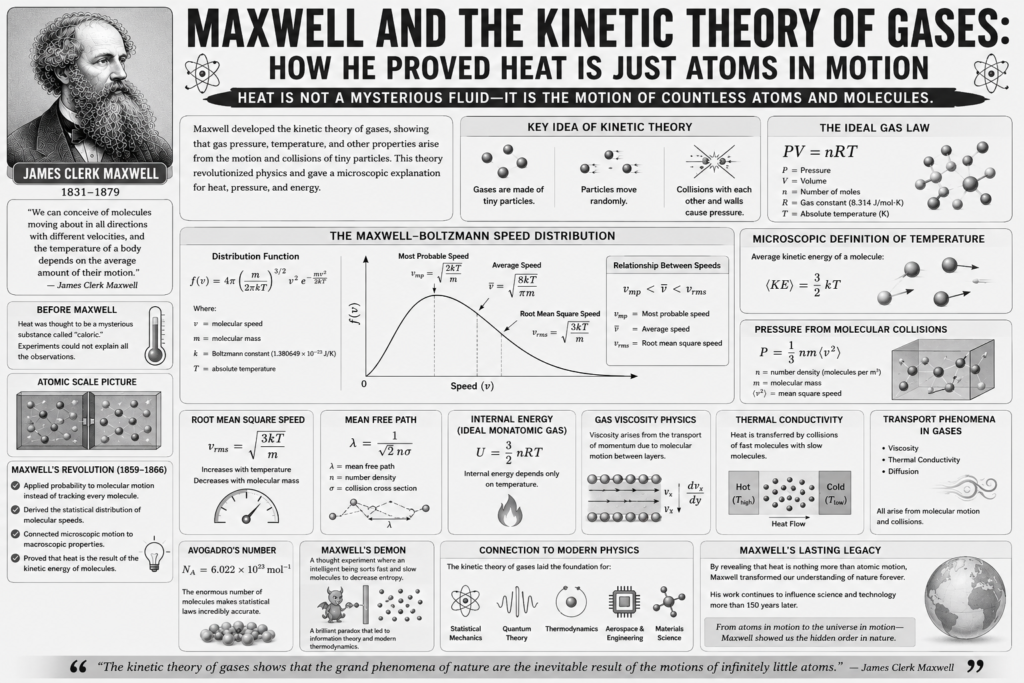
Before the rise of the kinetic theory of gases, many scientists believed in the caloric theory.
According to this idea, heat was a special invisible fluid called caloric.
Objects became hot when they gained caloric.
Objects became cold when they lost it.
Although the theory explained some observations, it struggled to account for many experiments.
Researchers increasingly suspected that heat might actually involve motion.
However, proving this idea required a new scientific framework.
The Early Foundations of Kinetic Theory
Several scientists contributed to early versions of the kinetic theory of gases.
Among them were:
- Daniel Bernoulli
- John Herapath
- Rudolf Clausius
These researchers proposed that gas particles constantly move and collide.
Pressure results from collisions with container walls.
Temperature reflects molecular motion.
Although promising, the theory lacked a complete mathematical treatment.
That challenge would be solved by Maxwell.
James Clerk Maxwell Enters the Problem (1859 – 1866)
James Clerk Maxwell approached the kinetic theory of gases with a unique perspective.
Rather than studying individual molecules, he examined the behavior of enormous collections of particles.
A single gas sample contains approximately:
N ≈ 10²³ molecules
Tracking every molecule individually is impossible.
Maxwell realized that statistical methods could reveal hidden patterns.
This insight launched a new era in physics.
Heat as Molecular Motion
The central idea behind the kinetic theory of gases is remarkably simple.
Heat is the result of molecular motion.
When molecules move faster:
Temperature increases.
When molecules move slower:
Temperature decreases.
This became the microscopic definition of temperature.
Instead of viewing heat as a substance, Maxwell showed that it is a consequence of particle velocity.
The idea transformed scientific understanding forever.
Molecular Collisions and Gas Behavior
The success of the kinetic theory of gases depends on molecular collisions.
Gas molecules constantly collide with:
- Other molecules
- Container walls
- Impurities
These collisions occur billions of times every second.
Pressure emerges naturally from these impacts.
The pressure equation can be derived as:
P = ⅓ nm⟨v²⟩
Where:
- P = Pressure
- n = Number density
- m = Molecular mass
- ⟨v²⟩ = Mean square velocity
This equation connected microscopic motion to observable properties.
Maxwell’s Statistical Revolution
One of Maxwell’s greatest achievements was introducing probability into physics.
Instead of assuming every molecule moves at the same speed, he recognized that molecular speeds vary.
Some molecules move slowly.
Some move rapidly.
Most occupy intermediate speeds.
This insight led directly to the maxwell boltzmann distribution.
The distribution describes the statistical distribution of molecular speeds within a gas.
It remains one of the foundations of statistical mechanics.
The Maxwell-Boltzmann Distribution
The famous speed distribution equation is:
f(v) = 4π (m/2πkT)^(3/2) v² e^(-mv²/2kT)
Where:
- v = Molecular speed
- m = Molecular mass
- k = Boltzmann constant
- T = Temperature
The kinetic theory of gases uses this distribution to explain why molecules possess different velocities.
This discovery helped establish modern statistical physics.
Understanding Temperature Through Motion
The kinetic theory of gases provided the first true microscopic definition of temperature.
Average molecular kinetic energy equals:
KE_avg = 3/2 kT
Where:
- KE_avg = Average kinetic energy
- k = Boltzmann constant
- T = Absolute temperature
This equation reveals a profound truth.
Temperature is directly related to molecular motion.
Hotter gases contain molecules with greater kinetic energy.
Colder gases contain slower moving particles.
Root Mean Square Speed
An important concept within the kinetic theory of gases is Root mean square speed.
The formula is:
v_rms = √(3kT/m)
This quantity measures the characteristic speed of gas molecules.
Notice that:
- Higher temperatures increase speed.
- Larger molecular masses reduce speed.
This relationship explains why hydrogen molecules move much faster than oxygen molecules at the same temperature.
Mean Free Path Formula
Another major achievement of the kinetic theory of gases involved understanding molecular travel between collisions.
The mean free path formula is:
λ = 1/(√2 nσ)
Where:
- λ = Mean free path
- n = Number density
- σ = Collision cross section
This equation predicts the average distance traveled before a collision occurs.
The concept remains important in modern physics and engineering.
Internal Energy and Molecular Motion
The kinetic theory of gases also explains internal energy.
For an ideal monatomic gas:
U = 3/2 nRT
Where:
- U = Internal energy
- n = Number of moles
- R = Gas constant
- T = Temperature
This equation demonstrates that internal energy arises from molecular motion.
The result provided strong support for the atomic theory of matter.
The Ideal Gas Law Revisited
Scientists had long known the ideal gas law:
PV = nRT
The kinetic theory of gases finally explained why this law works.
Gas pressure results from collisions.
Volume determines available space.
Temperature reflects molecular kinetic energy.
The theory connected microscopic behavior to macroscopic properties.
This achievement was revolutionary.
Gas Viscosity Physics
Before Maxwell, many scientists believed viscosity required strong intermolecular forces.
The kinetic theory of gases revealed a different explanation.
Gas viscosity physics arises because moving molecules transfer momentum between layers of gas.
Maxwell derived formulas showing how viscosity depends on molecular motion.
These predictions matched experiments remarkably well.
The success strengthened confidence in the theory.
Thermal Conductivity and Heat Transfer
The kinetic theory of gases also explains thermal conductivity.
Fast molecules transfer energy through collisions.
This process moves heat from hotter regions toward colder regions.
The rate of heat transfer depends on:
- Molecular speed
- Collision frequency
- Mean free path
Maxwell’s work helped establish the modern understanding of heat transport.
Transport Phenomena in Gases
A major success of the kinetic theory of gases involved transport phenomena in gases.
These include:
- Viscosity
- Thermal conductivity
- Diffusion
All three arise from molecular motion.
The theory successfully predicted their behavior using statistical methods.
This predictive power convinced many scientists that the atomic view of matter was correct.
Avogadro’s Number and Large Collections
The kinetic theory of gases works because gases contain enormous numbers of particles.
Avogadro’s number is:
N_A = 6.022 × 10²³ mol⁻¹
Such vast numbers allow probability laws to become highly reliable.
Although individual molecular motions are random, collective behavior becomes predictable.
This principle remains central to statistical physics.
Maxwell’s Demon and Molecular Motion
The famous maxwell demon thought experiment also emerged from Maxwell’s work on gases.
The demon supposedly sorts molecules according to speed.
The paradox highlighted the statistical nature of thermodynamics.
It demonstrated how deeply Maxwell understood molecular motion and entropy.
Even today, Maxwell’s demon remains an important concept in information theory and physics.
James Clerk Maxwell Contributions Beyond Electromagnetism
When discussing James Clerk Maxwell Contributions, many people focus on electromagnetism.
However, his achievements in the kinetic theory of gases are equally important.
His contributions include:
- Statistical mechanics
- Molecular speed distributions
- Gas transport theory
- Thermodynamics
- Electromagnetism
- Color vision science
Few scientists have transformed so many areas of knowledge.
From Maxwell to Einstein
The influence of the kinetic theory of gases extended into the twentieth century.
The intellectual journey from maxwell to einstein helped establish modern physics.
Einstein used statistical methods similar to Maxwell’s while studying Brownian motion.
These studies provided strong evidence for atoms and molecules.
The connection between einstein hero maxwell remains one of science’s most important intellectual links.
Why the Kinetic Theory Still Matters Today
Modern science continues relying on the kinetic theory of gases.
Applications include:
- Aerospace engineering
- Climate science
- Plasma physics
- Chemical engineering
- Semiconductor manufacturing
- Astrophysics
The theory helps scientists understand everything from planetary atmospheres to industrial processes.
Its importance remains enormous.
The Legacy of Maxwell’s Theory
The success of the kinetic theory of gases demonstrated that invisible molecular motion governs many everyday phenomena.
Heat, pressure, viscosity, diffusion, and thermal conductivity all arise from atoms in motion.
Maxwell’s work transformed abstract speculation into precise science.
His ideas continue influencing physics more than 150 years later.
Frequently Asked Questions (FAQs)
What is the kinetic theory of gases?
The kinetic theory of gases states that gases consist of constantly moving particles whose collisions explain pressure, temperature, and other properties.
How did Maxwell contribute to kinetic theory?
Maxwell introduced statistical methods and developed the Maxwell-Boltzmann distribution describing molecular speeds.
What is the microscopic definition of temperature?
Temperature measures the average kinetic energy of molecules.
What is root mean square speed?
Root mean square speed is:
v_rms = √(3kT/m)
It represents a characteristic molecular speed in a gas.
Why is kinetic theory important?
It explains heat, pressure, viscosity, diffusion, and many other physical phenomena using molecular motion.
Conclusion
The kinetic theory of gases stands among the greatest achievements in scientific history. Through mathematical brilliance and statistical reasoning, James Clerk Maxwell demonstrated that heat is not a mysterious substance but the motion of atoms and molecules.
His work connected microscopic particle behavior to macroscopic properties such as temperature, pressure, and energy. It transformed thermodynamics, strengthened the atomic theory of matter, and laid the foundation for modern statistical physics.
More than a century and a half later, Maxwell’s insights continue guiding science and engineering, proving that some of nature’s deepest secrets can be revealed through mathematics, probability, and imagination.