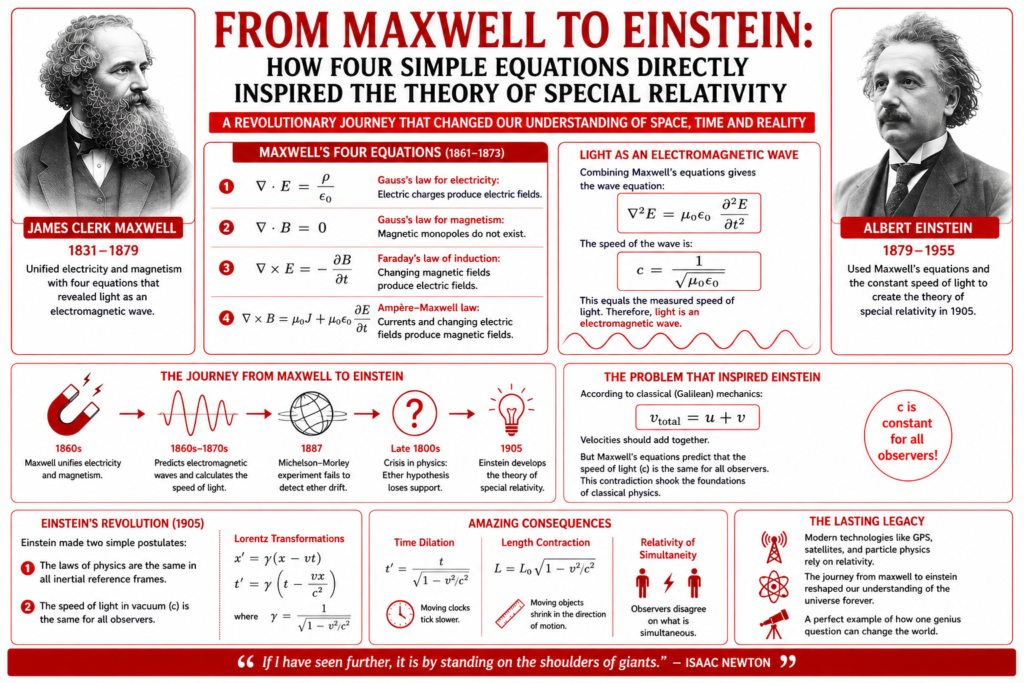
The story of maxwell to einstein is one of the greatest intellectual journeys in human history. It begins with four elegant equations written by James Clerk Maxwell and ends with Albert Einstein fundamentally changing our understanding of space, time, and reality itself.
Most people associate Einstein’s theory of special relativity with genius and imagination. While that is certainly true, Einstein’s breakthrough did not emerge from nowhere. It was built upon a profound problem hidden inside Maxwell’s equations.
In fact, the path from maxwell to einstein demonstrates how scientific discoveries often evolve. One scientist uncovers a mystery, and the next scientist solves it.
Without Maxwell’s equations, special relativity might never have existed.
Without Einstein, the deeper implications of Maxwell’s work might never have been fully understood.
The remarkable journey from maxwell to einstein changed physics forever.
The World Before Maxwell (1687 – 1860)
Before understanding maxwell to einstein, we must understand the scientific world Maxwell inherited.
For nearly two centuries, Isaac Newton’s mechanics dominated physics.
Newton’s laws described motion using simple principles:
F = ma
Where:
- F = Force
- m = Mass
- a = Acceleration
These laws successfully explained:
- Planetary motion
- Falling objects
- Mechanical systems
Scientists believed the universe operated like a giant machine.
However, electricity and magnetism remained mysterious.
Faraday’s Experiments and Maxwell’s Vision
The foundation of maxwell to einstein began with faraday and maxwell.
Michael Faraday discovered:
- Electromagnetic induction
- Magnetic fields
- Electric field behavior
However, Faraday lacked advanced mathematical training.
Maxwell transformed Faraday’s ideas into equations.
This achievement became maxwell electromagnetic theory.
Maxwell’s Four Equations (1861 – 1873)
The heart of the story of maxwell to einstein lies in Maxwell’s equations.
They are:
∇ · E = ρ/ε₀
∇ · B = 0
∇ × E = − ∂B/∂t
∇ × B = μ₀J + μ₀ε₀(∂E/∂t)
These equations unified electricity and magnetism into one framework.
This was among the greatest scientific achievements of the nineteenth century.
The Importance of Displacement Current
One crucial component of Maxwell’s theory was displacement current.
Maxwell added the term:
μ₀ε₀(∂E/∂t)
to Ampère’s law.
This mathematical correction completed electromagnetic theory.
Without displacement current, electromagnetic waves could not emerge naturally from the equations.
This single addition would eventually influence Einstein’s thinking.
Deriving Electromagnetic Waves
One of the greatest accomplishments in the journey from maxwell to einstein was Maxwell’s prediction of light itself.
By combining his equations, Maxwell derived the electromagnetic wave equation:
∇²E = μ₀ε₀(∂²E/∂t²)
This equation describes wave propagation through space.
It revealed the existence of electromagnetic wave theory.
The result was revolutionary.
Maxwell and the Speed of Light
Maxwell calculated the speed of electromagnetic waves using:
c = 1/√(μ₀ε₀)
Substituting known values produced:
c ≈ 3 × 10⁸ m/s
This matched the measured speed of light.
Maxwell realized:
Light is an electromagnetic wave.
The discovery known as maxwell and speed of light transformed physics.
However, it also created a serious problem.
The Hidden Contradiction
The journey from maxwell to einstein began because Maxwell’s equations appeared incompatible with Newtonian mechanics.
According to classical physics:
If a train moves at velocity v and a passenger throws a ball at velocity u:
Observed velocity = u + v
This principle is called Galilean relativity.
Scientists assumed it applied universally.
However, Maxwell’s equations suggested something different.
The speed of light remained constant.
This contradiction puzzled physicists.
Galilean Relativity Breakdown
The problem became known as the Galilean relativity breakdown.
Newtonian mechanics predicts:
v_total = v₁ + v₂
But Maxwell’s equations always predicted:
c = constant
Regardless of observer motion.
Both theories could not simultaneously be correct.
The contradiction sat unresolved for decades.
It became the central mystery of maxwell to einstein.
The Ether Hypothesis (1870 – 1890)
Many scientists attempted to solve the problem using the ether concept.
They proposed a substance called the luminiferous ether.
Light waves supposedly traveled through this invisible medium.
The ether served as a universal reference frame.
If true, Earth’s motion through the ether should be measurable.
Scientists began searching for evidence.
Ether Drift Experiments
The most famous ether drift experiments occurred during the late nineteenth century.
Researchers expected Earth’s motion to affect measured light speed.
If Earth moved through ether:
Light speed should vary in different directions.
The predicted effect seemed measurable.
Testing this prediction became a major scientific goal.
The Michelson-Morley Experiment (1887)
One of the most important milestones in maxwell to einstein was the Michelson-Morley Experiment.
The experiment attempted to detect Earth’s motion through the ether.
The result shocked physicists.
No ether drift appeared.
Light speed remained unchanged.
The experiment produced a null result.
The ether hypothesis faced serious trouble.
The Crisis in Physics (1887 – 1905)
The failure of ether drift experiments created a profound crisis.
Physicists faced two possibilities:
- Maxwell’s equations were wrong.
- Newtonian mechanics was incomplete.
Most scientists initially doubted Maxwell.
However, repeated experiments confirmed electromagnetic theory.
The crisis deepened.
The solution would eventually emerge from Einstein.
Einstein’s Early Fascination
As a young student, Albert Einstein became fascinated by Maxwell’s work.
The story of einstein hero maxwell reflects this admiration.
Einstein reportedly spent years thinking about Maxwell’s equations.
One question obsessed him:
What would happen if I traveled alongside a light wave?
The answer seemed impossible within classical physics.
This paradox inspired his revolutionary thinking.
Einstein’s Bold Assumption
Einstein approached the problem differently.
Rather than modifying Maxwell’s equations, he questioned assumptions about space and time.
He proposed two postulates:
First Postulate
The laws of physics are identical in all inertial reference frames.
Second Postulate
The speed of light is constant for all observers.
These ideas formed the foundation of special relativity.
The solution emerged directly from maxwell to einstein.
Special Relativity (1905)
In 1905, Einstein published:
“On the Electrodynamics of Moving Bodies”
The paper revolutionized physics.
Einstein accepted Maxwell’s equations exactly as written.
Instead, he changed humanity’s understanding of space and time.
The result became special relativity.
Time Dilation Foundation
One consequence of maxwell to einstein was time dilation.
The equation is:
t’ = t/√(1 − v²/c²)
Where:
- t = Proper time
- v = Velocity
- c = Speed of light
As velocity increases, time passes more slowly.
This surprising prediction has been experimentally verified.
Length Contraction
Special relativity also predicts length contraction.
The equation is:
L = L₀√(1 − v²/c²)
Where:
- L = Observed length
- L₀ = Proper length
Objects moving at high speeds appear shorter.
Again, this result emerged from preserving Maxwell’s equations.
Lorentz Transformations
The mathematical bridge between maxwell to einstein involves transformation equations.
The Lorentz transformations are:
x’ = γ(x − vt)
t’ = γ(t − vx/c²)
Where:
γ = 1/√(1 − v²/c²)
These equations replaced Galilean transformations.
They preserve Maxwell’s equations perfectly.
Lorentz Invariance Electromagnetism
One reason Maxwell’s theory inspired relativity involves Lorentz invariance electromagnetism.
Maxwell’s equations naturally maintain the same form under Lorentz transformations.
This property is called covariance.
The equations remain valid for all inertial observers.
Einstein recognized the importance of this symmetry.
The Birth of Spacetime
The journey from maxwell to einstein ultimately led to the spacetime continuum.
Space and time became interconnected.
Instead of separate entities, they formed a four-dimensional structure.
This concept fundamentally changed physics.
Modern cosmology and relativity continue relying on this framework.
James Clerk Maxwell Contributions to Relativity
When discussing James Clerk Maxwell Contributions, relativity deserves special attention.
Maxwell did not invent relativity.
However, his equations created the problem Einstein solved.
His contributions include:
- Electromagnetic theory
- Constant light speed prediction
- Electrodynamics foundations
- Field theory concepts
Without Maxwell, special relativity would not exist in its modern form.
Why Einstein Admired Maxwell
The story of maxwell to einstein explains why Einstein admired Maxwell so deeply.
Maxwell transformed physics fundamentally.
Einstein extended that transformation.
The intellectual connection between them remains one of science’s greatest stories.
Einstein repeatedly described Maxwell as one of the greatest physicists who ever lived.
Frequently Asked Questions (FAQs)
How did Maxwell influence Einstein?
Maxwell’s equations predicted a constant speed of light, creating the problem that Einstein solved with special relativity.
What is the connection between Maxwell and special relativity?
Special relativity was developed largely to preserve the validity of Maxwell’s electromagnetic equations.
What experiment challenged the ether theory?
The Michelson-Morley Experiment failed to detect ether drift, helping pave the way for relativity.
Why is the speed of light important?
The constant speed of light became the foundation of Einstein’s theory of special relativity.
Did Einstein modify Maxwell’s equations?
No. Einstein preserved Maxwell’s equations and instead changed our understanding of space and time.
Conclusion
The story of maxwell to einstein represents one of the greatest intellectual journeys in scientific history. Maxwell’s four equations unified electricity and magnetism while revealing that light is an electromagnetic wave traveling at a constant speed.
That seemingly simple result created a profound contradiction with classical mechanics. Decades later, Einstein resolved the conflict by transforming humanity’s understanding of space, time, and motion. Special relativity emerged directly from the implications of Maxwell’s work.
The journey from Maxwell to Einstein demonstrates how scientific progress unfolds across generations. One genius uncovers a mystery, and another reveals its deeper meaning. Together, Maxwell and Einstein reshaped our understanding of reality and laid the foundation for modern physics.